
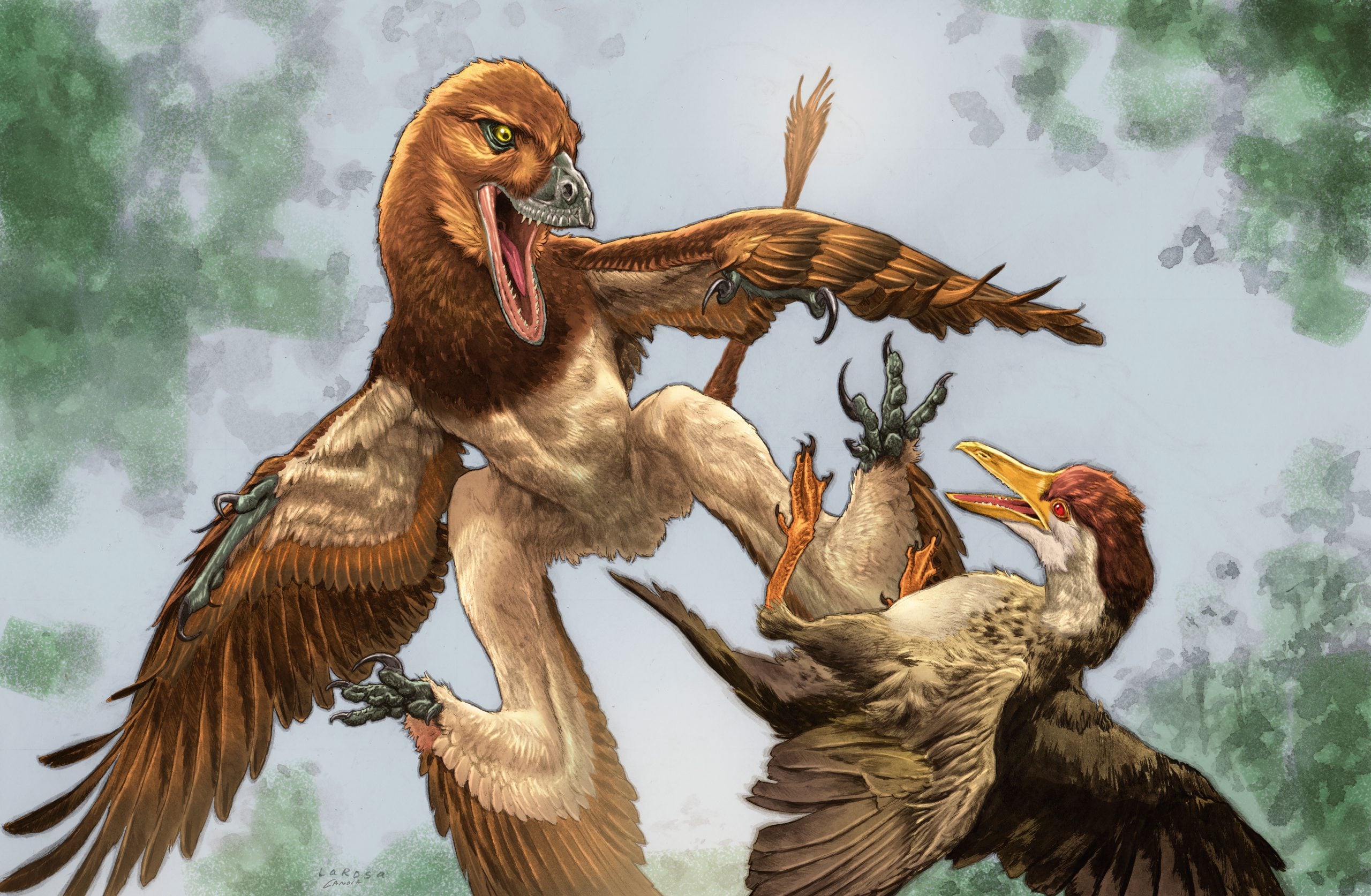
A newly discovered feathered dinosaur from China may help solve a long-standing mystery surrounding a fossil bed filled with ancient bird remains.
For years, one fossil site in northwestern China has posed a mystery. The area contains hundreds of fossilized birds, many remarkably well preserved. Mixed among them are strange clusters of shattered bones compressed into pellet-like masses, much like the regurgitated remains left behind by modern birds of prey. Scientists suspected a predator was responsible, but the culprit was nowhere to be found.
Now, researchers believe they have finally uncovered the missing piece of the puzzle.
In a study published in the Annals of Carnegie Museum, paleontologists describe a newly identified dinosaur, Jian changmaensis, a feathered relative of Velociraptor. Although the fossil consists of only partial remains, the animal stands out as the only known non-avian carnivorous dinosaur recovered from the site. Its discovery offers the strongest evidence yet for the predator that may have hunted the ancient birds whose remains dominate the fossil bed.
“Scientists have found these weird, broken-up clusters of bird bones at this site, and we didn’t know what made them. This new microraptor dinosaur, Jian changmaensis, is our best guess,” says Jingmai O’Connor, the associate curator of fossil reptiles at the Field Museum in Chicago and senior author of the paper describing the new species. “It’s the only dinosaur found at this site that wasn’t a bird, it was a carnivore, and it was much bigger than everything else that we’ve found there.”
A Feathered Relative of Velociraptor
Birds are the only dinosaurs that survived the aftermath of the asteroid impact that struck Earth 66 million years ago. Before that event, birds lived alongside many other dinosaur groups throughout the Jurassic and Cretaceous periods.
Among their closest relatives were dromaeosaurs, feathered dinosaurs that were generally small and agile. The Velociraptor made famous by Jurassic Park is one of the best-known members of this group, although real Velociraptor specimens were smaller and much more heavily feathered than their movie portrayals.
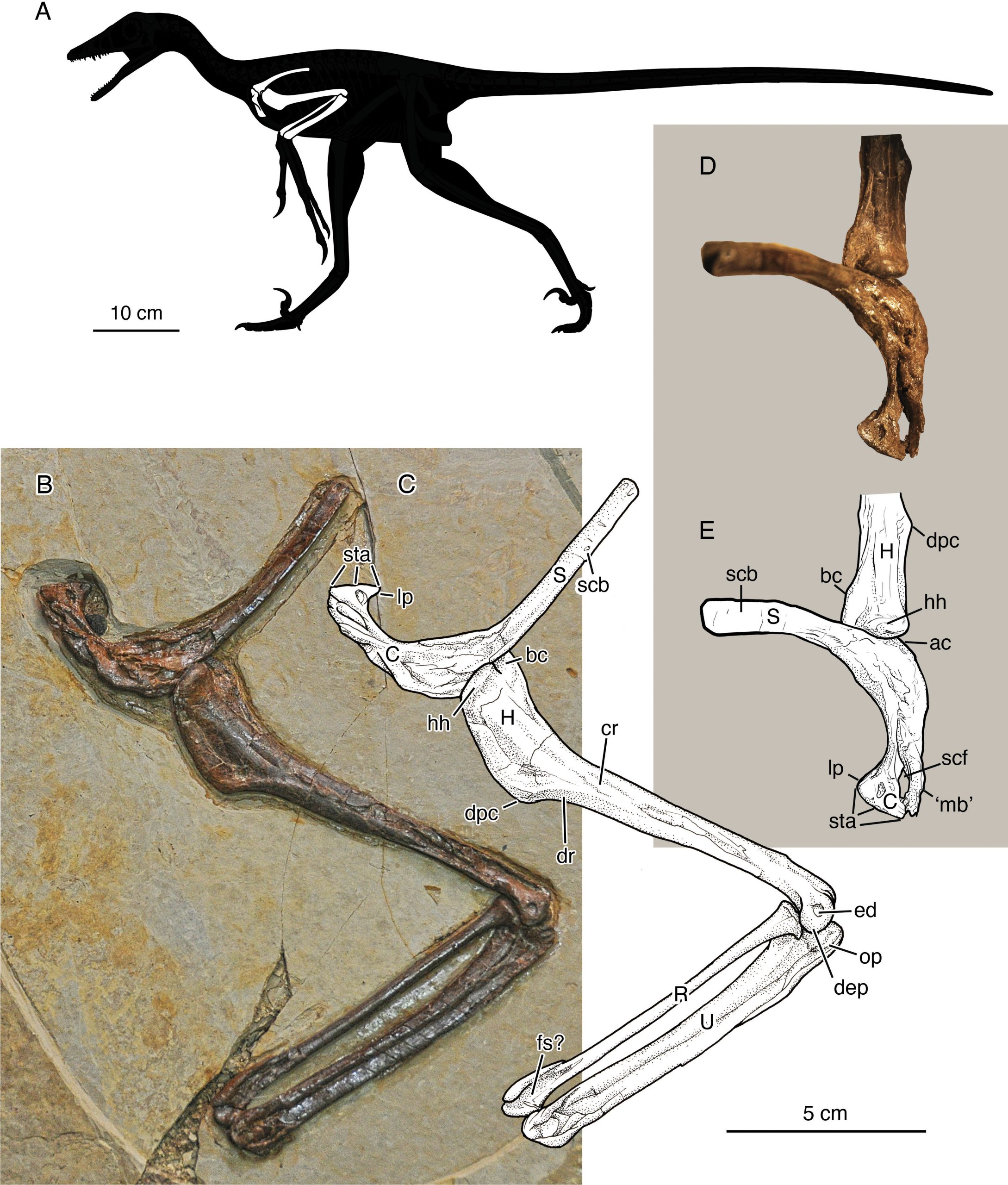
The newly identified species, Jian changmaensis, belongs to a subgroup of dromaeosaurs known as microraptors. Most microraptors were relatively small, with some species reaching only about the size of a crow.
“Jian is one of the biggest microraptor specimens that has ever been found,” says O’Connor. “The piece of its upper arm bone that we have is about 4 inches long, so the entire dinosaur probably had something like a four-foot wingspan, around the size of a barn owl.”
A Four-Winged Glider
Although researchers have recovered only part of Jian’s arm, they think it likely resembled other microraptors, which had long feathers on both their arms and legs. This gave them the appearance of having four wings that may have helped them glide through the air.
“Jian and the other microraptors probably weren’t capable of true, powered flight, but they could probably glide like a flying squirrel,” says O’Connor.
The name Jian changmaensis reflects both the animal’s appearance and where it was discovered. Jian is a winged creature from Chinese mythology, while changmaensis refers to the Changma Basin in China’s Gansu Province, where the fossil was found.
“Jian changmaensis reveals that non-avian dinosaurs lived in what is now the Changma Basin, an area famous for its fossil birds,” says Matt Lamanna, corresponding author of the study and Carnegie Museum of Natural History’s Mary R. Dawson Curator of Vertebrate Paleontology and senior dinosaur researcher. “Our team has recovered more than a hundred bird fossils at Changma, but only this single non-avian dinosaur specimen. Jian provides critical new insight into the biological history of the Changma region and the ecological context of the ancestors of today’s birds.”
“You cannot understand life on the planet today without looking at its origins,” says O’Connor. “Birds are arguably the most successful group of land-dwelling vertebrate animals on Earth today. Learning about early birds and their close non-bird dinosaur relatives gives us a better understanding of what made the group of birds that survived so special.”
Reference: “First Non-Avian Theropod (Dromaeosauridae, Microraptorinae) From the Bird-Bearing Lower Cretaceous Xiagou Formation of the Changma Basin, Gansu Province, Northwestern China” by Ling-Qi Zhou, Matthew C. Lamanna, Ashley W. Poust, Da-Qing Li, Hai-Lu You and Jingmai K. O’Connor, 4 June 2026, Annals of Carnegie Museum.
Never miss a breakthrough: Join the SciTechDaily newsletter.
Follow us on Google and Google News.
2 Comments
Fascinating article on Dinasaurs and early birds. Thanks.
so breathtaking interesting. who knew?