
Close Menu
    Facebook X (Twitter) Instagram
    SciTechDaily
    • Biology
    • Chemistry
    • Earth
    • Health
    • Physics
    • Science
    • Space
    • Technology
    Facebook X (Twitter) Pinterest YouTube RSS
    SciTechDaily
    Home»Space»New Fly-Through Video of the Ancient Flood Plain Kasei Valles
    Space

    New Fly-Through Video of the Ancient Flood Plain Kasei Valles

    By European Space AgencyJanuary 14, 2014No Comments2 Mins Read
    Facebook Twitter Pinterest Telegram LinkedIn WhatsApp Email Reddit
    Share
    Facebook Twitter LinkedIn Pinterest Telegram Email Reddit
    New Video Celebrates Ten Years of Imaging the Red Planet
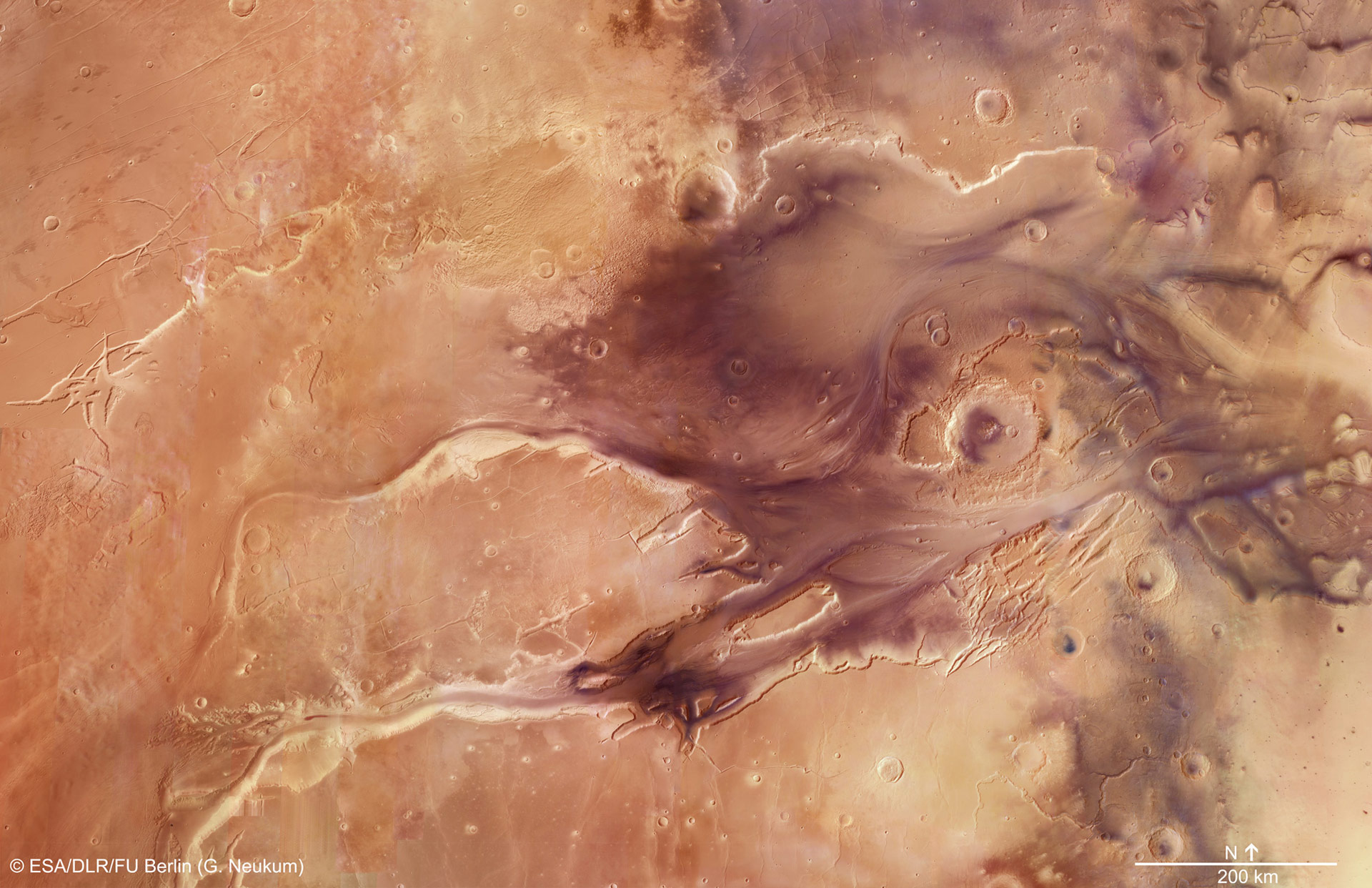
    This mosaic, which features the spectacular Kasei Valles, comprises 67 images taken with the High Resolution Stereo Camera on ESA’s Mars Express. The mosaic spans 987 km (613 mi) north–south (19–36°N) and 1550 km (963 mi) east–west (280–310°E). Credit: ESA/DLR/FU Berlin (G. Neukum)

    The European Space Agency has released a new five-minute fly-through movie of the ancient flood plain Kasei Valles based on the 67-image mosaic from Mars Express.

    Travel across the dramatic flood plains of Mars to celebrate ten years of imaging the Red Planet with Mars Express.

    Ten years ago, on January 14, 2004, Mars Express took its very first images of Mars in color and in 3D.

    To mark the occasion, the team produced a fly-through movie of the ancient flood plain Kasei Valles. The movie is based on the 67-image mosaic released as part of the ten-year-since-launch celebrations in June 2013. See http://www.esa.int/Our_Activities/Spa…

    The scene spans 987 km (613 mi) in the north-south direction, 19-36°N, and 1550 km (963 mi) in the east-west direction (280-310°E). It covers 1.55 million square kilometers (0.6 million square miles)  an area equivalent to the size of Mongolia.

    Kasei Valles is one of the largest outflow channel systems on Mars, created during dramatic flood events. From source to sink, it extends some 3,000 km (1,900 mi) and descends 3 km (1.9 mi).

    Kasei Valles splits into two main branches that hug a broad island of fractured terrain — Sacra Mensa — rising 2 km (0.8 mi) above the channels that swerve around it. While weaker materials succumbed to the erosive power of the fast-flowing water, this hardier outcrop has stood the test of time.

    Slightly further downstream, the flood waters did their best to erase the 100 km-wide Sharonov crater, crumpling its walls to the south. Around Sharonov many small streamlined islands form teardrop shapes rising from the riverbed as water swept around these natural obstacles.

    The Planetary Science and Remote Sensing Group at Freie Universität Berlin produced the movie. The processing of the High Resolution Stereo Camera image data was carried out at the DLR German Aerospace Center.

    Never miss a breakthrough: Join the SciTechDaily newsletter.
    Follow us on Google and Google News.

    Astronomy European Space Agency Mars Planetary Science
    Share. Facebook Twitter Pinterest LinkedIn Email Reddit

    Related Articles

    Mars Express Provides a Window to a Watery Past on Mars

    First Images from ExoMars Mission

    ESA’s Mars Express View Remnants of Mega-Flood on Mars

    New Mosaic Shows Off the Red Planet’s North Polar Ice Cap

    Mars Express Image of the Rim of the Schiaparelli Crater

    ESA’s Mars Express Sheds New Light on the Red Planet’s Rare Aurora

    New ESA Image of Craters within the Hellas Basin on Mars

    Mars Express Captures a Radar View of the Southern Highlands of Mars

    ESA’s Mars Express Captures New Images of Sulci Gordii

    Leave A Reply Cancel Reply

    • Facebook
    • Twitter
    • Pinterest
    • YouTube

    Don't Miss a Discovery

    Subscribe for the Latest in Science & Tech!

    Trending News

    Millions Take These IBS Drugs, But a New Study Finds Serious Risks

    Scientists Unlock Hidden Secrets of 2,300-Year-Old Mummies Using Cutting-Edge CT Scanner

    Bread Might Be Making You Gain Weight Even Without Eating More Calories

    Scientists Discover Massive Magma Reservoir Beneath Tuscany

    Europe’s Most Active Volcano Just Got Stranger – Here’s Why Scientists Are Rethinking It

    Alzheimer’s Symptoms May Start Outside the Brain, Study Finds

    Millions Take This Popular Supplement – Scientists Discover a Concerning Link to Heart Failure

    The Universe Is Expanding Too Fast and Scientists Can’t Explain Why

    Follow SciTechDaily
    • Facebook
    • Twitter
    • YouTube
    • Pinterest
    • Newsletter
    • RSS
    SciTech News
    • Biology News
    • Chemistry News
    • Earth News
    • Health News
    • Physics News
    • Science News
    • Space News
    • Technology News
    Recent Posts
    • Scientists Say a Hidden Structure May Exist Inside Earth’s Core
    • Doctors Surprised by the Power of a Simple Drug Against Colon Cancer
    • Why Popular Diabetes Drugs Like Ozempic Don’t Work for Everyone: The “Genetic Glitch”
    • Scientists Create Improved Insulin Cells That Reverse Diabetes in Mice
    • Scientists Stunned After Finding Plant Thought Extinct for 60 Years
    Copyright © 1998 - 2026 SciTechDaily. All Rights Reserved.
    • Science News
    • About
    • Contact
    • Editorial Board
    • Privacy Policy
    • Terms of Use

    Type above and press Enter to search. Press Esc to cancel.