
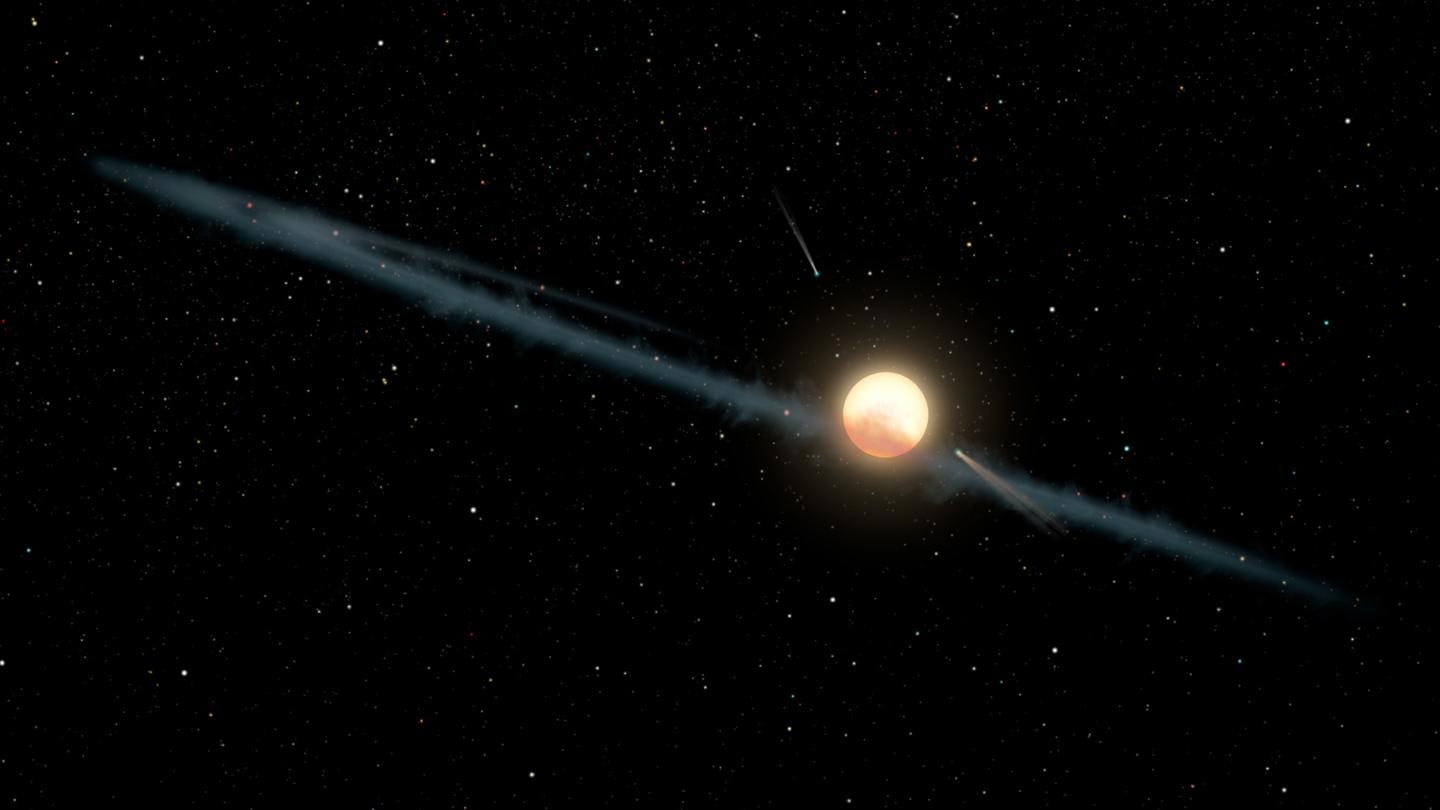
A Columbia study suggests chunks of an exomoon’s dusty outer layers of ice, gas and carbonaceous rock may be accumulating in a disk surrounding star.
For years, astronomers have looked up at the sky and speculated about the strange dimming behavior of Tabby’s Star.
First identified more than a century ago, the star dips in brightness over days or weeks before recovering to its previous luminosity. At the same time, the star appears to be slowly losing its luster overall, leaving researchers scratching their heads.
Now, astronomers at Columbia University believe they’ve developed an explanation for this oddity.
In a new paper published in the Monthly Notices of the Royal Astronomical Society, astrophysicists Brian Metzger, Miguel Martinez, and Nicholas Stone propose that the long-term dimming is the result of a disk of debris — torn from a melting exomoon — that is accumulating and orbiting the star, blocking its light as the material passes between the star and Earth.
“The exomoon is like a comet of ice that is evaporating and spewing off these rocks into space,” said Metzger, associate professor of astrophysics at Columbia University and principal investigator on the study. “Eventually the exomoon will completely evaporate, but it will take millions of years for the moon to be melted and consumed by the star. We’re so lucky to see this evaporation event happen.”
Tabby’s Star, also known as KIC 8462852 or Boyajian’s Star, is named after Tabetha Boyajian, the Louisiana State University (LSU) astrophysicist who discovered the star’s unusual dimming behavior in 2015. Boyajian found that Tabby’s Star occasionally dips in brightness — sometimes by just 1 percent and other times by as much as 22 percent — over days or weeks before recovering its luster. A year later, LSU astronomer Bradley Schaefer discovered that the star’s brightness is also becoming fainter overall with time, dimming by 14 percent between 1890 and 1989.
Scientists around the world have proposed a variety of theories, ranging from comet storms to alien “megastructures,” to explain the short-term dips in brightness, but very recently agreed on a much more mundane culprit — dust.
As an exoplanet is destroyed by strong interactions or collisions with its parent star, Metzger explained, the exomoon orbiting the exoplanet can become vulnerable to the pull of the system’s central star. The force can be so great that the star rips the exomoon away from its planet, causing the exomoon to either collide with a star or otherwise be ejected from the system.
In a small percentage of cases, however, the star steals the exomoon and places it into a new orbit around itself. In this new orbit, the icy, dusty exomoon is exposed to radiation from the star that rips apart its outer layers, creating dust clouds that are eventually blown out to the solar system. When those clouds of dust pass between the star and Earth, intermittent dips in brightness are observed.
This explains the short-term, inconsistent dimming of Tabby’s Star, but researchers have had a harder time explaining the long-term overall fading.
The Columbia team suggests that Tabby’s Star abducted an exomoon from a now long-gone, nearby planet and pulled it into orbit around itself, where it has been getting torn apart by stronger stellar radiation than existed in its former orbit. Chunks of the exomoon’s dusty outer layers of ice, gas, and carbonaceous rock have been able to withstand the radiation blow-out pressure that ejects smaller-grain dust clouds, and the volatile, large-grain material has inherited the exomoon’s new orbit around Tabby’s Star, where it forms a disk that persistently blocks the star’s light. The opaqueness of the disk can change slowly, as smaller-grain clouds pass through and larger particles stuck in orbit move from the disk toward Tabby’s Star, eventually getting so hot that they melt and fall onto the star’s surface.
Ultimately, after millions of years, the exomoon orbiting Tabby’s Star will completely evaporate, the researchers suggest.
Martinez, a Columbia College alumnus (CC’19) and researcher working with Metzger, said the team’s model is unique in its hypothesis of what drives the original planet toward the star in the first place. “It naturally results in the orphaned exomoons ending up on (highly eccentric) orbits with precisely the properties previous research had shown was needed to explain the dimming of Tabby’s star,” Martinez said. “No other previous model was able to put all these pieces together.”
There are other stellar systems that demonstrate unusual brightness dips, Martinez said, and there may be other explanations for the flux that are equally compelling. Tabby’s Star is unusual because it is very similar to Earth’s sun but is exhibiting drastically different behavior. It is the only star like it among the one million stars observed by Kepler, but there are many million times more stars in the universe that have yet to be observed.
The challenge now is finding other stars like Tabby’s that have abducted exomoons and have not yet finished annihilating them. If the team’s explanation is correct, Metzger said, it indicates that moons are a common feature of exoplanetary systems, thereby providing a way to probe the existence of exomoons.
“We don’t really have any evidence that moons exist outside of our solar system, but a moon being thrown off into its host star can’t be that uncommon,” he said. “This is a contribution to the broadening of our knowledge of the exotic happenings in other solar systems that we wouldn’t have known 20 or 30 years ago.”
Reference: “Orphaned Exomoons: Tidal Detachment and Evaporation Following an Exoplanet-Star Collision” by Miguel Martinez, Nicholas C Stone and Brian D Metzger, 5 September 2019, Monthly Notices of the Royal Astronomical Society.
DOI: 10.1093/mnras/stz2464
Never miss a breakthrough: Join the SciTechDaily newsletter.
Follow us on Google and Google News.