
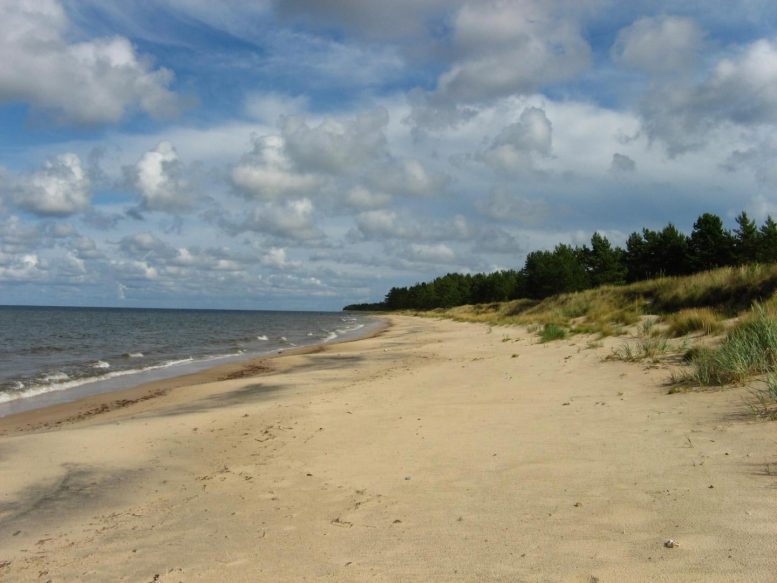
Agnes Anderson, a doctoral student of the School of Natural Sciences and Health of Tallinn University, recently defended her doctoral dissertation, in which she explores how the changing climate and human influence change the aeolian coastal dune landscapes. The dissertation concluded that the coastal dune landscapes are losing their distinctive features and diversity due to those influences.
The most dynamic, fragile, and attractive part of the coastal zone is characterized by the aeolian coastal dune landscapes, which extend over a 200 km² (77 mi²) area in Estonia. Their formation is mostly determined by climate, sediments, and vegetation, which affect the movement of sand and the formation of dunes.
The author of the dissertation focused her investigation on three regions of Western Estonia: the Tahkuna peninsula on Hiiumaa, the Keibu Bay area, and Ruhnu Island.
According to Agnes Anderson, the author of the dissertation, the aeolian coastal dune landscapes of the studied regions show similar trends. Their diversity is diminishing, which can be seen in the narrowing of beaches and the more forceful erosion of foredunes. ‘The landscapes are becoming afforested and the distinctive ‘familiar’ open terrain is disappearing, diminishing the attractiveness,’ she explains.
The dissertation concluded that the development dynamics of the seaward parts of the aeolian coastal dune landscapes are mainly affected by wave activity, sea-level fluctuations, and storms. They can cause rapid changes even within a few hours and depress the dynamics and development of the terrain. With the accumulation of sediments, nature is given an opportunity to create new coastal dune landscapes, distinguished by habitats characteristic of the area.
According to the author of the dissertation, unexpected factors affecting the environment, such as forest fires or blowdowns, are also important in shaping coastal landscapes. ‘The changes caused by disruptions last for decades in landscapes and recovery is a lengthy process,’ Anderson adds.
Human influence can be seen mainly on the landward side, stretching from foredunes to the afforested dunes. Anderson explains that the changes are predominantly caused by trampling, which has left a mark on distinctive habitats, such as white and grey dunes, and trampling-sensitive dune forests.
The dunes Anderson studied consisted mainly of coarser sands, contradicting earlier research and raising the question of dune formation conditions.
As part of her doctoral dissertation, the author also modeled coastal dune landscape development scenarios, which allow stakeholders to better understand the future development of these areas and implement more effective management plans for landscape protection.
The doctoral dissertation of Agnes Anderson, a doctoral student of the School of Natural Sciences and Health of Tallinn University, is titled ‘Development of aeolian coastal dune landscapes in changing climate and under human influence in Estonia.’
Public defense of the dissertation was held on August 28, 2019.
Never miss a breakthrough: Join the SciTechDaily newsletter.
Follow us on Google and Google News.
1 Comment
My father took a picture at a beach on the Baltic Sea near Narva in 1943. When we revisited the same beach in 2012 he remarked has it looks the same. We recreated the image, estimating same spot. What changed most was the consession stands, they were gone over time.