
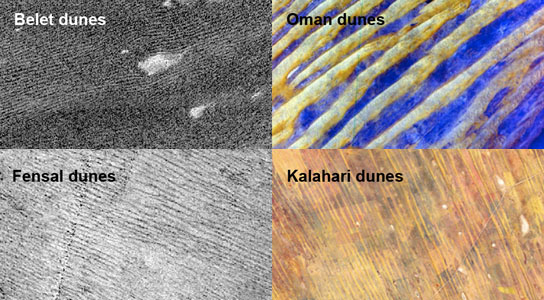
Images taken from NASA’s Cassini spacecraft show variations in the sizes of dunes found on Saturn’s moon Titan. Scientists believe these variations may be a function of altitude and latitude since dunes found in the Fensal region are thinner and more widely separated with less covering sand, while dunes in the lower altitude and latitude Belet region are wider with thicker blankets of sand between them.
A new analysis of radar data from NASA’s Cassini mission, in partnership with the European Space Agency and the Italian Space Agency, has revealed regional variations among sand dunes on Saturn’s moon Titan. The result gives new clues about the moon’s climatic and geological history.
Dune fields are the second most dominant landform on Titan, after the seemingly uniform plains, so they offer a large-scale insight into the moon’s peculiar environment. The dunes cover about 13 percent of the surface, stretching over an area of 4 million square miles (10 million square kilometers). For Earthly comparison, that’s about the surface area of the United States.
Though similar in shape to the linear dunes found on Earth in Namibia or the Arabian Peninsula, Titan’s dunes are gigantic by our standards. They are on average 0.6 to 1.2 miles (1 to 2 kilometers) wide, hundreds of miles (kilometers) long and around 300 feet (100 meters) high. However, their size and spacing vary across the surface, betraying the environment in which they have formed and evolved.
Using radar data from the Cassini spacecraft, Alice Le Gall, a former postdoctoral fellow at NASA’s Jet Propulsion Laboratory, Pasadena, California, who is currently at the French research laboratory LATMOS, Paris, and collaborators have discovered that the size of Titan’s dunes is controlled by at least two factors: altitude and latitude.
In terms of altitude, the more elevated dunes tend to be thinner and more widely separated. The gaps between the dunes seem to appear to Cassini’s radar, indicating a thinner covering of sand. This suggests that the sand needed to build the dunes is mostly found in the lowlands of Titan.
Scientists think the sand on Titan is not made of silicates as on Earth, but of solid hydrocarbons, precipitated out of the atmosphere. These have then aggregated into grains 0.04 inch in size by a still unknown process.
In terms of latitude, the sand dunes on Titan are confined to its equatorial region, in a band between 30 degrees south latitude and 30 degrees north latitude. However, the dunes tend to be less voluminous toward the north. Le Gall and colleagues think that this may be due to Saturn’s elliptical orbit.
Titan is in orbit around Saturn, and so the moon’s seasons are controlled by Saturn’s path around the sun. Because Saturn takes about 30 years to complete an orbit, each season on Titan lasts for about seven years. The slightly elliptical nature of Saturn’s orbit means that the southern hemisphere of Titan has shorter but more intense summers. So the southern regions are probably drier, which implies they have less ground moisture. The drier the sand grains, the more easily they can be transported by the winds to make dunes. “As one goes to the north, we believe the soil moisture probably increases, making the sand particles less mobile and, as a consequence, the development of dunes more difficult,” says Le Gall.
Backing this hypothesis is the fact that Titan’s lakes and seas are not distributed symmetrically by latitude. These reserves of liquid ethane and methane are predominantly found in the northern hemisphere, suggesting again that the soil is moister toward the north and so, again, the sand grains are less easy to transport by the wind.
“Understanding how the dunes form as well as explaining their shape, size and distribution on Titan’s surface is of great importance to understanding Titan’s climate and geology because the dunes are a significant atmosphere-surface exchange interface”, says Nicolas Altobelli, ESA’s Cassini-Huygens project scientist. “In particular, as their material is made out of frozen atmospheric hydrocarbon, the dunes might provide us with important clues on the still puzzling methane/ethane cycle on Titan, comparable in many aspects with the water cycle on Earth.”
The Cassini-Huygens mission is a cooperative project of NASA, the European Space Agency, and the Italian Space Agency. NASA’s Jet Propulsion Laboratory, a division of the California Institute of Technology in Pasadena, manages the mission for NASA’s Science Mission Directorate, Washington, D.C. The Cassini orbiter was designed, developed and assembled at JPL. The radar instrument was built by JPL and the Italian Space Agency, working with team members from the U.S. and several European countries.
Never miss a breakthrough: Join the SciTechDaily newsletter.
Follow us on Google and Google News.