
Close Menu
    Facebook X (Twitter) Instagram
    SciTechDaily
    • Biology
    • Chemistry
    • Earth
    • Health
    • Physics
    • Science
    • Space
    • Technology
    Facebook X (Twitter) Pinterest YouTube RSS
    SciTechDaily
    Home»Space»New Horizons Reveals Dunes Made of Tiny Grains of Solid Methane on Pluto
    Space

    New Horizons Reveals Dunes Made of Tiny Grains of Solid Methane on Pluto

    By AMERICAN ASSOCIATION FOR THE ADVANCEMENT OF SCIENCEJune 3, 20181 Comment4 Mins Read
    Facebook Twitter Pinterest Telegram LinkedIn WhatsApp Email Reddit
    Share
    Facebook Twitter LinkedIn Pinterest Telegram Email Reddit
    Dunes across the Solar System
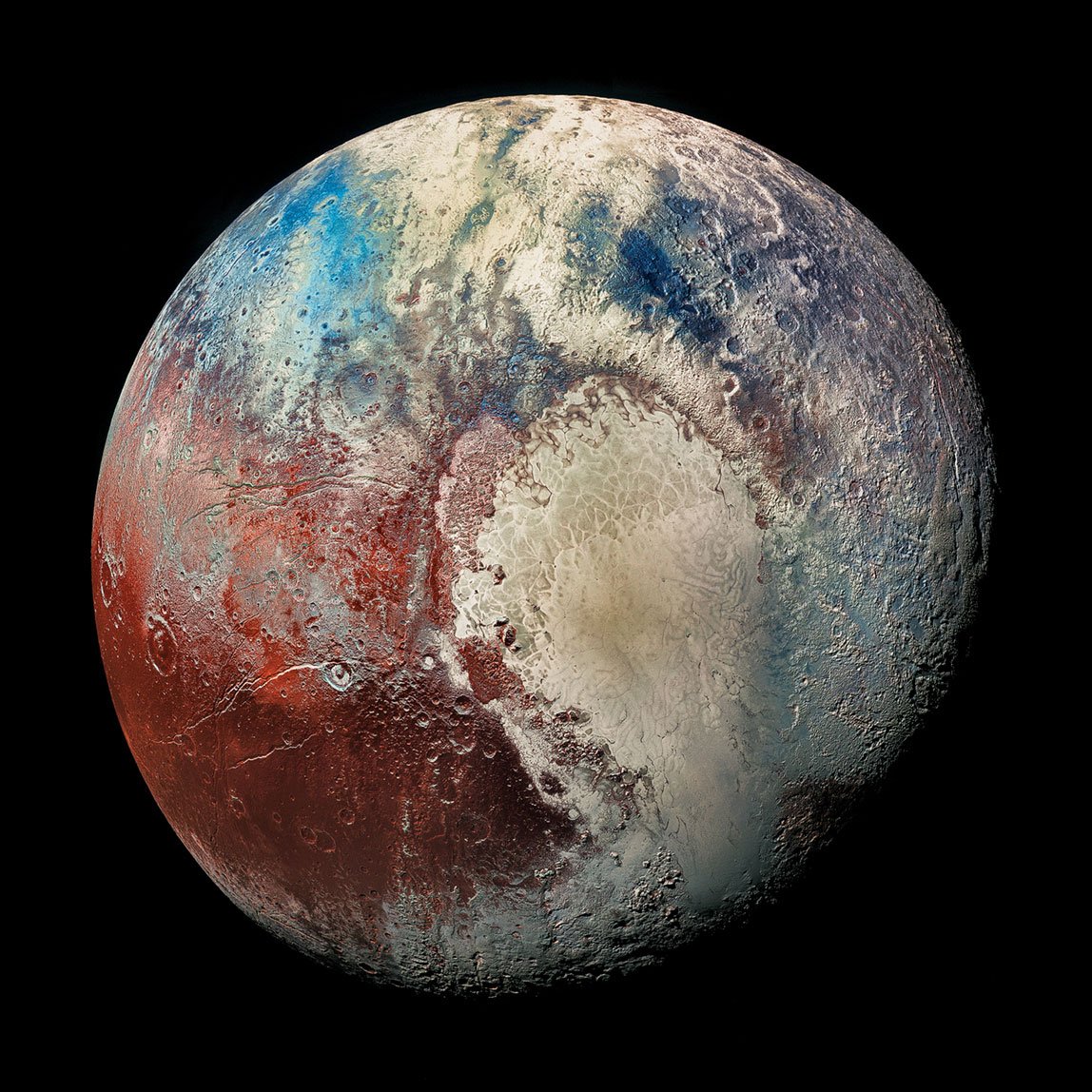
    In this image of Pluto’s surface, the red luminance corresponds to the infrared data acquired by the Ralph/MVIC instrument carried by New Horizons. Credit: NASA/Johns Hopkins University Applied Physics Laboratory/Southwest Research Institute/ZLDoyle

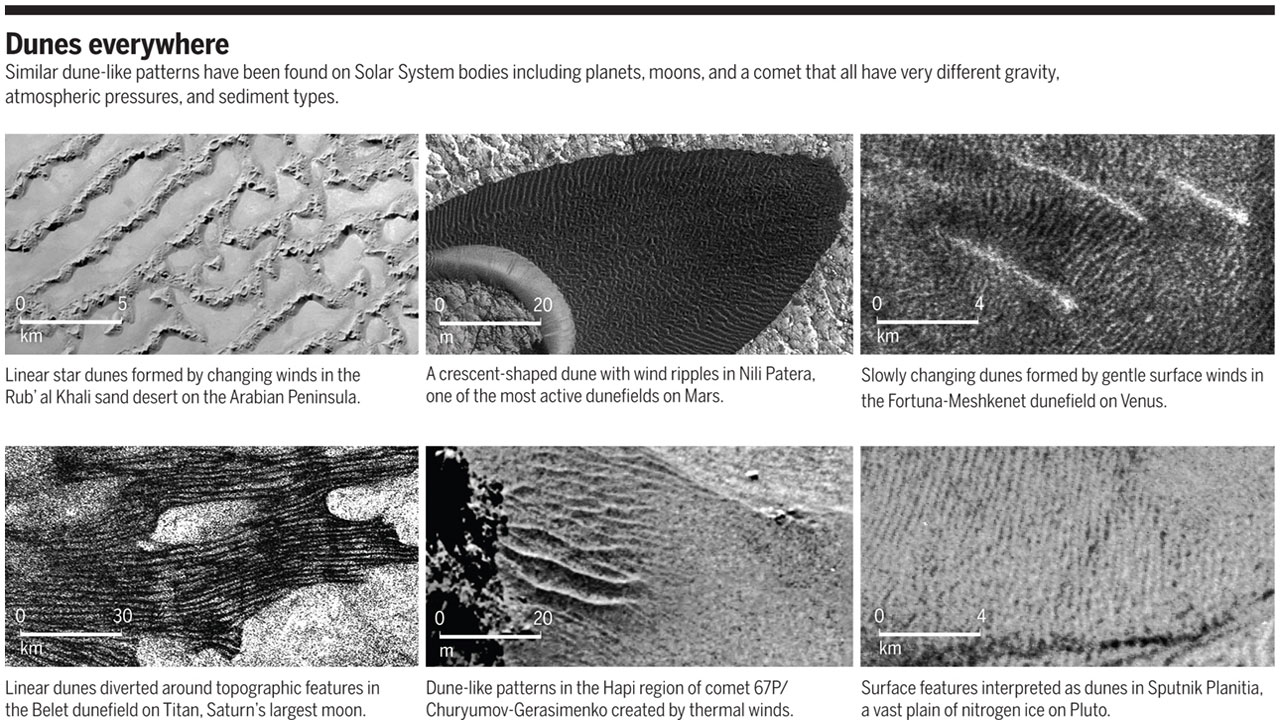
    Dunes are known to form on Earth, Mars, Venus, Titan, and Comet 67P – and now on the dwarf planet Pluto, according to a new study, the latest discovery from New Horizons. These dunes are unlike the dunes made of sand seen on Earth though; instead, Pluto’s dunes are likely made of tiny grains of solid methane, the study’s authors say.

    “What makes this discovery surprising,” writes Alexander Hayes in a related Perspective, “is that the sediment can be mobilized despite Pluto’s tenuous atmosphere, whose surface pressure (1 Pa) is 100,000 times lower than Earth’s.”

    When the New Horizons spacecraft flew by Pluto on 14 July 2015, it obtained the most detailed images yet of the dwarf planet. When analyzing the data, Matt Telfer and colleagues spotted a collection of 357 pale ridges, as well as six darker wind streaks, located on one of Pluto’s largest features, a vast plain called Sputnik Planitia. Along the western area of the plain, the ridges run parallel with a mountain range, but farther east, they shift their orientation and become more spread out, a pattern also seen in the wind streaks.
    Methane Dunes on Pluto
    Similar dune-like patterns have been found on Solar System bodies including planets, moons, and a comet that all have very different gravity, atmospheric pressures, and sediment types. Credit: (Clockwise from top left) NASA; NASA/JPL/University of Arizona; Greeley et al. (9); Telfer et al. (2); Jia et al. (4); NASA/JPL-Caltech/ASI

    Several clues revealed that these landforms were created by wind; namely, the locations of the ridges and their distribution patterns demonstrate this. Modeling by the authors shows that wind can create these dunes once the grains are airborne; however, a process called sublimation is required first, to lift the grains from the planet’s surface.

    In this process, the Sun heats surface ice enough that gas is released into the atmosphere, lofting particles into the air as a result. The likely source of the dune grains is methane ice blown from nearby mountains, say the authors, although nitrogen ice cannot be ruled out, as a source. “If an extremely tenuous atmosphere like that of Pluto can support the generation of bedforms from wind-driven sediment,” poses Hayes in his Perspective, “what kind of aeolian activity might we see on places like Io or Triton?”

    New HorizonsDiscovers Methane Dunes on Pluto
    New Horizons flyby imagery of landforms attributed to eolian origins. All images are unrectified, and thus all scales are approximate. Color-composite MVIC images are shown here for context; dune identification was performed on grayscale LORRI images (shown below). (A) Overview of Pluto centered on ~25° latitude, ~165° longitude, showing the locations of images (B) and (E) and Fig. 3A and fig. S3. (B) The spatial context for SP and the AIM mountains to the west. Insets (C) and (D) show details of the highly regular spatial patterning, which we attribute to eolian dune formation, and two newly identified wind streaks (arrows x), along the margins of the SP/AIM border. Here the dunes show characteristic bifurcations (arrows y) and a superposition with SP’s polygonal patterning (arrow z), suggesting a youthful age for these features. (E) Two further wind streaks on the surface (x’), downwind of the Coleta de Dados Colles (4). These wind streaks, farther from the SP/AIM margin, are oriented differently than those close to the icefield’s edge and are still roughly orthogonal to the dunes there.

    Reference: “Dunes on Pluto” by Matt W. Telfer, Eric J. R. Parteli, Jani Radebaugh, Ross A. Beyer, Tanguy Bertrand, François Forget, Francis Nimmo, Will M. Grundy, Jeffrey M. Moore, S. Alan Stern, John Spencer, Tod R. Lauer, Alissa M. Earle, Richard P. Binzel, Hal A. Weaver, Cathy B. Olkin, Leslie A. Young, Kimberly Ennico, Kirby Runyon, and The New Horizons Geology, Geophysics and Imaging Science Theme Team, 1 June 2018, Science.
    DOI: 10.1126/science.aao2975

    Never miss a breakthrough: Join the SciTechDaily newsletter.
    Follow us on Google and Google News.

    Astronomy New Horizons Planetary Science Pluto Popular
    Share. Facebook Twitter Pinterest LinkedIn Email Reddit

    Related Articles

    New Horizons Reveals ‘Snakeskin’ Pluto Image and More

    NASA Releases New Pluto Images Taken by the New Horizons Spacecraft

    NASA Reveals New Pluto Images from New Horizons Spacecraft

    Data from NASA’s New Horizons Hints at Underground Ocean on Pluto

    New Horizons Reveals Flowing Ices, Exotic Surface Chemistry, Mountains, and Haze on Pluto

    New Horizons Reveals a Dense Region of Atmospheric Ions Behind Pluto

    NASA’s New Horizons Spacecraft Reaches Historic Encounter with Pluto

    New Horizons Reveals Signs of Pluto’s Geology

    Dwarf Planet Pluto: The ‘Other’ Red Planet

    1 Comment

    1. Mr. Brian Douglas White on December 18, 2018 6:33 pm

      Oh a planet, duh.

      Reply
    Leave A Reply Cancel Reply

    • Facebook
    • Twitter
    • Pinterest
    • YouTube

    Don't Miss a Discovery

    Subscribe for the Latest in Science & Tech!

    Trending News

    Scientists Discover Cheap, Natural Remedy for High Blood Pressure

    Earth’s Upper Atmosphere Is Cooling Fast and Scientists Finally Know Why

    32,000 Olympic Pools of Magma Nearly Erupted Beneath Atlantic Island

    Exercise Changes the Heart in a Way Researchers Never Expected

    Too Much Sleep May Age Your Body Faster, New Study Warns

    Scientists Uncover Promising New Strategy To Stop Parkinson’s in Its Tracks

    Experts Reveal the Surprising Cancer Link Behind a Common Vitamin

    This Strange “Golden Orb” Found 2 Miles Deep Stumped Scientists for Years

    Follow SciTechDaily
    • Facebook
    • Twitter
    • YouTube
    • Pinterest
    • Newsletter
    • RSS
    SciTech News
    • Biology News
    • Chemistry News
    • Earth News
    • Health News
    • Physics News
    • Science News
    • Space News
    • Technology News
    Recent Posts
    • Canada’s Billion-Year-Old Rocks Could Hold the Future of Clean Energy
    • Climate Change Is Quietly Choking Rivers Across the Planet
    • Scientists Finally Solve the Mystery of “Clockwork” Earthquakes
    • Your Immune System Remembers Obesity for up to a Decade, Study Finds
    • Breakthrough Parkinson’s Drug Targets Disease at Its Genetic Roots
    Copyright © 1998 - 2026 SciTechDaily. All Rights Reserved.
    • Science News
    • About
    • Contact
    • Editorial Board
    • Privacy Policy
    • Terms of Use

    Type above and press Enter to search. Press Esc to cancel.