
Close Menu
    Facebook X (Twitter) Instagram
    SciTechDaily
    • Biology
    • Chemistry
    • Earth
    • Health
    • Physics
    • Science
    • Space
    • Technology
    Facebook X (Twitter) Pinterest YouTube RSS
    SciTechDaily
    Home»Health»New Study Shows Brain stimulation Counteracts Dangerous Side Effect of Seizures
    Health

    New Study Shows Brain stimulation Counteracts Dangerous Side Effect of Seizures

    By Bill HathawayDecember 2, 20141 Comment2 Mins Read
    Facebook Twitter Pinterest Telegram LinkedIn WhatsApp Email Reddit
    Share
    Facebook Twitter LinkedIn Pinterest Telegram Email Reddit
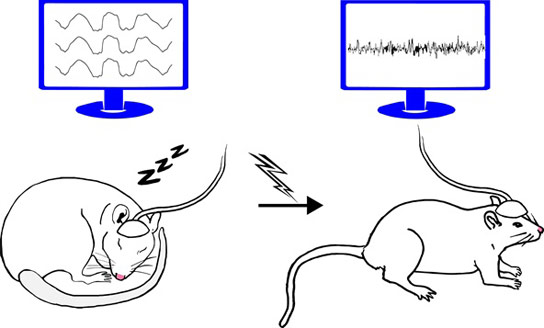
    Brain Stimulation Can Restore Consciousness after a Seizure
    Brain stimulation can restore consciousness in a rat after a seizure. Credit: Image courtesy of the Blumenfeld lab

    In a newly published study, neurologists from Yale University have reawakened rats after seizures by stimulating parts of the brain involved in conscious awareness. The research may lead to treatments for individuals with epilepsy.

    Loss of consciousness is a common and dangerous side effect of epileptic seizures. A study published this week in the journal Epilepsia, however, shows that activation of electrodes in key brain areas can awaken rats with induced seizures.

    “At least a quarter of people with epilepsy have seizures that can’t be controlled,” said Dr. Hal Blumenfeld, professor of neurology, neurobiology, and neurosurgery, and senior author of the study. “Our hope is that for this population, brain stimulation can help reduce injuries and deaths that result from a loss of consciousness.”

    Blumenfeld and colleagues brought rats back to consciousness after seizures by stimulating the thalamus and areas of the brain stem known to play a role in wakefulness. The rats immediately began to explore their cages again.

    Additional testing needs to be done to determine if such brain stimulation can be conducted safely in humans, he said.

    There may be as many as 500,000 epilepsy patients in the United States who suffer from chronic, treatment-resistant seizures, Blumenfeld estimated. These patients might be aided by implants of electrodes that could prevent loss of consciousness during and following seizures, he said.

    Reference: “Thalamic stimulation to improve level of consciousness after seizures: Evaluation of electrophysiology and behavior” by Abhijeet Gummadavelli, Joshua E. Motelow, Nicholas Smith, Qiong Zhan, Nicholas D. Schiff and Hal Blumenfeld, 2 December 2014, Epilepsia.
    DOI: 10.1111/epi.12872

    Lead author of the paper is Yale’s Abhijeet Gummadavelli.

    Primary funding for the research was provided by the National Institutes of Health.

    Never miss a breakthrough: Join the SciTechDaily newsletter.
    Follow us on Google and Google News.

    Kavli Institute Neurology Neuroscience Yale University
    Share. Facebook Twitter Pinterest LinkedIn Email Reddit

    Related Articles

    Monkeys and Humans Share Same Signs of Alzheimer’s

    Yale Researchers Show Sedative Combats Virus That Causes Birth Defects

    New Reserach Reveals How Zika Virus Causes Fetal Brain Damage

    Rare ALK Genetic Mutation Extends Cancer Survival

    New Drug Significantly Reduces Mortality Rate After Stroke

    Researchers Reveal a New Pathway to Help Treat Perinatal Brain Injuries

    New Drug Compound Reverses the Brain Deficits of Alzheimer’s Disease in Mice

    Neurobiologists Reveal Age-Related Changes that Answer Key Questions about Alzheimer’s Disease

    Study Shows Oxytocin Improves Brain Function in Children with Autism

    1 Comment

    1. Brian on December 2, 2014 1:18 pm

      I wonder (assuming this is just a helmet that provides an electric jolt) what practical use this method could potentially end up having?

      Reply
    Leave A Reply Cancel Reply

    • Facebook
    • Twitter
    • Pinterest
    • YouTube

    Don't Miss a Discovery

    Subscribe for the Latest in Science & Tech!

    Trending News

    A SpaceX Falcon 9 Rocket Hit the Moon and Blasted Open a 60-Foot Crater

    Study Reveals Your Organs May Be Aging at Very Different Speeds

    Scientists Finally Solve a 20-Year Mystery About Diamond Melting

    Ultra-Processed Foods Linked to 30% Higher Prostate Cancer Risk

    More Screen Time, Better Thinking? An 8-Year Study Finds a Surprising Link

    Cleaner Cars May Be Hiding a New Pollution Problem

    Common Plant Chemical Linked to Widespread Organ Damage in Aquatic Animals

    Dogs and Humans May Share a Surprising Biological Secret to Longevity

    Follow SciTechDaily
    • Facebook
    • Twitter
    • YouTube
    • Pinterest
    • Newsletter
    • RSS
    SciTech News
    • Biology News
    • Chemistry News
    • Earth News
    • Health News
    • Physics News
    • Science News
    • Space News
    • Technology News
    Recent Posts
    • Tiny Hidden Vibrations Could Make Aircraft More Fuel Efficient
    • Two Opposing Quantum Particles Could Form a Bizarre New Kind of Matter
    • This New Molecule Could Transform How We Recover Gold From Electronic Waste
    • A Relentless Storm Pattern Is Making Arctic Sea Ice Disappear Faster
    • Monkeys Just Challenged a Major Assumption About How Human Ancestors Climbed
    Copyright © 1998 - 2026 SciTechDaily. All Rights Reserved.
    • Science News
    • About
    • Contact
    • Editorial Board
    • Privacy Policy
    • Terms of Use

    Type above and press Enter to search. Press Esc to cancel.