
A Recent Study Has Identified Brain Network Cores With Strong Bidirectional Connections
Science may be getting closer to figuring out where consciousness resides in the brain. New research demonstrates the significance of certain kinds of neural connections in identifying consciousness.
Jun Kitazono, a corresponding author of the study and project researcher at the Department of General Systems Studies at the University of Tokyo, conducted the study, which was published in the journal Cerebral Cortex.
“Where in the brain consciousness resides has been one of the biggest questions in science,” said Associate Professor Masafumi Oizumi, corresponding author and head of the lab conducting the study. “Although we have not reached a conclusive answer, much empirical evidence has been accumulated in the course of searching for the minimal mechanisms sufficient for conscious experience, or the neural correlates of consciousness.”
Importance of Bidirectional Neural Connections
The researchers made a step toward discovering the minimally sufficient subnetworks in the brain that support conscious experience with this study.
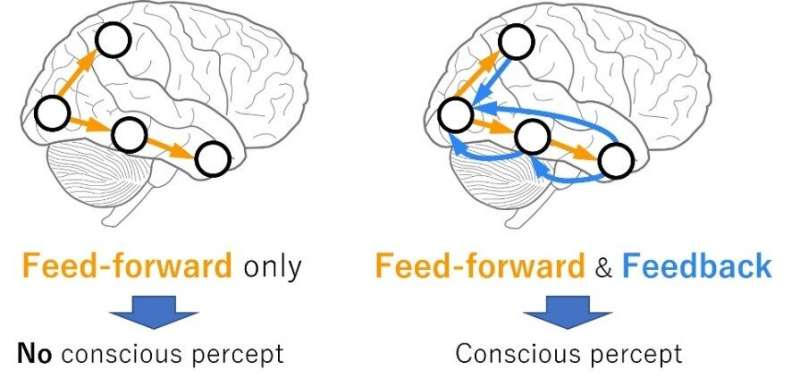
The researchers looked for one particular hallmark of consciousness within the neural networks of the brain, bidirectional pathways, to pinpoint the parts of the brain where awareness resides. Our brains process information when we see something or experience something. This is known as a feed-forward signal, however receiving such signals is insufficient for consciousness. Our brains must also convey information back to us in what is known as feedback. Not every area of the brain can receive and respond to feed-forward information. Researchers hypothesized that these bidirectional connections are an essential hallmark of the parts of the brain responsible for consciousness.
“Feed-forward processing alone is insufficient for subjects to consciously perceive stimuli; rather, feedback is also necessary, indicating the need for bidirectional processing. The feedback component disappears not only during the loss of specific contents of consciousness in awake states, but also during unconscious states where conscious experiences are generally lost, such as general anesthesia, sleep, and vegetative states,” said Kitazono. He also explained that it does not matter if you are looking at a human, monkey, mouse, bird, or fly; the bi-directionality of processing remains essential.
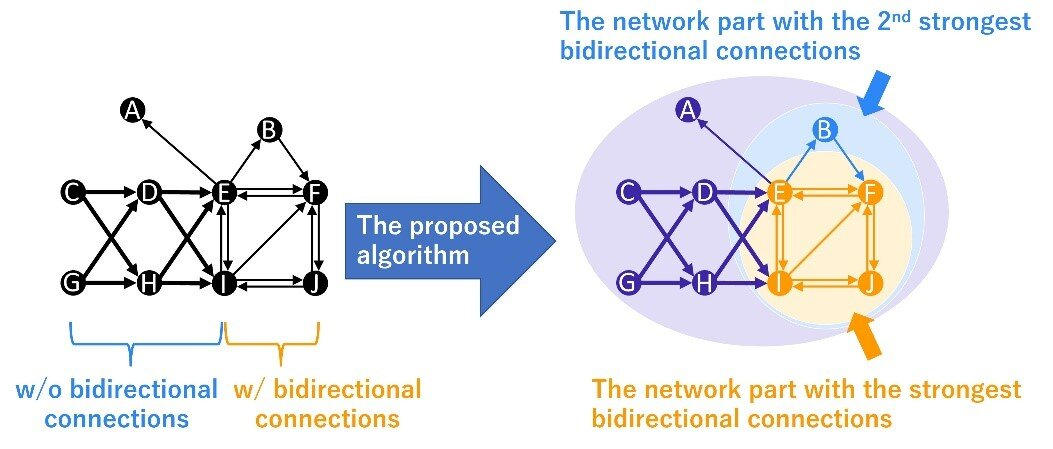
Researchers used a mouse connectome and computational techniques to test their idea. A connectome is a detailed map of the connections in the brain. First, they developed an efficient algorithm to extract the parts of the brain with strong bidirectional connections, called complexes. Then, they applied the algorithm to the mouse connectome.
Cortical and Thalamic Regions Linked to Consciousness
“We found that the extracted complexes with the most bidirectionality were not evenly distributed among all major regions, but rather are concentrated in the cortical regions and thalamic regions,” said Kitazono. “On the other hand, regions in the other major regions have low bi-directionality. In particular, regions in the cerebellum have much lower bidirectionality.”
These findings align with where scientists have long thought consciousness resides in the brain. The cerebral cortex, located on the surface of the brain, contains sensory areas, motor areas and association areas that are thought to be essential to consciousness experience. The thalamus, located in the middle of the brain, has likewise been thought to be related to consciousness, and in particular, the interaction between the thalamus and cortical regions, called the thalamocortical loop, is considered important for consciousness. These results support the idea that the bi-directionality in the brain network is a key to identifying the place of consciousness.
Researchers emphasized that they are still working toward identifying the place of consciousness.
“This study focuses only on ‘static’ anatomical connections between neurons or brain areas. However, consciousness is ‘dynamic,’ changing from moment to moment depending on neural activity,” said Oizumi. “Although anatomical connections tell us how neural activity would propagate and how brain areas would interact, we need to directly investigate the dynamics of neural activity to identify the place of consciousness at any given moment.”
As a next step, he said the team is currently analyzing activity-based networks of the brain in various types of neural recordings.
Mathematical Understanding of Consciousness
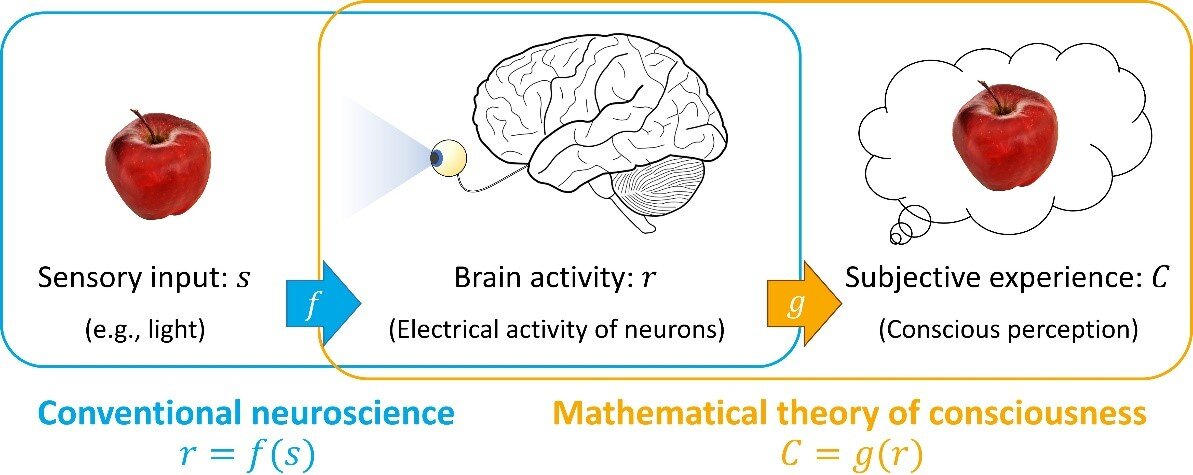
“The ultimate goal of our lab is to find the mathematical relationship between consciousness and the brain,” said Oizumi. “In this study, we have attempted to relate the network properties of the brain to the place of consciousness. We will further investigate the relationship between consciousness and the brain, toward what is our ultimate goal.”
Reference: “Bidirectionally connected cores in a mouse connectome: towards extracting the brain subnetworks essential for consciousness” by Jun Kitazono, Yuma Aoki and Masafumi Oizumi, 21 July 2022, Cerebral Cortex.
DOI: 10.1093/cercor/bhac143
Never miss a breakthrough: Join the SciTechDaily newsletter.
Follow us on Google and Google News.
13 Comments
This article implies that plants aren’t conscious, and neither is any living thing without a brain. I suggest that every living cell has some level of consciousness, and the collection of all the conscious cells becomes the consciousness of the living thing. This idea is an extension of those from Roger Penrose and Stuart Hammeroff.
For a more complete description, go to YouTube and look up “Consciousness – A String Theory Way”.
There is a problem with the idea of a single nexus for ‘consciousness’ in the bod. The personal identity of a subject is a simple unchanging sameness, never fluctuating. That is a datum. Now consider that we sense that which moves; for it takes contact with sensory receptors to induce them to transmit a signal. It is a datum that our core identity never ‘moves’, never changes. So our experience of being the same me always, despite maturation, can’t transmit over sensory media for lacking impetus. Therefore, our experience of being the same core ‘me’ over a lifetime cannot be experience of a sensation. How then is it that we experience our ‘I’-ness’s unfluctuating continuity?
Classical physics, in particular the principles of relativity of motion and position tell us that we can’t experience motion meaningfully except in a relation to rest actual or presumed. Nor does experience of unfluctuating continuity for ‘me’ become an experience of sameness absent motion, or unsameness. That’s a scientific statement because the first principles are relativity of position and motion, classical physics a physics of measurement founded on on classical relativity. And since our sense of core simple me is unchanging in its agential relation to change, the object whose quale is of a simple sameness must be independent of dynamics in order for those dynamics to have experiential order within a flow for time. If you then say that our experience of our ‘I’-ness’s unfluctuating continuity is quale of an object whose properties are agential knowing and personal identity, then quale of motion is quale of flowing dynamics relativistically associated to the stasis of ‘me’, the ego, the narrating self, the autobiographical self. That isn’t a philosophical framing. Instead it is a standard model for mind as an unchanging personal identity’s will and agency in relation to sensuous reality; and where from the foregoing, our experience of our own personal identity’s continuity is not an experience of sensuous reality. That is a scientific statement, not a philosophical or theological statement. It is a scientific model of self, or mind, as a fixed point of observation in relation to change as experienced via the senses, where relativity requires reference to an object independent of the change we attempt to measure.
If you then say of our role as a personal identity within an organism is that of a life management system experiencing negotiable sensations, then as to life management systems overall, we can surmise that where we find life management going on in an organisms, we would find it to be managed subliminally by our agential ego. Well, when neuroscience finds such management going on, as in ‘the brain makes decisions before we know of them’, it isn’t the brain which makes decisions, it is our subliminal agency which does so. From that view, our experience of managing our survival and reproduction is the tip of the iceberg of experience writ large. How large we would like to say, and can’t yet.
Fear not. The studies have been done which show subliminal optimizing influence of a regularity on retina movements during visual fixation. Retina motion, to be optimized, must reference a regularity in order to have a goal. The goal is visual acuity for objects stationary to a visually fixating observer, an observer stationary, or holding still, to fixate vision by definition. Experientially, our personal identity is absolute regularity. And it is for the benefit of personal identity that vision is optimized as to its adaptiveness.
Here are the studies. https://www.ncbi.nlm.nih.gov/pmc/articles/PMC38864/ and
https://www.frontiersin.org/articles/10.3389/fpsyg.2015.01072/full . The second study, 2015, is shortsighted in that it does not recognize that the body’s physiology is, by extension, adaptive use of free energy by a substance, personal identity, antinomic to dynamics. Which is quizzical because energy conserves and personal identity conserves despite change.
Again, the foregoing is not philosophy or theology or theosophy. It is logic and prediction with verification formed of a datum, first principles from science, prediction and empirical verification. A short hand version above, but with salient points presented in order to change a cognitive bias which, as in the study reported on, doesn’t really really really understand the meaning of the phrase ‘correlation is not causation’. Neurons respond and that’s all they do and can do as per Gallistel https://plato.stanford.edu/entries/associationist-thought/.
Scrubbed wow biased…
Silvan S. Tomkins (in “Affect Imagery Consciousness. Springer) postulated that consciousness is learned my a matching of efferent patterns with incoming afferent patterns. (see Introduction volume #1) He also postulated innate affect as the gateway to concsciusnes via a positive feedback loop which amplifies the stimuus..
It’s becoming clear that with all the brain and consciousness theories out there, the proof will be in the pudding. By this I mean, can any particular theory be used to create a human adult level conscious machine. My bet is on the late Gerald Edelman’s Extended Theory of Neuronal Group Selection. The lead group in robotics based on this theory is the Neurorobotics Lab at UC at Irvine. Dr. Edelman distinguished between primary consciousness, which came first in evolution, and that humans share with other conscious animals, and higher order consciousness, which came to only humans with the acquisition of language. A machine with primary consciousness will probably have to come first.
What I find special about the TNGS is the Darwin series of automata created at the Neurosciences Institute by Dr. Edelman and his colleagues in the 1990’s and 2000’s. These machines perform in the real world, not in a restricted simulated world, and display convincing physical behavior indicative of higher psychological functions necessary for consciousness, such as perceptual categorization, memory, and learning. They are based on realistic models of the parts of the biological brain that the theory claims subserve these functions. The extended TNGS allows for the emergence of consciousness based only on further evolutionary development of the brain areas responsible for these functions, in a parsimonious way. No other research I’ve encountered is anywhere near as convincing.
I post because on almost every video and article about the brain and consciousness that I encounter, the attitude seems to be that we still know next to nothing about how the brain and consciousness work; that there’s lots of data but no unifying theory. I believe the extended TNGS is that theory. My motivation is to keep that theory in front of the public. And obviously, I consider it the route to a truly conscious machine, primary and higher-order.
My advice to people who want to create a conscious machine is to seriously ground themselves in the extended TNGS and the Darwin automata first, and proceed from there, by applying to Jeff Krichmar’s lab at UC Irvine, possibly. Dr. Edelman’s roadmap to a conscious machine is at https://arxiv.org/abs/2105.10461
OK, please listen: If you give a radio to an alien will they realize that the sounds they hear are not actually coming from the radio but are being converted from one form of energy to another? So then why do we continue to believe that consciousness (the sound) is in the brain? The brain is the radio that convers thought energy into sound , it is not the sound itself. Further just as a radio that is malfunctioning only picks up part of the signal so too does a brain that is either not fully functional. When you look at consciousness this way it makes much more sense.
It’s very simple for the ones who actually understand. Consciousness doesn’t reside in the brain, the brain resides in consciousness. The body everything included is nothing but particles and atoms aka energy being projected by our own consciousness.
When the permanent soul can’t be found, now they are shifting their attention on the permanent consciousness. Consciousness can’t arise without brain.
Consciousness does not reside in the brain, but permeates all of space. The images of the brain taken above are essentially only the pathways through which consciousness flows.
Consciousness lies partially inside the top of the head’s ethric body and outside of the body astral, thus it’s a universal consciousness. The brain is simply transmitter and receiver. “All is one and one is all”. “The all is contained with in the all. Popular Science is backed by popular dollars,to me it is a dead and implicit faith until scientists acknowledge the spiritual aspect they will ot find the awnser….
… the another one!
… the Consciousness is when one thinks about a number 1631, so hard… and then it can be aware that it is thinking about it, and that can stop and continue to think about it… okay that is a easy level…
Consciousness lies partially inside the top of the head’s ethric body and outside of the body astral, thus it’s a universal consciousness. The brain is simply transmitter and receiver. “All is one and one is all”. “The all is contained with in the all. Popular Science is backed by popular dollars,to me it is a dead and implicit faith until scientists acknowledge the spiritual aspect they will ot find the awnser….