
Close Menu
    Facebook X (Twitter) Instagram
    SciTechDaily
    • Biology
    • Chemistry
    • Earth
    • Health
    • Physics
    • Science
    • Space
    • Technology
    Facebook X (Twitter) Pinterest YouTube RSS
    SciTechDaily
    Home»Biology»Neurologists Reveal What Happens in the Split Second Before the Emergence of Consciousness
    Biology

    Neurologists Reveal What Happens in the Split Second Before the Emergence of Consciousness

    By Bill Hathaway, Yale UniversityFebruary 27, 20181 Comment4 Mins Read
    Facebook Twitter Pinterest Telegram LinkedIn WhatsApp Email Reddit
    Share
    Facebook Twitter LinkedIn Pinterest Telegram Email Reddit
    Neurologists Reveal What Happens Before the Emergence of Consciousness
    Neurologists reveal what happens before the emergence of consciousness

    Our brains are bombarded with information about events around us, but we only become conscious of a few of them. Yale researchers have captured what happens in the split second before the emergence of consciousness, a fundamental state of human life.

    “There is a very tight window of a few milliseconds when we come aware of stimuli and before the experience is passed on to be coded in our memory and analyzed,” said Dr. Hal Blumenfeld, the Mark Loughridge and Michele Williams Professor of Neurology and senior author of the research published in the journal Cerebral Cortex.

    At that precise moment, a wave of electrical activity flows from the visual cortex in the rear of the brain to the frontal lobes, the Yale team reports. When stimuli do not trigger consciousness, the visual cortex is activated but no wave is seen and information is not passed on. In the milliseconds when subjects become conscious of a stimulus and the wave begins, the visual cortex switches off — as does brain’s default mode, when the brain is idling and processing internal thoughts.


    Watching consciousness spread through the brain: Electrical waves and switching brain networks ignite when a face is consciously perceived (left images), but only minimal activity occurs when the face is not perceived (right images).

    “It is a switch and wave network that allows the brain to concentrate on the stimuli undistracted,” Blumenfeld said.

    The Yale team surgically embedded sensors in the brains of subjects who while watching a movie were also shown flickering images of a face. Local changes were recorded in the visual cortex regardless of whether subjects reported seeing the faces. But widespread switch and wave-like electrical activity in the brain was striking and consistent only as subjects became consciously aware of the faces on the screen, the researchers report.

    Limits on consciousness play a role in a host of maladies, from coma, Alzheimer’s, attention deficit disorder, and schizophrenia. Consciousness is central to all human existence, whether sick or healthy, Blumenfeld argues.
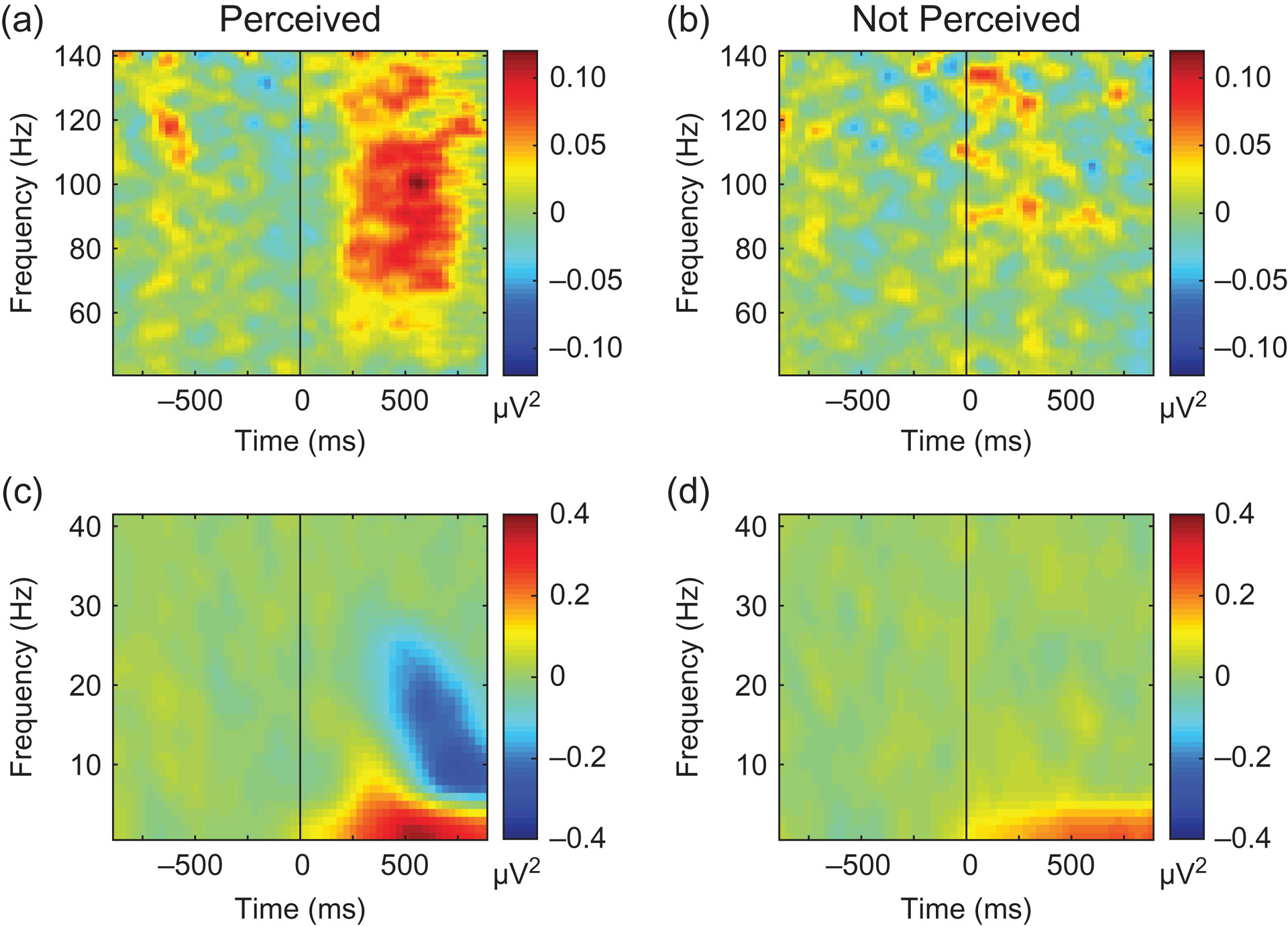
    Neurologists Capture What Happens in the Split Second Before Consciousness
    Overall view of changes through time–frequency analysis across all electrodes, subjects and trials. Both low and high frequency changes occurred during Perceived trials that were not present in Not Perceived trials. (a) 40–140 Hz power in Perceived trials. (b) 40–140 Hz power in Not Perceived trials. (c) 0.1–40 Hz power in Perceived trials. (d) 0.1–40 Hz power in Not Perceived trials. Marked broadband gamma frequency (40–140 Hz) power increases are seen in Perceived but not in the Not Perceived trials (a,b). In addition, delta range (0.1–4 Hz) power increased from baseline in both Perceived (c) and Not Perceived (d) trials, although with higher amplitude increases in Perceived trials. Perceived trials also had alpha (8–12 Hz) and beta power (12–30 Hz) increases and decreases that were absent in Not Perceived trials (c, d). Data for Perceived and Not Perceived trials were first averaged across electrodes within subjects and then results were averaged across all 9 subjects. Wendy X. Herman, et al., Cerebral Cortex, doi:10.1093/cercor/bhx327

    “Without consciousness, nothing else matters,” he said. “Our quality of life itself is tied to consciousness.”

    Reference: “A Switch and Wave of Neuronal Activity in the Cerebral Cortex During the First Second of Conscious Perception” by Wendy X Herman, Rachel E Smith, Sharif I Kronemer, Rebecca E Watsky, William C Chen, Leah M Gober, George J Touloumes, Meenakshi Khosla, Anusha Raja, Corey L Horien, Elliot C Morse, Katherine L Botta, Lawrence J Hirsch, Rafeed Alkawadri, Jason L Gerrard, Dennis D Spencer and Hal Blumenfeld, 29 November 2017, Cerebral Cortex.
    DOI: 10.1093/cercor/bhx327

    Never miss a breakthrough: Join the SciTechDaily newsletter.
    Follow us on Google and Google News.

    Cognitive Science Neurology Neuroscience Yale University
    Share. Facebook Twitter Pinterest LinkedIn Email Reddit

    Related Articles

    New Research Shows Seizures Knock Out Brain Arousal Centers

    Yale Research Shows Immune Cells Are an Ally, Not Enemy, in Battle Against Alzheimer’s

    New Research Identifies Enzyme Crucial to the Shaping and Division of Brain Cells

    Neurobiologists Block the Effects of Stress

    Study Shows Human Brain Development is Divided into Three Major Phases

    Suppressing NgR1 Returns Brain to Adolescent Levels of Plasticity

    Neurologists Repair Neurons Associated With Traumatic Nerve Injury Pain

    GATA1 Plays a Role in the Loss of Connections Between Neurons and in Symptoms of Depression

    Neuroscientists Create Model to Study Burst Suppression and Brain States

    1 Comment

    1. Vishnu on December 1, 2019 1:34 am

      I had repeated experiences years ago in my late 20s that, if I properly understand this article, seem to contradict it. I was living alone in a rural area and from a normal deep sleep would awaken, realize that I was awake & conscious, and THEN hear a loud chorus of frogs in a nearby pond. This happened over quite a few different nights and was so striking that I’ve always remembered it. It was like I had awakened and was conscious and then the frogs suddenly started up. But that was NOT the case. That could have happened one time perhaps but this experience occurred repeatedly over many nights. The loud frog chorus was probably what had actually awakened me but for a split second, probably milliseconds, I heard nothing even though consciousness had returned.

      Reply
    Leave A Reply Cancel Reply

    • Facebook
    • Twitter
    • Pinterest
    • YouTube

    Don't Miss a Discovery

    Subscribe for the Latest in Science & Tech!

    Trending News

    Monster Storms on Jupiter Unleash Lightning Beyond Anything on Earth

    Scientists Create “Liquid Gears” That Spin Without Touching

    The Simple Habit That Could Help Prevent Cancer

    Millions Take These IBS Drugs, But a New Study Finds Serious Risks

    Scientists Unlock Hidden Secrets of 2,300-Year-Old Mummies Using Cutting-Edge CT Scanner

    Bread Might Be Making You Gain Weight Even Without Eating More Calories

    Scientists Discover Massive Magma Reservoir Beneath Tuscany

    Europe’s Most Active Volcano Just Got Stranger – Here’s Why Scientists Are Rethinking It

    Follow SciTechDaily
    • Facebook
    • Twitter
    • YouTube
    • Pinterest
    • Newsletter
    • RSS
    SciTech News
    • Biology News
    • Chemistry News
    • Earth News
    • Health News
    • Physics News
    • Science News
    • Space News
    • Technology News
    Recent Posts
    • These Tiny Robots 50x Smaller Than a Hair Can Hunt and Move Bacteria
    • Simple Blood Test May Predict Alzheimer’s Years Before Brain Scans Show Signs
    • Scientists Say Adding This Unusual Seafood to Your Diet Could Reverse Signs of Aging
    • U.S. Waste Holds $5.7 Billion Worth of Crop Nutrients
    • Scientists Say a Hidden Structure May Exist Inside Earth’s Core
    Copyright © 1998 - 2026 SciTechDaily. All Rights Reserved.
    • Science News
    • About
    • Contact
    • Editorial Board
    • Privacy Policy
    • Terms of Use

    Type above and press Enter to search. Press Esc to cancel.