
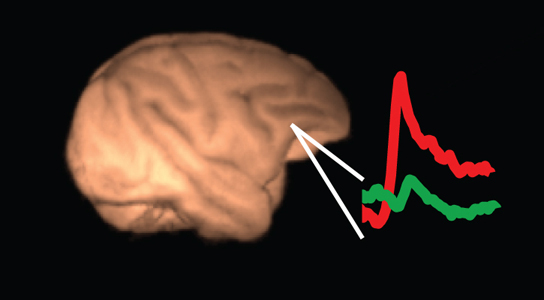
New research from scientists at the Max Planck Institute for Biological Cybernetics supports the view that the content of consciousness is not localized in a unique cortical area but, rather, that a global network of neurons from different areas of the brain is responsible for it.
Consciousness is a selective process that allows only a part of the sensory input to reach awareness. But up to today, it has yet to be clarified which areas of the brain are responsible for the content of conscious perception. Theofanis Panagiotaropoulos and his colleagues — researchers at the Max Planck Institute for Biological Cybernetics in Tübingen and University Pompeu Fabra in Barcelona — have now discovered that the content of consciousness is not localized in a unique cortical area, but is most likely an emergent property of global networks of neuronal populations.
The question which parts of the brain are responsible for the things that reach our awareness is one of the main puzzles in neurobiology today. Previous research on the brains of primates has shown that neurons in primary and secondary cortices provide poor representation of visual consciousness. In contrast, the neurons in the temporal lobe seem to reliably reflect the actual conscious perception of a visual stimulus. These findings indicated that not all parts of the brain are responsible for the content of conscious awareness. Nevertheless, the question of whether only one of the brain’s areas is responsible for the content of perception or whether more regions are involved in the process has so far remained unanswered.
The Max Planck scientists in Tübingen led by Nikos Logothetis have now addressed this issue using electrophysiological methods to monitor the neural activity in the lateral prefrontal cortex of macaque monkeys during ambiguous visual stimulation. The visual stimuli used allow for multiple perceptual interpretations, even though the actual input remained the same. In doing so, Panagiotaropoulos and his team were able to show that the electrical activity monitored in the lateral prefrontal cortex correlates with what the macaque monkeys actually perceive.
They thus concluded that visual awareness is not only reliably reflected in the temporal lobe, but also in the lateral prefrontal cortex of primates. The results depict that the neuronal correlates of consciousness are embedded in this area, which has a direct connection to premotor and motor areas of the brain, and is, therefore, able to directly affect motor output. These findings support the “frontal lobe hypothesis” of conscious visual perception established in 1995 by the researchers Crick (the co-discoverer of the structure of the DNA molecule) and Koch that awareness is related to neural activity with direct access to the planning stages of the brain.
The results support this theory in so far as they show that the lateral prefrontal cortex is involved in the process of visual awareness. However, the fact that neural activity in two different cortical areas reflects conscious perception shows that the decision which sensory input reaches our awareness is most likely not made in a unique cortical area but, rather, that a global network of neurons from different areas of the brain is responsible for it. “Our results, therefore, broaden the hypothesis and create new questions regarding the cortical mechanisms of visual awareness”, Panagiotaropoulos explains. In the near future, the group is going to record the electrical activity in both regions simultaneously.
By this, they will try to find out which of the two areas is activated first and draw conclusions on how the two areas interact with each other during conscious perception. This may lead to a better understanding of why only certain things reach our awareness and others remain suppressed.
Reference: “Neuronal Discharges and Gamma Oscillations Explicitly Reflect Visual Consciousness in the Lateral Prefrontal Cortex” by Theofanis I. Panagiotaropoulos, Gustavo Deco, Vishal Kapoor and Nikos K. Logothetis, 7 June 2012, Neuron.
DOI: 10.1016/j.neuron.2012.04.013
Never miss a breakthrough: Join the SciTechDaily newsletter.
Follow us on Google and Google News.
1 Comment
Change title of this article to…
…Selective Perception from a Global Network of Neurons
That consciousness and awareness…is not physicalness is not perceptiveness…
…but we can’t have one with out the other…for…