
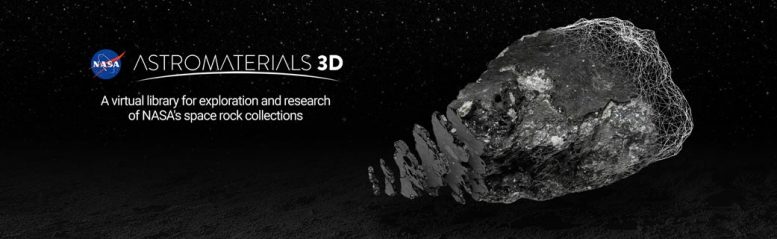
NASA’s New 3D Explorer Brings Lunar and Meteorite Samples Online.
NASA’s astromaterials sample collections, which include a library of Apollo lunar and Antarctic meteorite samples, are now offered online through a new virtual exploration tool for scientific researchers and the public. The Astromaterials 3D Explorer site offers an unprecedented research tool to engage the public in a new way to explore the significance of NASA’s space rock collections.
Virtually sharing the Apollo samples, which were collected around 50 years ago, is particularly timely as NASA is preparing to send a new group of astronauts to the Moon with the Artemis lunar exploration program. The agency’s return to the Moon will see robots and humans exploring more of the Moon – and collecting more samples than ever before.
The samples featured on the website have been stored on Earth been kept secluded in pristine condition since crashing into Earth or being picked up by Apollo astronauts combing through lunar soil.
“Most of the samples are preserved for scientific research. There are some subsamples available for educators or in exhibitions and installations around the world, but most of the collection is in a vaulted cleanroom facility for their preservation and protection,” said Erika Blumenfeld, transdisciplinary artist, and principal investigator and project lead for 3D Astromaterials science, at NASA’s Johnson Space Center in Houston. “Finding a way to make these samples more accessible is part of our goal to expand people’s knowledge of the samples and exploration.”
A Visual Voyage
Through the new site, a researcher, curious child, and everyone in between can, “in a sense, hold the rocks in their hands,” Blumenfeld said.
The website also offers a virtual voyage through the Milky Way before viewers can dive into learning about a specific sample.
“Our goal is to make the user feel as though they are inside the inner solar system or the asteroid belt,” Blumenfeld said. “We see meteorites, we read about them, and we know about the Moon rocks, but Astromaterials 3D really brings this sense of imagination and exploration in a visceral and visual way.”
Then, by selecting a sample, “people can actually interact with the rocks individually and have the opportunity to wonder, to ask questions, to study and do research,” Blumenfeld said.
Showcase of Stories
“I think of every rock as having its own origin story,” Blumenfeld said. “Rocks are storytellers, time travelers … I was inspired listening to geologists talk about their particular interest in some geologic process. Inevitably, you will always hear them say, ‘But the story is in the rock.’”
Viewers navigating through the samples on the site can follow each rock’s history, learning what happened to the rock — and follow it to its ultimate destination, like Antarctica in the case of the meteorites.
For some of the samples collected on the Moon, there’s an option to watch actual footage of the specimen being collected by the astronaut. Included on the website is the first sample ever collected on the Moon — the contingency sample from Apollo 11 picked up by astronaut Neil Armstrong — and three from Apollo 17. Additional “Apollo-era footage will become available as more missions come online.

Science About Matter … Matters
Perhaps most meaningful to scientists, each sample offers cutting-edge views of the matter within — without having rely on destructive techniques to examine its makeup and origins.
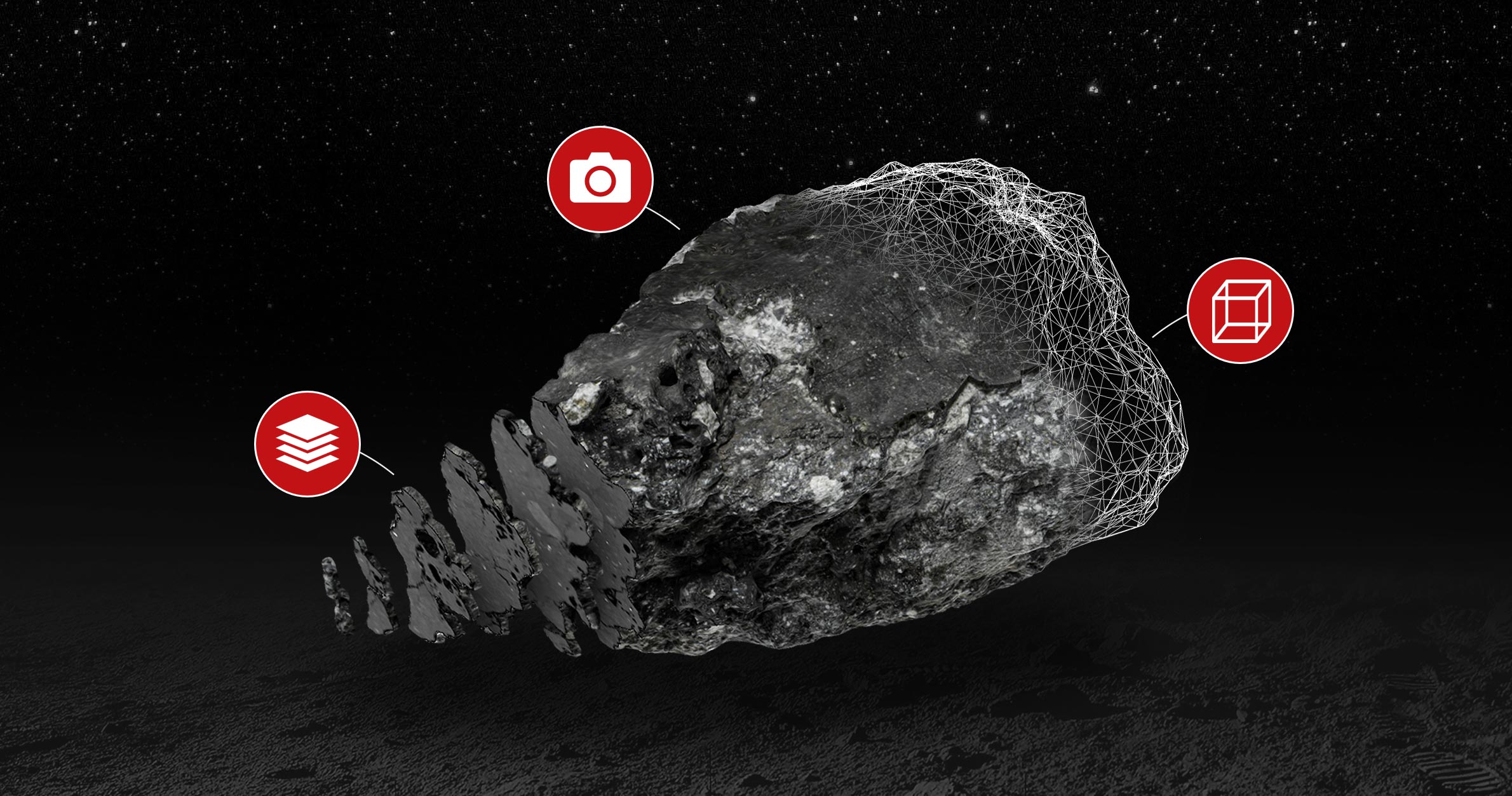
On the website is a “digitized version of the rock, a 3D visualization of the real thing,” Blumenfeld noted. “So it’s using current technology to achieve a high-enough resolution, what we call a research-grade 3D model.”
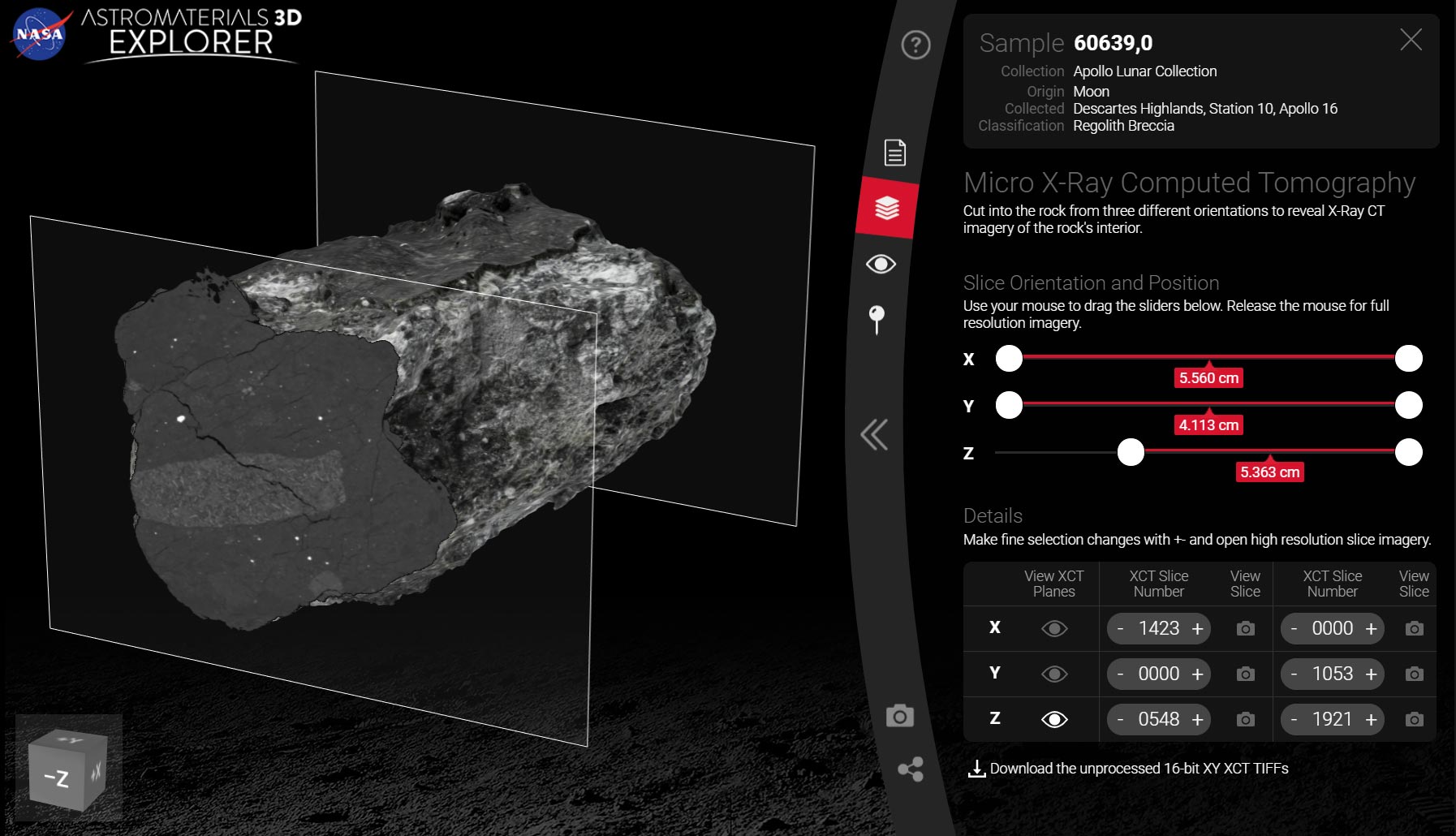
To create these models the multidisciplinary team manually photographed the rocks, at minimum, from 240 different angles in a nitrogen cabinet in the cleanroom using super-high resolution photography. Then each one was scanned using X-ray computed tomography (CT).
The internal and external scans are integrated into one on the Explorer site, where you can see both the inside and outside of the specimen simultaneously and virtually dissect it.
This modernization of documentation practices in the field of curation creates better opportunities for targeted science, too. “It’s a new first step for analyses, because the CT scans provide some analysis in and of itself — and that data can now be downloaded and brought into other software programs that a researcher can then interrogate and make pretty good determinations about what the thing is made of,” Blumenfeld said.
Sharing All of NASA’s Collection
The site currently includes 10 meteorites and 10 lunar samples. By early summer 2021, additional samples from NASA’s astromaterials sample collection will be available.
“Rocks have sparked curiosity and wonder in us from the beginning,” Blumenfeld said. “I think there’s been this incredible relationship between humans and rocks for as long as we’ve been on the planet. And, the fact that these rocks also refer to our planet and how our planet formed, and what’s beyond our planet, is really what my motivation is. It’s about linking these incredible connections across the whole cosmos, understanding that we are inextricably linked to them. It’s through the study of astromaterials that we were finally able to correlate that we are made of stars.”
And while our own origins may be easier to trace, people around the world will now be able to do their own investigations into where and how it all began.
The site was created by a team in the Astromaterials Research and Exploration Science Division at NASA Johnson.
Never miss a breakthrough: Join the SciTechDaily newsletter.
Follow us on Google and Google News.
1 Comment
Best..