
Researchers have discovered that fungi, despite lacking brains, exhibit forms of intelligence such as memory, learning, and decision-making.
Through experiments, fungi demonstrated strategic growth patterns when exposed to different physical setups, suggesting a form of communication within their mycelial networks. This groundbreaking study reveals the complex and intelligent behaviors of fungi, challenging our understanding of cognition in simple organisms.
Exploring Fungal Intelligence
Can organisms without a brain still show signs of intelligence? Researchers at Tohoku University and Nagaoka College had this question in mind when conducting a study to measure the decision-making processes in fungi. While it may sound like science fiction, this level of basal cognition is possible even in fungi.
“You’d be surprised at just how much fungi are capable of,” remarks Yu Fukasawa of Tohoku University, “They have memories, they learn, and they can make decisions. Quite frankly, the differences in how they solve problems compared to humans is mind-blowing.”

The Underground Network
Fungi grow by releasing spores, which can germinate and form long, spidery threads underground (a mycelium). We typically only see the tiny mushrooms on the surface without realizing that there’s a vast network of interconnected mycelium beneath our feet. It is through this network that information can be shared, somewhat like neural connections in the brain.
Fungal Decision-Making Observed
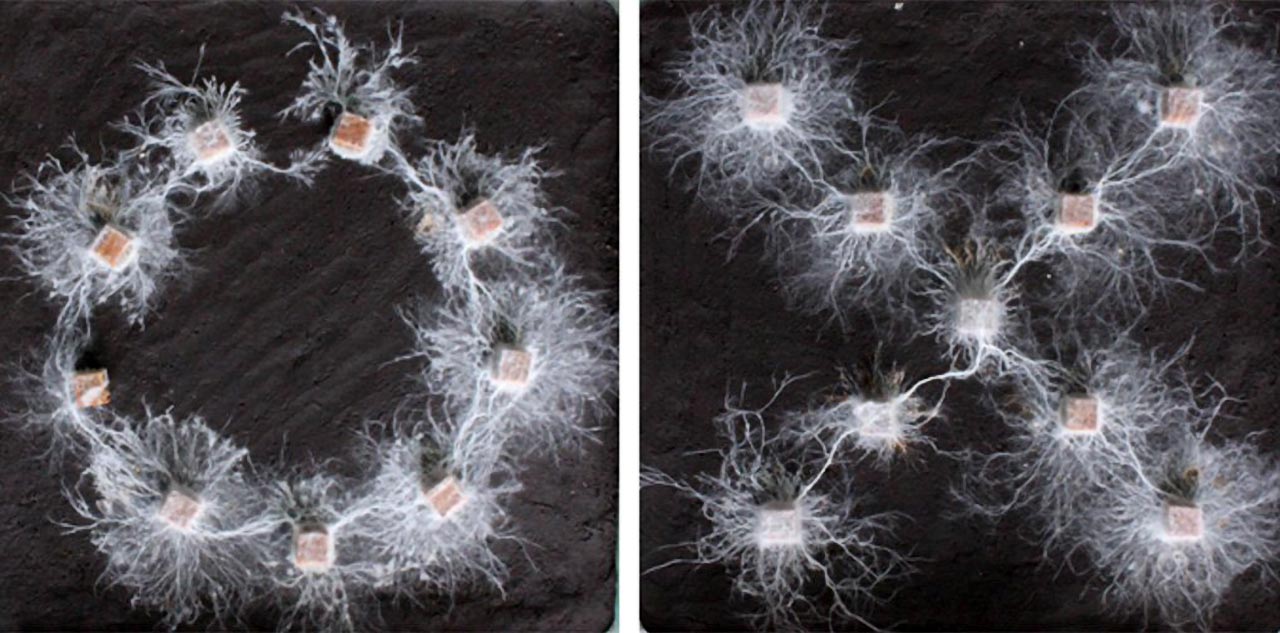
The present study examined how a wood-decaying mycelial network responded to two different situations: wood blocks placed in a circle versus cross arrangement. For example, if the fungi didn’t display decision-making skills, they would simply spread out from a central point without consideration for the position of the blocks. Remarkably, this is not what the researchers witnessed.
For the cross arrangement, the degree of connection was greater in the outermost four blocks. It was hypothesized that this was because the outermost blocks can serve as “outposts” for the mycelial network to embark in foraging expeditions, therefore more dense connections were required. In the circle arrangement, the degree of connection was the same at any given block. However, the dead center of the circle remained clear. It was proposed that the mycelial network did not see a benefit in overextending itself in an already well-populated area.
Implications for Understanding Fungal Ecology
These findings suggest that the mycelial network was able to communicate information about its surroundings throughout the entire network, and change its direction of growth accordingly based on the shape.
Our comprehension of the mysterious world of fungi is limited, especially when compared to our knowledge of plants and animals. This research will help us better understand how biotic ecosystems function and how different types of cognition evolved in organisms.
These results were published in the journal Fungal Ecology.
Reference: “Spatial resource arrangement influences both network structures and activity of fungal mycelia: A form of pattern recognition?” by Yu Fukasawa, Kosuke Hamano, Koji Kaga, Daisuke Akai and Takayuki Takehi, 12 September 2024, Fungal Ecology.
DOI: 10.1016/j.funeco.2024.101387
Never miss a breakthrough: Join the SciTechDaily newsletter.
Follow us on Google and Google News.
4 Comments
Since intelligence has not been defined yet, but dumbness has the headline is a joke.
Fungi as such have no more intelligence than the average citizen or any company executive: they are looking for the best resources (CEO’s have to). And when they are found they concentrate their efforts on them and try to thrive. And as soon as the resources are expired they move on to the next food source and discard the least nutritional one.
The behavior of fungi is purely mathematical: How can I thrive best with the least effort.
WHY are some vegetarians and justify it, as others even eat raw meat and justify it!!
Which of the two mathematics is the correct one – and what does this show on who is qualified to teach others and lead others!?
Also
What does this show about your own ideas, which you have written here – is it true or is it false!? Should others accept it and follow it!!??
The proof of all these questions would include not just irrevocable statements of facts, but also your surpassing all other beings and/or entities in existence – SO everyone would confirm that your own mathematical thriving with the least effort is the correct one!
Authors (Fukasawa et al.) should be banned and openly ridiculed. If they have any funding, it should be pulled immediately. Oh, and if they do have funding, the proposal reviewers that approved the funding should also be sacked. This is not “intelligence”. It is simply a case of “resources (i.e., chemicals needed to sustain cellular function) are better over here (hence cell growth); resources are not better over here, so no cell growth in that area.”
How is this not a form of intelligence? Its adapting, problem solving, and learning, you’re the one who should be ridiculed for undercutting research on fungi and the importance of mycelial networks, which exist on every continent under everything you walk over