
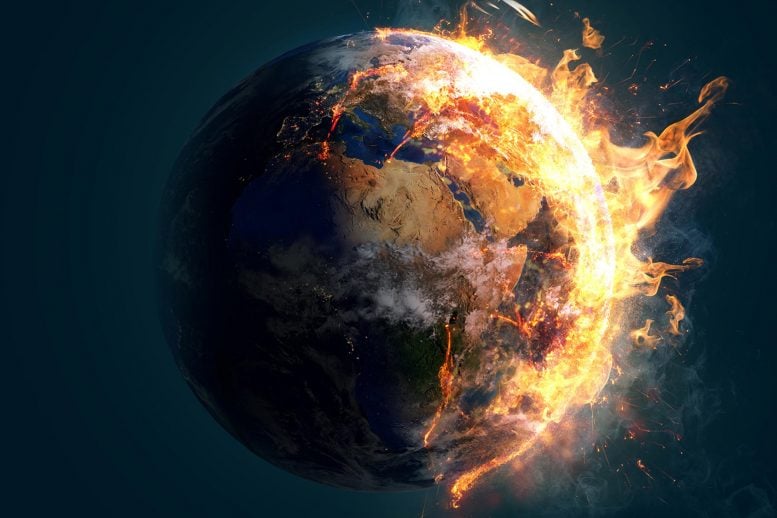
IPCC’s new report confirms that climate change is worsening rapidly due to human actions.
UN scientists recently released a landmark study detailing humanity’s damaging impact on the climate as a ‘statement of fact’, and revealing that ongoing emissions of warming gases could see a key temperature limit broken in just over a decade.
The 42-page document from the Intergovernmental Panel on Climate Change (IPCC) also states that a rise in sea levels approaching 2m by the end of this century ‘cannot be ruled out’.
The assessment report is the first in a series, which will be released in four stages over the next year. Its publication comes less than three months before the UN Climate Change Conference, COP26, hosted by the UK and due to take place in Glasgow in November.
Experts from the University of Sussex have been responding to the report, which is the first major review of climate change science since 2013.
Benjamin Sovacool Professor of Energy Policy in the Science Policy Research Unit (SPRU) and Director of the Sussex Energy Group, was involved in the IPCC report as lead author for chapters on Mitigation, and contributing author for chapters on Energy Systems and Transport. He said:
“The report, while complex, carries a sobering and simple message: we are on a track to true climate catastrophe. And while the science is sound, research is needed to examine why and under which conditions initiatives can be a successful driver of change, and which policies, institutional changes, governance structures, and legal regimes would support changes.”
“In order to ensure that global warming does not exceed 2°C ( 3.6°F) temperature levels, rapid, transformative, and sustained action is needed. The world is set to use up its carbon budget in a matter of years, not decades. We must act with an urgency unlike any other challenge facing human history.”
Extreme Weather Events Confirm Scientific Predictions
Professor Joseph Alcamo is the former Chief Scientist of the United Nations Environment Programme and has co-authored IPCC reports since 1995. Now, as Professor of Environmental Systems Science and Director of the Sussex Sustainability Research Programme (SSRP), he said:
“The predictions of the IPCC report, as well as the heat waves, floods, and wildfires we’re experiencing day to day, are deplorable but not surprising. For at least three decades the main science has been clear on climate change, but for three decades our response has been too weak.
“A stronger response will have to come from all parts of society, and sooner or later the fight against climate change will have to be linked up with our other big fights … against poverty, hunger, and inequality.”
Research Underscores Links Between Climate, Health, and Displacement
Dr. Sonja Ayeb-Karlsson, Senior Researcher in Climate Change, Health, and Migration, and an IPCC expert reviewer, said:
“This is an incredibly important report which clearly states the looming, and very real, dangers and risks posed by climate change. From the impacts of extreme heat events upon outdoor labor’s safety and productivity, to the links between air pollution and declining health, and increasing sea level rise that could lead to forced movements and displacement.
“The assessment highlights important findings from a vast body of scientific research, such as the Lancet Countdown reports of which I am a co-author. We need substantive changes to help protect our planet and humanity.”
Dr. Melissa Lazenby, Lecturer in Climate Change, said:
“It could not be more timely for the 6th IPCC assessment report to come out today. Experiencing and living through a pandemic and having to quickly create policies based on the science should be a lesson learned and one taken forward with the latest climate science that the AR6 has now provided in their latest report.
“Most of the globe now experiences some form of climate impacts due to human activity that has caused the rapid warming trends we have been experiencing. This will only worsen, and we have clear scientific evidence of the cause of this warming. It is time to act globally on this very pressing issue and reduce our emissions with the guidance and leadership of all countries.
“The AR6 report could not be clearer, the scientific evidence could not be clearer – action is required now.”
Never miss a breakthrough: Join the SciTechDaily newsletter.
Follow us on Google and Google News.
7 Comments
Apparently Sussex didn’t get the memo that COP26 has been postponed.
The illustration is the graphical equivalent of hyperbole! Earth has been warmer than the much feared 1.5 degree ‘tipping point’ several times and it wasn’t the end of life. While some extinction events are associated with warming, the Mother of All Warming, the Paleocene-Eocene Thermal Event, is known for the rapid evolution and expansion of mammalian life.
Yes there have been times when the Earth was warmer,,,thats not the point as
in those conditions humans would not have survived
Why do you say that humans would not have survived? Much of the world’s population lives in the tropics. People live in the Sahara and the Australian Outback.
But those people have lived in relative to modern standards poverty on a minimal basis for millenia.
Us western folks are not interested in that kind of aboriginal life style unless we can have a serious amount of energy to keep us cool and well fed with Qatar like energy consumption would do the trick nicely except its all petro based.
Have these scientists prove global warming is from Man, not the Sun
And don’t give us that crap that we are climate deniers
Teraform Earth before Mars to convert more CO2 to O2
Do so with the highest photosynthesizing foliage
Eliminate coal fired power plants by UN edict. China and India are the worst culprits and must be reigned in.
Edict electric vehicles only if we do it with clean energy
Restore and multiply nuclear power which is the cleanest full time energy sources
Develop a plan to stop bunny rabbit population growth
The damage cannot be undone and only mitigation strategies will be employed. These mitigation strategies may turn the click back on the inevitable but not enough to prevent catastrophic loss of flora and fauna necessary to sustain our planet. The most pressing issue is water. We will all die without it. Gotta address that first.