

A crucial ocean layer essential to the dynamics of the El Niño–Southern Oscillation (ENSO).
A recent study published in the Journal of Geophysical Research: Oceans reports a marked acceleration in upper-ocean circulation within the equatorial Pacific over the last three decades.
The primary driver of this acceleration is intensified atmospheric winds, resulting in stronger and shallower ocean currents. These changes may influence regional and global climate patterns, potentially affecting the frequency and intensity of El Niño and La Niña events. The study offers a spatial perspective on these long-term trends based on observational data, extending insights by at least another decade beyond previous research.
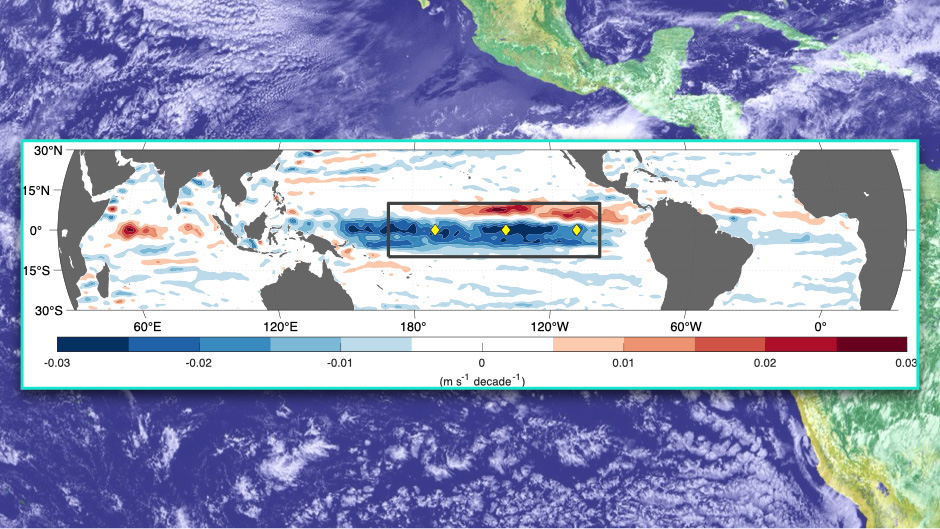
The research team, led by Franz Philip Tuchen, a postdoctoral scientist at the University of Miami Rosenstiel School’s NOAA Cooperative Institute for Marine and Atmospheric Studies (CIMAS), in collaboration with NOAA’s Atlantic Oceanographic and Meteorological Laboratory (AOML), synthesized thirty years of long-term ocean and atmosphere observations from satellites, mooring buoys, and ocean surface drifters.
By integrating the reanalysis of wind data and satellite altimetry into a high-resolution, gridded time series of near-surface ocean currents, this study presents a new and comprehensive view to date of the changes in the Pacific upper-ocean circulation.
Findings: Accelerated Currents and Potential Climate Impacts
The research findings indicate that stronger winds across the equatorial Pacific have caused a notable acceleration of westward near-surface currents by approximately 20 percent in the central equatorial Pacific. Poleward currents north and south of the equator have also accelerated, with increases of 60 percent and 20 percent, respectively.
“The equatorial thermocline—a critical ocean layer for El Niño–Southern Oscillation (ENSO) dynamics—has steepened significantly,” said Tuchen. “This steepening trend could reduce ENSO amplitude in the eastern Pacific and favor more frequent central Pacific El Niño events, potentially altering regional and global climate patterns associated with ENSO.”
The researchers indicate the study offers a benchmark for climate models, which have had limited success to accurately represent Pacific circulation and sea surface temperature trends. The researchers suggest the findings could help improve the predictability of ENSO events and related weather patterns, especially for regions like the United States, which experience significant climate variability from ENSO-driven changes.
Reference: “Strengthening of the Equatorial Pacific Upper-Ocean Circulation Over the Past Three Decades” by Franz Philip Tuchen, Renellys C. Perez, Gregory R. Foltz, Michael J. McPhaden and Rick Lumpkin, 31 October 2024, Journal of Geophysical Research: Oceans.
DOI: 10.1029/2024JC021343
Funding for this study was provided by NOAA’s Global Ocean Monitoring and Observing (GOMO) programs, including the Global Tropical Moored Buoy Array (GTMBA), the Global Drifter Program (GDP), and the Tropical Atmosphere Ocean (TAO) program.
Never miss a breakthrough: Join the SciTechDaily newsletter.
Follow us on Google and Google News.
28 Comments
A national phenomenon, not man caused.
A Natural Phenomenon…
Gart: A Natural Moron.
Perhaps you would be good enough to share with us how one distinguishes a long-term trend from natural variation when the recent change only covers a few years.
One letter too far😊
Most likely he is right.
So climate models are not acurate? Well there’s a surprise!! Climates are forever changing and scientists need funding so…..fear is the preferred scientific conclusion to all studies. Plants need CO2 and the world is 15% greener in the last 20 years. Plants don’t need scientists.
Right on Edgar.
Mother Nature does, whatever she wants to and if ALL of the mammals, birds and reptiles have been around a long, long time, she most certainly will take care of us. I trust her over scientists.
Beverly: Please share your “Mother Nature” wisdom with the Sabre Tooth Tiger, Wooly Mammoth, and Dodo bird … oh wait, you can’t 🙁
The Passenger pigeon is the most recent, previously abundant/widespread example.
Scared, hide in my pocket.
Exactly
Man has been doing wrong from the beginning of civilization while trying to control everything and we are now at the Tipping point we can not move from. All the countries have put us here.
Long before civilization, people resorted to such things as fires to kill animals directly or concentrate them into small areas where they could be killed more easily. Then there was the practice of American indigenous people of driving bison over cliffs (aka buffalo jumps) and primarily taking the delicacies while leaving the rest to rot.
At this point, should we even care?
Even if you only ever read this magazine, you’ll find so many contradictory articles on the topic of climate that you’ll realize they really don’t know jack. And this is just one of many such magazines.
I was once told by an expert on ‘Abuse ‘ that the reason people do not accept what the abused says is because, accepting that evidence would require action to support the abused and confront the abuser. It seems to be the same with climate change – it demands accepting the evidence and behaving differently because of it.
yes, exactly, and when it requires a consumer to give up their gas guzzler truck, it causes denial
Some people deny climate change because they look deeper into the subject instead of just listening to main stream media and scientist that are paid to push climate change.
The real reason behind this climate change push is so they can control you and the rest of the population.
Your explanation is bollocks and I’m a direct proof. I don’t believe in climate change and I don’t even own a car. There’s no behavior I’d have to modify over this agenda.
But I’ve seen the seminal paper on how they reached the “scientific consensus” on “climate change”. And it’s just one big forgery.
So, tell me again what’s the evidence I ought to accept?
Right on Boba !!!
The problem is that there is contradictory evidence and alarmists only present the evidence that supports their position. They also tend to use the language of lawyers (could, may, might, possibly, etc.) instead of the the language of science — mathematics. Alarmists rarely include the margin of error when they give averages, and when they do, they typically only use one standard deviation (68% probability) instead of the two standard deviations (95%) common to most other disciplines. That is because the 95% confidence interval is usually so large as to say very little about the precision of the measurements, and only restricting to conclusions to being a small number with a positive sign.
thermodynamics make sense, as global warming increase the heat content of the oceans, ocean currents will increase to transfer that heat
“…, ocean currents will increase to transfer that heat …”
Only if there is a thermal gradient. As it is, with the Arctic apparently warming 2-4X faster than the rest of the world, the gradient is probably decreasing.
Geologic records over eons show consistent peaks in global temperatures, followed by an ice age. Earth has nearly reached the peak, and humans may be speeding it up.
“They also tend to use the language of lawyers (could, MAY, might, possibly, etc.) instead of the the language of science — mathematics.”
The climate and extreme weather is changing. Governments will make policy changes. Individual responsibility, = adapt, store water, move from the flood plain, or coastal house, grow your own food supply. Strange that houses very closeto sea level, are still being built and 🌊 are rising in cost, in most developed countries 🤔.
If governments didn’t reimburse people when they make poor economic decisions, such as building on flood plains or storm-battered coasts, they might decide to invest in some education and find other places to site their homes and businesses. As it is, there is little incentive to stop making poor decisions because they will expect either insurance companies or government flood relief to bail them out.