

Close Menu
    Facebook X (Twitter) Instagram
    SciTechDaily
    • Biology
    • Chemistry
    • Earth
    • Health
    • Physics
    • Science
    • Space
    • Technology
    Facebook X (Twitter) Pinterest YouTube RSS
    SciTechDaily
    Home»Physics»Physicists Create World’s Smallest Engine – 10 Billion Times Smaller Than a Car Engine
    Physics

    Physicists Create World’s Smallest Engine – 10 Billion Times Smaller Than a Car Engine

    By Trinity College DublinAugust 24, 2019No Comments3 Mins Read
    Facebook Twitter Pinterest Telegram LinkedIn WhatsApp Email Reddit
    Share
    Facebook Twitter LinkedIn Pinterest Telegram Email Reddit
    The World's Smallest Engine
    The world’s smallest engine works due to its intrinsic spin, which converts heat absorbed from laser beams into oscillations, or vibrations, of the trapped ion. Credit: Professor Goold, Trinity College Dublin.

    Theoretical physicists at Trinity are among an international collaboration that has built the world’s smallest engine – which, as a single calcium ion, is approximately ten billion times smaller than a car engine.

    Work performed by Professor John Goold’s QuSys group in Trinity’s School of Physics describes the science behind this tiny motor.

    The research, published in the international journal Physical Review Letters, explains how random fluctuations affect the operation of microscopic machines. In the future, such devices could be incorporated into other technologies in order to recycle waste heat and thus improve energy efficiency.
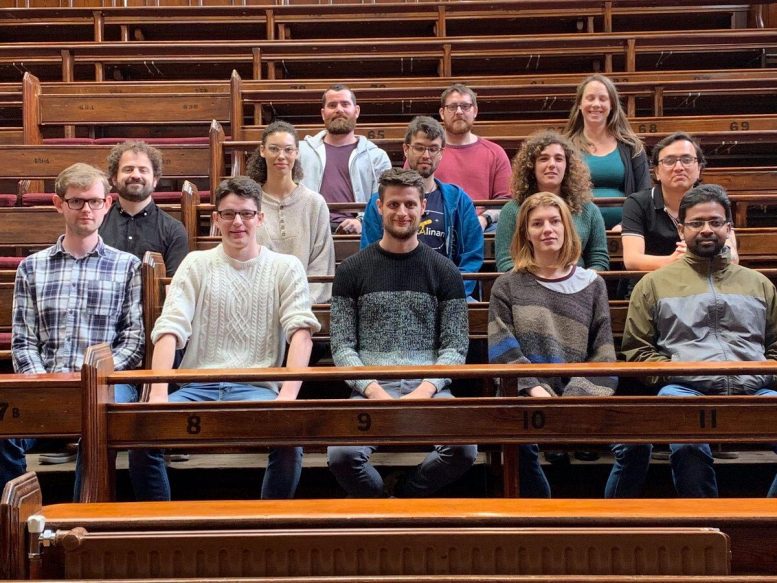
    Trinity College Dublin Researchers
    The QuSys research group from Trinity College Dublin’s School of Physics, with Professor John Goold pictured in the back row, first left. Credit: Professor Goold, Trinity College Dublin.

    The groundbreaking experiment was carried out by a research group led by Professor Ferdinand Schmidt-Kaler and Dr. Ulrich Poschinger of Johannes Gutenberg University in Mainz, Germany.

    The engine itself – a single calcium ion – is electrically charged, which makes it easy to trap using electric fields. The working substance of the engine is the ion’s intrinsic “spin” (its angular momentum). This spin is used to convert heat absorbed from laser beams into oscillations, or vibrations, of the trapped ion.

    These vibrations act like a “flywheel”, which captures the useful energy generated by the engine. This energy is stored in discrete units called “quanta”, as predicted by quantum mechanics.

    “The flywheel allows us to actually measure the power output of an atomic-scale motor, resolving single quanta of energy, for the first time,” said Dr. Mark Mitchison of the QuSys group at Trinity, and one of the article’s co-authors.

    Starting the flywheel from rest — or, more precisely, from its “ground state” (the lowest energy in quantum physics) — the team observed the little engine forcing the flywheel to run faster and faster. Crucially, the state of the ion was accessible in the experiment, allowing the physicists to precisely assess the energy deposition process.

    Assistant Professor in Physics at Trinity, John Goold said: “This experiment and theory ushers in a new era for the investigation of the energetics of technologies based on quantum theory, which is a topic at the core of our group’s research. Heat management at the nanoscale is one of the fundamental bottlenecks for faster and more efficient computing. Understanding how thermodynamics can be applied in such microscopic settings is of paramount importance for future technologies.”

    ###

    Professor Goold’s QuSys group is supported by a recently awarded ERC Starting Grant and an SFI-Royal Society University Research Fellowship.

    The groundbreaking experiment was carried out by a research group led by Professor Ferdinand Schmidt-Kaler and Dr Ulrich Poschinger of Johannes Gutenberg University in Mainz, Germany.

    References: “Spin Heat Engine Coupled to a Harmonic-Oscillator Flywheel” by D. von Lindenfels, O. Gräb, C. T. Schmiegelow, V. Kaushal, J. Schulz, Mark T. Mitchison, John Goold, F. Schmidt-Kaler and U. G. Poschinger, 22 August 2019, Physical Review Letters.
    DOI: 10.1103/PhysRevLett.123.080602

    Never miss a breakthrough: Join the SciTechDaily newsletter.
    Follow us on Google and Google News.

    Engine Trinity College Dublin
    Share. Facebook Twitter Pinterest LinkedIn Email Reddit

    Related Articles

    How Tiny Bubbles Are Supercharging Your Car’s Engine

    2,000-Year-Old Mystery: Scientists Discover Paradoxical Quantum Cooling Effect

    Physicists Rewrite Quantum Rules – New Theories Could Revolutionize Materials Science

    Quantum Leap: Physicists Successfully Simulate Super Diffusion

    Shocking Experiment Indicates Our Brains Use Quantum Computation

    Physicists Unlock Secret to Synchronization – From Flashing Fireflies to Cheering Crowds

    Maxwell’s Demon: A Uniquely Quantum Effect in Erasing Information Discovered

    Ultra-Fast Magnetic Switching Could Transform Fiber Optic Communications & Expand the Capacity of the Internet

    Theoretical Physicists Find Deep Link Between Quantum Entanglement and Thermalization

    Leave A Reply Cancel Reply

    • Facebook
    • Twitter
    • Pinterest
    • YouTube

    Don't Miss a Discovery

    Subscribe for the Latest in Science & Tech!

    Trending News

    Popular Sugar-Free Sweetener Linked to Liver Disease, Study Warns

    What Is Hantavirus? The Deadly Disease Raising Alarm Worldwide

    Scientists Just Discovered How the Universe Builds Monster Black Holes

    Scientists Unveil New Treatment Strategy That Could Outsmart Cancer

    A Simple Vitamin May Hold the Key to Treating Rare Genetic Diseases

    Scientists Think the Real Fountain of Youth May Be Hiding in Your Gut

    Ravens Don’t Follow Wolves, They Predict Them

    This Common Knee Surgery May Be Doing More Harm Than Good

    Follow SciTechDaily
    • Facebook
    • Twitter
    • YouTube
    • Pinterest
    • Newsletter
    • RSS
    SciTech News
    • Biology News
    • Chemistry News
    • Earth News
    • Health News
    • Physics News
    • Science News
    • Space News
    • Technology News
    Recent Posts
    • Why Are So Many New Fathers Dying? Scientists Say the U.S. Has a Dangerous Blind Spot
    • Scientists Identify Simple Supplement That Greatly Reduces Alzheimer’s Damage
    • You May Have a Dangerous Type of Cholesterol Even if Your Tests Look Normal
    • Study Reveals Dangerous Flaw in AI Symptom Checkers
    • New MRI Breakthrough Captures Stunningly Clear Images of the Eye and Brain
    Copyright © 1998 - 2026 SciTechDaily. All Rights Reserved.
    • Science News
    • About
    • Contact
    • Editorial Board
    • Privacy Policy
    • Terms of Use

    Type above and press Enter to search. Press Esc to cancel.