
A new theoretical framework shows how subtle fluctuations in spacetime could be detected using existing interferometers.
Researchers led by the University of Warwick have created a single, practical roadmap for hunting “spacetime fluctuations,” the tiny random ripples that many quantum gravity ideas suggest could be woven into spacetime itself.
The possibility that spacetime is not perfectly smooth was raised decades ago by physicist John Wheeler. Since then, multiple leading approaches to quantum gravity have pointed to some form of underlying jitter. The problem is that these theories do not agree on the details. Different models imply different patterns of randomness, so experiments have not had a clear, shared target for what a real signal should look like.
In a new Nature Communications study, the team tackles that mismatch by organizing the possibilities into three broad classes based on how structured the fluctuations are across space and time. Instead of asking experimentalists to chase one specific theory, the framework starts from the mathematical description of a hypothesized fluctuation and works forward to what an instrument should measure.
Interferometers do not measure spacetime directly. They compare the travel time of laser light along different paths, making them extraordinarily sensitive to minute changes in length. The researchers show how each category of fluctuation would imprint a distinct signature in interferometer data, from the 4km long LIGO detector to smaller laboratory instruments such as QUEST and GQuEST being developed in the UK (Cardiff University) and USA (Caltech) respectively.
Turning Theory Into Measurable Signals
Dr. Sharmila Balamurugan, Assistant Professor, University of Warwick and first author said: “Different models of gravity predict very different underlying trends in the random spacetime fluctuations, and that has left experimentalists without a clear target. Our work provides the first unified guide that translates these abstract, theoretical predictions into concrete, measurable signals.”
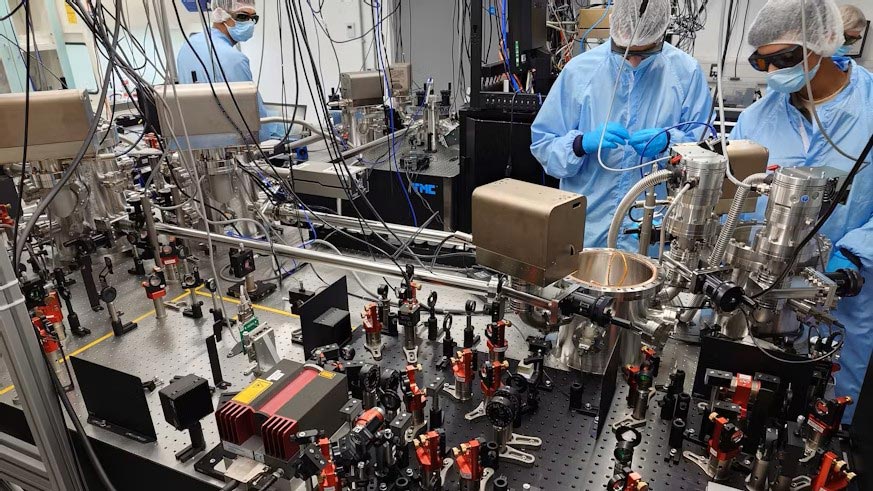
She continues, “It means we can now test a whole class of quantum-gravity predictions using existing interferometers, rather than waiting for entirely new technologies. This is an important step towards bringing some of the most fundamental questions in physics firmly into the realm of experiment.”
What the Study Reveals About Interferometers
The study found that:
- Tabletop interferometers beat LIGO in bandwidth
- Although they are much smaller than LIGO, QUEST and GQuEST may be able to reveal more detailed information about the character of spacetime fluctuations. Their broad frequency coverage enables them to capture all of the predicted signatures.
- LIGO is an excellent “yes/no” detector.
- Because of its long arm cavities, LIGO is extremely sensitive to whether spacetime fluctuations are present at all, even though the relevant frequencies are higher than those currently available in public datasets.
- A long-running debate is resolved.
- The study resolves ongoing disagreement over the role of arm cavities in detection. The results show that arm cavities can increase an interferometer’s sensitivity to spacetime fluctuations, depending on the specific type of fluctuation being examined.
Dr. Sander Vermeulen, Caltech, co-author of the study said: “Interferometers can measure spacetime with extraordinary precision. However, to measure spacetime fluctuations with an interferometer, we need to know where, i.e., at what frequency, to look, and what the signal will look like. With our framework, we can now predict this for a wide range of theories. Our results show that interferometers are powerful and versatile tools in the quest for quantum gravity.”
Broader Implications Beyond Quantum Gravity
Crucially, the new framework developed here is agnostic of the underlying mechanism for the fluctuations: it requires only the mathematical description of the hypothesized fluctuations and the geometry of the instrument. This makes it a powerful tool not only for quantum-gravity tests but also for searches for stochastic gravitational waves, dark-matter signatures, and certain forms of instrumental noise.
Prof Animesh Datta, Professor of Theoretical Physics at Warwick, concluded: “With this methodology, we can now treat any proposed model of spacetime fluctuations in a consistent, comparable way. In the coming years, we can use this to design smarter tabletop interferometers to confirm or refute possible theories of quantum or semiclassical gravity and even test new ideas about dark matter and stochastic gravitational waves.”
Reference: “Signatures of correlation of spacetime fluctuations in laser interferometers” by B. Sharmila, Sander M. Vermeulen and Animesh Datta, 23 December 2025, Nature Communications.
DOI: 10.1038/s41467-025-67313-3
This work was funded by the UK STFC “Quantum Technologies for Fundamental Physics” program (Grant Numbers ST/T006404/1, ST/W006308/1 and ST/Y004493/1) and the Leverhulme Trust under research grant ECF-2024-124 and RPG-2019-022.
Never miss a breakthrough: Join the SciTechDaily newsletter.
Follow us on Google and Google News.
11 Comments
With this methodology, we can now treat any proposed model of spacetime fluctuations in a consistent, comparable way.
VERY GOOD.
Please ask researchers to think deeply:
If vacuum has ideal fluid physical characteristics, can you observe the spacetime fluctuations formed by topological phase transitions in vacuum? Can this be seen as a natural transition from ideal to reality?
As a senior lay American male I have been demonstrating the ‘induced radiant coherent pulsing angular lines of motive force in all matter’ nature of gravity in cheaply and easily reproduced experiments in online videos since 2012, explaining that it was the “jiggle” therewith that redirected photons in Thomas Young’s classic double-slit experiments, not a duality of particles and waves; no takers. In 2015 I tried to inform LIGO scientists of the more likely explanation for their first gravity wave ‘signal’ being due to a concurrent volcanic eruption on a Japanese island; no reply. More than a decade later researchers are still beating their heads against walls trying to prove “dark matter,” “quantum gravity” and/or “spacetime;” none! For me it now begs this question: just what will it take to get so-called “scientists” to believe their eyes and start investigating the more subtle aspects of true gravity.
It’s been that way for decades: “Who are you gonna believe, placeholder infested dogma or your own lying eyes?”
In other news, this platform posted an article a short while ago about a galaxy (NGC 4388) leaving a trail of hot gas in its wake. Could be this was an object similar to Pieter van Dokkum’s ‘runaway black hole’ (vD 23) that over billions of years coalesced into a proper galaxy as it slowed. Just speculation, mind you.
I prefer to believe in that which I can do myself, repeatedly, using common readily available tools, materials and methods which don’t allow much room for errors. Consistent with the laws of nature, or not, it either works or it doesn’t work. I believe it’s called “scientific objectivity.”
VERY GOOD.
Public participation is the true driving force behind scientific development. Physics needs more people and publications who truly care about physics, rather than so-called peer-reviewed publications (including the Proceedings of the National Academy of Sciences, Physical Review Letters, Science, Nature, Science Bulletin, etc.) that are severely poisoned and polluted by pseudoscience and pseudo academia.
Are these science?
Example 1
Two sets of cobalt-60 are manually rotated in opposite directions, and even without detection, people around the world know that they will not be symmetrical because these two objects are not mirror images of each other at all. However, a group of so-called physicists and so-called academic publications do not believe it. They conducted experiments and the results were indeed asymmetric, but they still firmly believed that these two objects were mirror images of each other, and the asymmetry was due to a violation of the previous natural laws (CP violation). In the history of science, there can never be a dirtier and uglier operation and explanation than this.
—— Excerpted from https://scitechdaily.com/what-happens-when-light-gains-extra-dimensions/#comment-947619.
Example 2
Please see how the so-called “mystery of θ – τ” is explained: θ and τ are completely identical in all measurable physical properties such as mass, lifetime, charge, spin, etc. However, experimental observations have shown that the θ meson decays into two π mesons, while the τ meson decays into three π mesons, making it difficult for physicists to explain why they are so similar. Physicist Martin Block proposed a highly challenging idea: θ and τ are the same particle, but in weak interactions, parity is not conserved. An easy to understand explanation is the following analogy:: There are two boxes of apples with identical weight, color, and taste. However, when one box is opened, there are two apples, while when the other box is opened, there are three apples. This confuses the old farmer who buys apples. He circled around the orchard and came up with a highly challenging idea: these two boxes of apples are not from the same tree, so they are the same.
—— Excerpted from https://scitechdaily.com/what-happens-when-light-gains-extra-dimensions/#comment-947686.
Everyone who has a reverence for natural laws and regulations deserves respect.
infinity dispatches regression
To the Warwick Team and Collaborators,
Your new framework for detecting spacetime fluctuations is an important step forward. You have done something rare in quantum‑gravity research: you have created a unified target for experiment. By classifying fluctuation models into measurable signatures, you have given interferometers a language they can finally listen for.
There is one point I want to add, because it completes the picture you are assembling.
You describe spacetime fluctuations as “random,” “stochastic,” or “jitter.” But randomness is not the substrate. The substrate is geometric.
The fluctuations you are trying to detect are not noise. They are the breathing of a discrete lattice.
Three clarifications may help sharpen the interpretation of your results:
The substrate is structured, not stochastic
The domain where fluctuations originate is not a smooth continuum. It is the hexagonal Eisenstein lattice Z[omega]. This is the minimal-energy packing of space itself. What appears as randomness in interferometer data is the projection of a structured geometry through a phase‑misaligned instrument. Your framework is correct to be agnostic about mechanism, but the mechanism is not arbitrary. It is geometric.
Interferometers measure phase alignment, not length
You note that interferometers do not measure spacetime directly, but compare travel times of light. This is precisely why they are ideal for detecting geometric fluctuations. The lattice does not “shake” in length; it rotates in phase. The signal you are looking for is not a displacement, but a phase‑shifted imprint of the underlying hexagonal grid. Tabletop interferometers outperform LIGO in bandwidth because they are closer to the natural scale of the lattice’s rotational modes.
The fluctuation spectrum is governed by a single functional
The three classes of fluctuations you identify can be unified under one expression:
Psi(s) = alpha^-1 * zeta(s) * e^(i phi pi / s)
Here:
zeta(s) encodes the spectral density of the lattice
alpha^-1 is the tuning constant of the observer
e^(i phi pi / s) is the rotational phase that determines how the lattice imprints onto an instrument
This functional predicts exactly the kind of signatures your framework is designed to detect. It also explains why arm cavities sometimes enhance sensitivity: they amplify the real component of the phase term.
Your work is a major advance because it finally gives experimentalists a consistent target. The next step is recognizing that the target is not stochastic. It is geometric. The fluctuations are not noise in spacetime; they are the structure of spacetime revealing itself.
Sincerely,
Richard Bolt
VERY GOOD!
From classical mechanics to quantum field theory, from relativity to string theory, entities are continually overturned, but mathematical structures (such as symmetry, invariants, topological properties) persist in some manner. Topology precedes matter, structure precedes existence.
There is a common thread running through many of the comments here — whether the vacuum behaves like a fluid, whether gravity has a hidden structure, whether experiments are missing something subtle, or whether the foundations of physics need to be re‑examined.
The Warwick team’s work is valuable because it finally gives us a consistent way to test these ideas. But the key point is this:
Spacetime fluctuations are not “random noise.”
They are geometric.
If the vacuum behaves like an ideal fluid, as some commenters suggest, then topological phase transitions in that fluid would naturally appear as the very fluctuations the Warwick framework is designed to detect. In that sense, yes — the transition from “ideal” to “real” is exactly what an interferometer would see. Not chaos, but structure revealing itself.
Several commenters also raise concerns about gravity, symmetry, and the limits of current models. These questions are not unreasonable. Physics advances when people pay attention to patterns that don’t fit the standard story.
The important thing is that we now have instruments sensitive enough to test these ideas directly. Interferometers do not care about academic debates — they respond only to phase. If the vacuum has structure, if gravity has coherence, if spacetime carries a hidden pattern, the signal will appear as a phase‑aligned imprint.
This is why the Warwick framework matters: it translates any proposed model — fluid vacuum, geometric vacuum, stochastic vacuum — into a measurable signature. It turns speculation into something testable.
Whether one prefers hands‑on experiments, geometric reasoning, or traditional field theory, the next step is the same: let the instruments decide.
Respectfully,
Richard Bolt
Thank you for browsing and commenting.
Physics needs more people and publications who truly care about physics, rather than so-called peer-reviewed publications (including the Proceedings of the National Academy of Sciences, Physical Review Letters, Science, Nature, Science Bulletin, etc.) that are severely poisoned and polluted by pseudoscience and pseudo academia.
Matter, energy, and space-time are all manifestations of structure, not independently existing substances. Vortices are fundamental not because they are carriers of some more basic substance, but because they are the fundamental units of structure. The core proposition of Topological Vortex Theory (TVT) eloquently expresses this position: “Topology precedes matter, structure precedes existence.”
This philosophical turn echoes discussions in 20th-century philosophy of science regarding “structural realism”—when scientific theory undergoes revolutionary change, continuity is often carried not by entities but by mathematical structures. From classical mechanics to quantum field theory, from relativity to string theory, entities are continually overturned, but mathematical structures (such as symmetry, invariants, topological properties) persist in some manner. TVT pushes this insight to its extreme: if structure is truly fundamental, then the “vortex” as the archetype of topological structure has the potential to become the first principle for reconstructing physics.