
Two prominent X-ray emission lines of highly charged iron have puzzled astrophysicists for decades: their measured and calculated brightness ratios always disagree. This hinders good determinations of plasma temperatures and densities. New, careful high-precision measurements, together with top-level calculations now exclude all hitherto proposed explanations for this discrepancy, and thus deepen the problem.
Hot astrophysical plasmas fill the intergalactic space, and brightly shine in stellar coronae, active galactic nuclei, and supernova remnants. They contain charged atoms (ions) that emit X-rays observable by satellite-borne instruments. Astrophysicists need their spectral lines to derive parameters such as plasma temperatures or elemental abundancies. Two of the brightest X-ray lines arise from iron atoms that have lost 16 of their 26 electrons, Fe16+ ions – also known in astrophysics as Fe XVII. Iron is rather abundant in the universe; it lets stars similar to our Sun burn their hydrogen fuel very slowly for billions of years by nearly stopping the energy flowing as radiation from the fiery fusion core to the, in comparison only mildly hot, stellar surface.
For more than forty years, X-ray astronomers have been bothered by a serious problem with the two key Fe16+ lines: the ratio of their measured intensities significantly disagrees with theoretical predictions. This also holds for laboratory measurements, but uncertainties in experiment and theory have been too large for settling the issue.
An international team of 32 researchers led by groups from the Max Planck Institute for Nuclear Physics (MPIK) and the NASA Goddard Space Flight Center has just published the outcome of its renewed massive effort to resolve this discrepancy. They have performed both the highest-resolution measurements thus far reported, and several top-level quantum-theoretical calculations.
Elaborate measurement strategy …
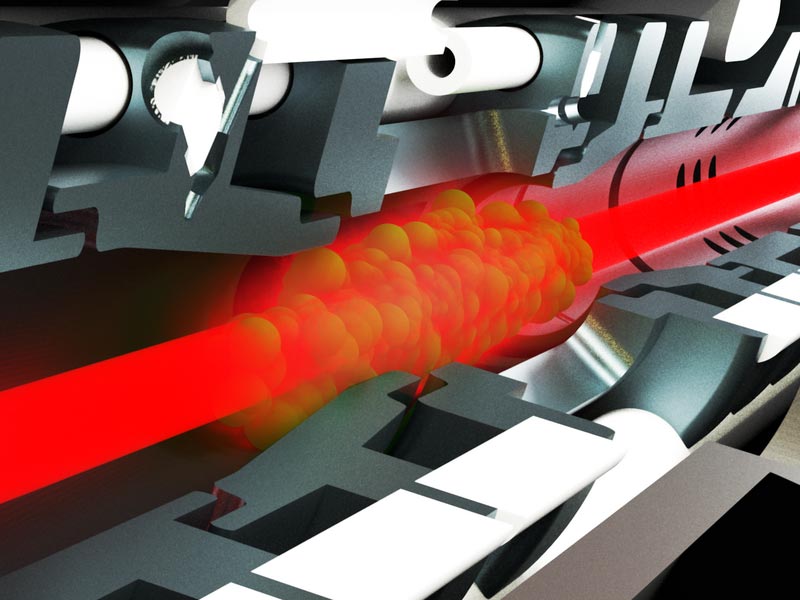
Steffen Kühn, a Ph.D. student at MPIK and responsible for the setup, describes the effort: “To resonantly excite highly charged iron ions, we continuously generate them with our compact mobile electron beam ion trap (PolarX-EBIT) and irradiate them with X-rays from the PETRA III synchrotron at DESY. We find resonance with the lines by scanning the synchrotron energy over the range where they should appear and observing the fluorescence light. To handle the experimental data flow, we had colleagues from 19 institutions working at DESY, and painstakingly analyzing and cross-checking results for more than one year.”

To make sure that everything is consistent, the researchers combined three different measurement procedures to determine the intensity ratio of the two Fe16+ lines, dubbed 3C and 3D. First, overall scans revealed line positions, widths and intensities. Second, the experimentalists set the energy of the X-ray photons to match the peak fluorescence yield while cyclically turning the photon beam off and on to get rid of the strong background. Third, they scanned the lines again, but using the on-off trick at the same time in order to reduce instrumental effects. “This way, we could derive the presently most accurate value of the brightness ratio, and this with ten times higher spectral resolution than earlier work,” states Chintan Shah, NASA postdoctoral fellow. “And the properties of the PETRA III beam avoided possible non-linear effects depending on the flux of synchrotron photons that may have affected earlier measurements,” adds Sven Bernitt, researcher at the Helmholtz Institute Jena. Remarkably, the resulting intensity ratio confirms earlier astrophysical and laboratory measurements with much reduced uncertainty.
… and advanced calculations
Theory teams around Natalia Oreshkina at the MPIK, from Australia, USA, and Russia applied three independent very-large-scale relativistic quantum-theoretical methods, letting clusters of hundreds of processors run hot for weeks. This computational marathon delivered concordant results at high numerical precision. However, while the calculated energy difference between the two lines agrees well with the measured value, the intensity ratio clearly departs from the experimental result. “There are no other known quantum-mechanical effects or numerical uncertainties to consider within our approaches,” emphasizes Marianna Safronova, professor at the University of Delaware.
Thus, the cause for the discrepancy between the experimental and theoretical intensity ratios of the 3C and 3D lines of Fe16+ remains puzzling, since also all effects that could perturb the measurements were as far as possible suppressed, and the remaining uncertainty understood. As a consequence, astrophysical parameters derived on the basis of X-ray line intensities are, to some degree, uncertain. While this is unsatisfactory, “the new accurate experimental result may be immediately used to empirically correct the astrophysical models,” recommends Maurice Leutenegger, also a NASA researcher. “Upcoming space missions with advanced X-ray instrumentation, such as ESA’s Athena X-ray Observatory, will soon start sending an incredible stream of high-resolution data to the ground, and we have to be prepared to understand it and squeeze the maximum value from those billion-dollar investments.”
Reference: “High-resolution Photo-excitation Measurements Exacerbate the Long-standing Fe XVII Oscillator-Strength Problem” by Steffen Kühn, Chintan Shah, José R. Crespo López-Urrutia, Keisuke Fujii, René Steinbrügge, Jakob Stierhof, Moto Togawa, Zoltán Harman, Natalia S. Oreshkina, Charles Cheung, Mikhail G. Kozlov, Sergey G. Porsev, Marianna S. Safronova, Julian C. Berengut, Michael Rosner, Matthias Bissinger, Ralf Ballhausen, Natalie Hell, SungNam Park, Moses Chung, Moritz Hoesch, Jörn Seltmann, Andrey S. Surzhykov, Vladimir A. Yerokhin, Jörn Wilms, F. Scott Porter, Thomas Stöhlker, Christoph H. Keitel, Thomas Pfeifer, Gregory V. Brown, Maurice A. Leutenegger and Sven Bernitt, 1 June 2020, Physical Review Letters.
DOI: 10.1103/PhysRevLett.124.225001
Never miss a breakthrough: Join the SciTechDaily newsletter.
Follow us on Google and Google News.
20 Comments
This sounds like good news for those in search of “new physics” — but I don’t hear any cheering.
If you don’t hear any cheer, it is because this development is not implying new physics. It is implying that some observed quantities that have been known to be uncertain for decades will remain so.
Can you explain why you think there can’t be “new physics” here? Doesn’t this result point to a consistent disagreement of experimental results and theory? Do you not think we can trust the experimental results here more than we can trust theory?
– “Can you explain why you think there can’t be “new physics” here?”
I can try to reformulate, to see if that helps, but the explanation remains the same.
Well, then: These observed quantities have apparently long been known to be uncertain, so they can’t be used for good determinations of plasma temperatures and densities. Meanwhile, the outcome of the complex modeling that underlies attempts to extract theoretical values differ, which discrepancy “remains puzzling”.
The result is that some observed quantities that have been known to be uncertain for decades will remain so.
– “Doesn’t this result point to a consistent disagreement of experimental results and theory?”
Consistent in the sense of persistent yes, consistent in the sense of implying a forever remaining disagreement, no. The latter complex modeling merely “remains puzzling”.
– “Do you not think we can trust the experimental results here more than we can trust theory?”
I refer to the paper, that may delve into that question – using highly charged Fe ions as a proxy for plasma temperatures and densities may best described as a topic for connoisseurs – if lab experiments and astronomy observations agree maybe they can be trusted to be used as proxy. Else everything is crap.
Yeah, definitely ride out that difference, rock it for a hot minute rome weren’t built in a day if two things are exactly the same but unequal? Pretty strong stuff.
The goal and end of physics to to find the mathematical expression of Ultimate Reality which I have solved. It is DOMICENTRISM. See MATHEMATICAL THERAPY FORUM @https://www.facebook.com/onoja.akohyakubu
That is self promotion. It is also not referencing peer reviewed literature.
[But FWIW, we know from physics that mathematics alone can’t tell us anything about the world. That’s why we have science in the first place, to make observations and test our theories, and why mathematics is a tool and not a form of knowledge.]
The goal and end of physics is to find the mathematical expression of Ultimate Reality which I have solved. It is DOMICENTRISM. See MATHEMATICAL THERAPY FORUM: https://www.facebook.com/onoja.akohyakubu
Is it not officially spam the second time around? Already it is grown to three referencing the same spam, is this the way to go?
shine brightly not brightly shine
Did this physics thing also puzzle Einstein?
Way after his time.
Relevance?
Perhaps the difference in intensity ratio from theory versus experiment has more to do with a difference in absorption of the two energies in the detectors and surrounding materials than it does to the processes involved in their emission?
Maybe, but while I don’t know anything on this specific issue, I know the modeling to extract values out of quantum theory can be fiercely complicated. As here:
“An international team of 32 researchers led by groups from the Max Planck Institute for Nuclear Physics (MPIK) and the NASA Goddard Space Flight Center has just published the outcome of its renewed massive effort to resolve this discrepancy. They have performed both the highest-resolution measurements thus far reported, and several top-level quantum-theoretical calculations.”
“”To handle the experimental data flow, we had colleagues from 19 institutions working at DESY, and painstakingly analysing and cross-checking results for more than one year.””
“Theory teams around Natalia Oreshkina at the MPIK, from Australia, USA and Russia applied three independent very-large-scale relativistic quantum-theoretical methods, letting clusters of hundreds of processors run hot for weeks.”
Simplest explanation is simplest.
Dummy me, (as I am but an engineer,) but nowhere in this article does anyone (experimentalist, or theoretician), actually address whether there are reasons to think that interstellar or intergallactic media can account for the observed discrepancies. Are generating energies/ temperatures different in the lab than in space? And if there are no perceived physical explanations (within current knowledge) then what is wrong with the models? In the interim, seems like lab work corroborates observation and engineers would tend to go with empirical data. (Just saying.)
Measuring instruments need to be calibrated to a known standard within a specific tolerance.I would start the search for error there.
The more y’all seek answers, the less y’all seem to know, cause y’all’s models are flawed from the get go, just like y’all. Humans are upright walk’n/talk’n apes according to y’all. Order out of chaos, random ping pong balls, NO y’all! GOD did it, that’s all, y’all!
The search for God, and trying to understand the creation, Are similar.
Why are you here then?, y’all! 🙂
This happens when you have feedbacks (casual or non-casual) in closed systems. So, there is no new physics, just they had to think more exotic (like time feedbacks)…
They just forgot to put some more dark matter into the ecuacion… Or maybe substrat? 🤔