

A sample of estuarine mud taken 16 years ago has yielded a potential new class of painkiller as potent as opioids, but without their disadvantages.
Researchers from The University of Queensland and University of Sydney have filed a patent application for the potential drug, which is a modified version of a molecule found in a Penicillium fungus, and published their results in the scientific journal Proceedings of the National Academy of Sciences USA.
Professor Rob Capon, from UQ’s Institute for Molecular Bioscience, said he and his team were investigating the chemistry of marine fungi, including a sample collected next to a boat ramp in Tasmania.
“We came across a fungus that yielded a new type of molecule which we named the bilaids, that I noticed were similar to endomorphins – natural peptides produced by the human body that activate opioid receptors and provide pain relief,” Professor Capon said.
He teamed up with IMB colleague Professor Paul Alewood, and the University of Sydney’s Professor Macdonald Christie, to see if they could harness these promising molecules to develop a new painkiller.
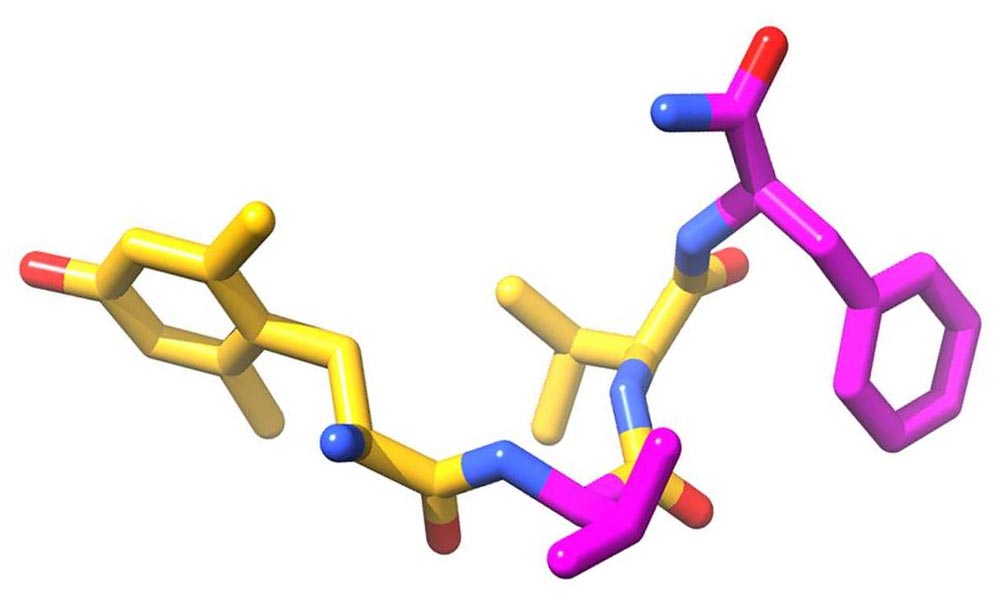
Professor Alewood oversaw chemical modifications that delivered a new molecule based on the bilaids, named bilorphin, which is as potent as morphine and potentially far more suitable as a pain drug.
School of Medical Sciences Associate Dean Research Professor Christie, said such a development could have a major impact globally.
“No one had ever pulled anything out of nature, anything more ancient than a vertebrate, that seemed to act on opioid receptors – and we found it,” Professor Christie said. “If this proves successful and leads to a new medication, it will significantly reduce the risk of death by overdose from opioid medications such as codeine.”
The key to the success of these molecules lies in their chemical structure, or ‘handedness.’
The bilaids consisted of a chain of four of the building blocks of life, amino acids, and also had a curious ‘handedness’.
“In Nature, many molecules can be described as either ‘left-handed’ or ‘right-handed’, and just like hands, they are mirror images of each other,” Professor Capon said. “While almost all natural amino acids are ‘left-handed’, the bilaids were unique in featuring alternating ‘left-handed’ and ‘right-handed’ amino acids.”
The opioid receptor sends out two signaling cascades, with opioids such as morphine activating the receptor with a bias towards one cascade – in contrast, bilorphin activates the receptor with the opposite bias.
Researchers hypothesized that the signaling bias is behind the adverse side effects seen in opioid drugs – addiction, tolerance, respiratory depression – so by activating the opposite bias, bilorphin has the potential to be a safer pain drug.
Professor Capon said a targeted program analyzing soil samples and the diverse microbes found within them could benefit the development of drugs for conditions without effective treatments.
“Although our discovery of an analgesic from an estuarine mud fungus was serendipitous, it does beg the question – with an almost infinite diversity of fungi in the soils, plants, animals, and waters of the planet, perhaps we should be exploring other fungi for analgesics?”
Reference: “A tetrapeptide class of biased analgesics from an Australian fungus targets the µ-opioid receptor” by Zoltan Dekan, Setareh Sianati, Arsalan Yousuf, Katy J. Sutcliffe, Alexander Gillis, Christophe Mallet, Paramjit Singh, Aihua H. Jin, Anna M. Wang, Sarasa A. Mohammadi, Michael Stewart, Ranjala Ratnayake, Frank Fontaine, Ernest Lacey, Andrew M. Piggott, Yan P. Du, Meritxell Canals, Richard B. Sessions, Eamonn Kelly, Robert J. Capon, Paul F. Alewood and MacDonald J. Christie, 14 October 2019, Proceedings of the National Academy of Sciences.
DOI: 10.1073/pnas.1908662116
Never miss a breakthrough: Join the SciTechDaily newsletter.
Follow us on Google and Google News.
3 Comments
This could be truly revolutionary for chronic pain patients in the U.S., who have seen just about ALL of their resources for combating intractable, debilitating pain recently disappear after the U.S. Center for Disease Control issued new guidelines for prescribing opioids to patients! Dear God, they cannot get this to market SOON ENOUGH!!
I’d like more information plz
It’s now 2024. I searched online for “bilorphin” and “bilaid” and neither word was even found in the last year. ZERO results at Google and DuckDuckGo. Don’t expect anything to come from this discovery, at least not in the next 10-15 years and probably never.