

Molecular biologists and bioinformatics researchers conducted detective work in order to accomplish this feat.
The research team, led by Professors Mario Mörl and Sonja Prohaska, focused on enzymes called tRNA nucleotidyltransferases, which attach three nucleotide building blocks in the sequence C-C-A to small RNAs (transfer RNAs) in cells. These RNAs are subsequently used to supply amino acids for protein synthesis. Using phylogenetic reconstructions, the team reconstructed a candidate for an ancestral enzyme that existed in bacteria around 2 billion years ago and compared it to a modern bacterial enzyme.
They found that both enzymes work with similar precision, but have clear differences in their reactions. Previously, scientists were unable to understand why modern enzymes often interrupt their activity, but this study showed that this tendency is actually an evolutionary advantage, which had puzzled biochemists for decades.
The ancestral enzyme is processive, i.e. it works without interruption, but every now and then removes nucleotide building blocks that have already been correctly added. The results show that much can be learned about the evolution and properties of modern enzymes from enzyme reconstructions and that many questions can only be solved through interaction between bioinformatics and biochemistry – in a back-and-forth between computer calculations and laboratory experiments.
Shimmying Into the Past by Tracing Relationships
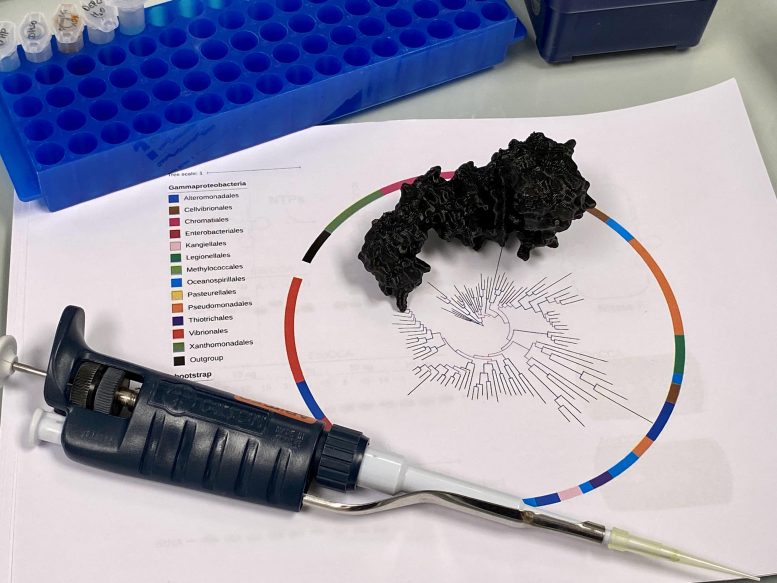
Using gene sequences, evolutionary phylogenetic trees can also be created of bacteria. Starting from today’s broad diversity of organisms in a species tree, the evolutionary path of individual genes can be reconstructed along relationships and branches, and painstakingly traced back to a common origin.
The reconstruction is essentially a three-step process. First, databases are searched for corresponding modern enzymes in order to be able to examine the sequence of amino acid building blocks. The sequences obtained can then be used to calculate what the original sequence should have looked like. The corresponding gene sequence coding for the old enzyme is then introduced into laboratory bacteria so that they form the desired protein. The enzyme can then be studied in detail to determine its properties and compared with modern enzymes. “When the news came back from the lab that the reconstructed enzyme performs the C-C-A addition, and does so even in a wider temperature range than today’s enzymes, that was the breakthrough,” Sonja Prohaska recalls.
Evolutionary Optimization: Pauses in Activity Increase Efficiency
Like organisms, enzymes are also optimized through evolution. The work (catalysis) performed by an enzyme usually runs faster and better the stronger it can bind its substrate. The reconstructed ancestral enzyme does precisely that, it holds on to the substrate, the tRNA, and attaches the three C-C-A nucleotides one after the other without letting go. Modern tRNA nucleotidyltransferases, on the other hand, are distributive, i.e. they work in stages with pauses during which they repeatedly release their substrate. Nevertheless, they are more efficient and faster than their ancestral predecessors. This puzzled the researchers. Why do modern enzymes keep letting go of their substrate? The explanation lies in the phenomenon of the reverse reaction, in which the incorporated nucleotides are removed again by the enzyme. While the strong binding of the ancestral enzyme to the substrate results in subsequent removal, the reverse reaction in modern enzymes is almost completely prevented by letting go of the substrate. This allows them to work more efficiently than their predecessors.
“We have now finally been able to explain why modern tRNA nucleotidyltransferases work so efficiently despite their distributive nature,” says Mario Mörl. “The finding took us in the team completely by surprise. We didn’t expect anything like this. We had the question 20 years ago and now we can finally answer it using bioinformatics reconstruction methods. This close cooperation between bioinformatics and biochemistry has existed in Leipzig for several years and has proven, not for the first time, to be a great advantage for both sides.”
Reference: “Substrate Affinity Versus Catalytic Efficiency: Ancestral Sequence Reconstruction of tRNA Nucleotidyltransferases Solves an Enzyme Puzzle” by Martina Hager, Marie-Theres Pöhler, Franziska Reinhardt, Karolin Wellner, Jessica Hübner, Heike Betat, Sonja Prohaska and Mario Mörl, 21 November 2022, Molecular Biology and Evolution.
DOI: 10.1093/molbev/msac250
Never miss a breakthrough: Join the SciTechDaily newsletter.
Follow us on Google and Google News.