
If you see people walking down a street and coming to a junction, it’s difficult to predict which direction they might take. But, if you see people sitting in separate boats, floating down a stream, and the stream splits into two channels, it’s likely that most, if not all, of them will be carried down one channel, the channel that has the stronger flow.
Scientists in the Quantum Dynamics Unit at Okinawa Institute of Science and Technology Graduate University (OIST) are looking at something similar, but their research is at a much smaller scale. They’re running experiments to see how the motion of electrons is impacted by fluid. This study was published in Physical Review Letters.
Professor Denis Konstantinov, who runs the Unit, demonstrated the concept with a piece of wire. “If we run an electric current through a piece of wire, then we know that the electrons will move from one end to the other. If we split the wire into two, half of electrons will flow down one side, and the other half will flow down the other.”
This is due to Ohm’s law, a physics law, which states that electric current is proportional to voltage and inversely proportional to resistance, so if the resistance equally distributes between two channels, half the electrons will go down each channel.
“But,” Professor Konstantinov explained. “If the electrons are sitting on liquid, rather than in a solid, they might break Ohm’s law. That’s what we wanted to measure.”

This theory comes from the concept of a polaron, which is an electron that’s “dressed” by a cloud of the medium it’s sitting in. This makes it heavier, slower and changes its behavior. Previously polarons have been discussed in terms of ionic crystals in solids, but much more rarely in liquids.
The researchers used superfluid helium, which has several unique properties. For example, it remains in a liquid form at temperatures down to absolute zero, when any other liquid would freeze, and behaves like fluid with zero viscosity, or no resistance. Electrons would only be able to sit on top, rather than sink. Thus, it provided the researchers with a 2D electron system.
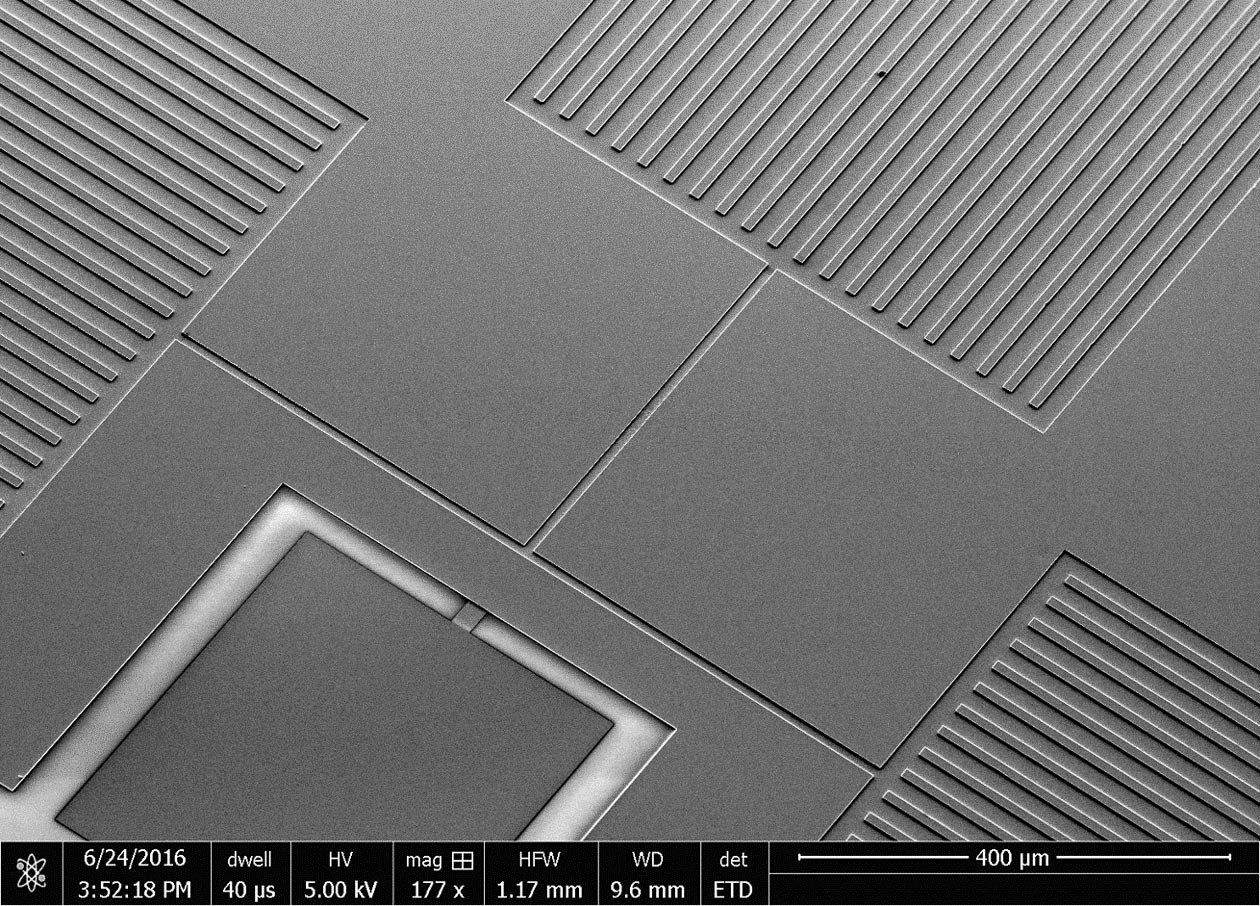
They created a tiny structure, on the scale of micrometers, of three reservoirs connected by a T-junction, and slightly submerged this structure in superfluid helium.
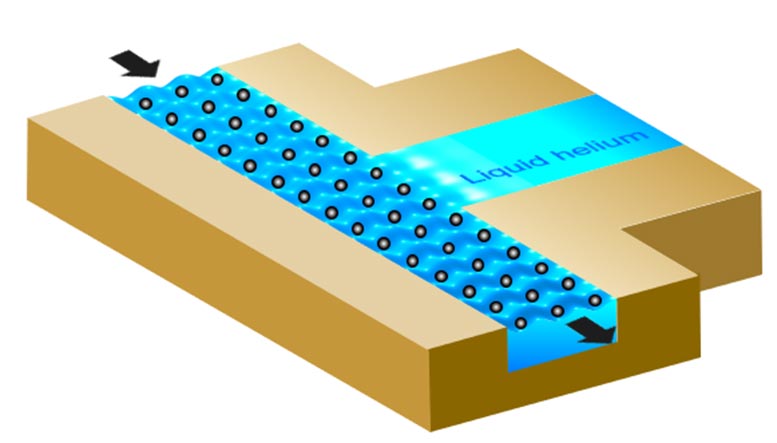
As the electrons moved and disturbed the liquid, they created capillary waves, or ripples. At high electron densities, the electrons became trapped in the shallow dimple of the waves. These are slightly different from the traditional polarons, so the researchers called them ripplopolarons, inspired by their similarities to ripples on water.
“Ohm’s law states that the electrons should split at the T junction,” said Professor Konstantinov, “But, due to momentum conservation, the flow of fluid should keep going down the straight path. We theorized that the ripplopolarons – the trapped electrons – would break Ohm’s law and all be carried in the same direction.”
The researchers applied an electric field, which moved the ripplopolarons out of the left reservoir. As they moved along the channel, they came to the junction, and could either turn and go to the side reservoir or continue straight to the right reservoir.
It was as the researchers predicted. The ripplopolarons continued straight from the left reservoir to the right reservoir, following momentum conservation rather than Ohm’s law.
However, this law-breaking behavior only occurred in certain situations. The density of electrons had to be high, or the ripplopolarons wouldn’t form, and the temperature had to be low, or the waves would simply pitter out. When the researchers ran the experiment in the opposite direction, they found the same unidirectional movement, but when they ran the electrons out of the side reservoir, they found that the ripplopolarons would crash into the wall at the top, the waves would disappear and the [now-free] electrons would once again follow Ohm’s law.
Although there are applications for understanding how electrons operate, this experiment was mainly driven by curiosity. “We wanted to know how electrons are influenced by the medium they’re in,” said Professor Konstantinov, “For us, it was the discovery that was exciting. But it’s also important that we understand these properties. Electrons in fluids could be useful when it comes to building qubits, the tiny parts that make up quantum computers. If we could use electrons in fluids for qubits, we could create a flexible, moveable architecture for the computers.”
Reference: “Unidirectional Charge Transport via Ripplonic Polarons in a Three-Terminal Microchannel Device” by A. O. Badrutdinov, D. G. Rees, J. Y. Lin, A. V. Smorodin and D. Konstantinov, 23 March 2020, Physical Review Letters.
DOI: 10.1103/PhysRevLett.124.126803
Never miss a breakthrough: Join the SciTechDaily newsletter.
Follow us on Google and Google News.
8 Comments
They threatened to murder the electrons’ families.
No projections, please.
This will be helpful for later evolution of the human surrogate brain. Sad thing is it takes years to stop the hackers as to how easy it is to tamper with.
I would try the experiment with different “y” & “Y” configurations of different angles..!!!
They basically quantized the energy of the electron so its energy couldn’t be split evenly between two paths. However, I bet the average energy over time would still adhere to ohms law.
Energy is equal to mass times the speed of light squared. The experiment will have better results if performed in a vacuum using the Curry method.
Raymer For threatening the electons’ families there is hell to pay, and they better start believing it…It gives comfort to see the freely and equally chosen RIGHT AND LEFT paths ,with all the predicted stability , without that forced manipulation. Shema?
No, the electricians would consider the side path to have infinite resistance to make it easier to calculate lol