
Long predicted but never observed before, this fluid-like electron behavior could be leveraged for efficient low-power next-generation electronics.
Water molecules, although being distinct particles, flow collectively as liquids, creating streams, waves, whirlpools, and other classic fluid phenomena.
It isn’t the same with electricity. While an electric current is likewise constructed of distinct particles — in this case, electrons — the particles are so small that any collective behavior among them is drowned out by larger influences as electrons pass through ordinary metals. However, in particular materials and under specific conditions, such effects fade away, and electrons can directly influence each other. In these specific instances, electrons can flow collectively like a fluid.
Now, physicists at MIT and the Weizmann Institute of Science have finally observed electrons flowing in vortices, or whirlpools — a hallmark of fluid flow that theorists predicted electrons should exhibit, but that has never been seen before now.
“Electron vortices are expected in theory, but there’s been no direct proof, and seeing is believing,” says Leonid Levitov, professor of physics at MIT. “Now we’ve seen it, and it’s a clear signature of being in this new regime, where electrons behave as a fluid, not as individual particles.”
Reported on July 6, 2022, in the journal Nature, the observations could inform the design of more efficient electronics.
“We know when electrons go in a fluid state, [energy] dissipation drops, and that’s of interest in trying to design low-power electronics,” Levitov says. “This new observation is another step in that direction.”
Levitov is a co-author of the new paper, along with Eli Zeldov and others at the Weizmann Institute for Science in Israel and the University of Colorado at Denver.
A Collective Squeeze
When electricity runs through most ordinary metals and semiconductors, the momenta and trajectories of electrons in the current are influenced by impurities in the material and vibrations among the material’s atoms. These processes dominate electron behavior in ordinary materials.
But theorists have predicted that in the absence of such ordinary, classical processes, quantum effects should take over. Namely, electrons should pick up on each other’s delicate quantum behavior and move collectively, as a viscous, honey-like electron fluid. This liquid-like behavior should emerge in ultraclean materials and at near-zero temperatures.
In 2017, Levitov and colleagues at the University of Manchester reported signatures of such fluid-like electron behavior in graphene, an atom-thin sheet of carbon onto which they etched a thin channel with several pinch points. They observed that a current sent through the channel could flow through the constrictions with little resistance. This suggested that the electrons in the current were able to squeeze through the pinch points collectively, much like a fluid, rather than clogging, like individual grains of sand.
This first indication prompted Levitov to explore other electron fluid phenomena. In the new study, he and colleagues at the Weizmann Institute for Science looked to visualize electron vortices. As they write in their paper, “the most striking and ubiquitous feature in the flow of regular fluids, the formation of vortices and turbulence, has not yet been observed in electron fluids despite numerous theoretical predictions.”
Channeling Flow
To visualize electron vortices, the team looked to tungsten ditelluride (WTe2), an ultraclean metallic compound that has been found to exhibit exotic electronic properties when isolated in single-atom-thin, two-dimensional form.
“Tungsten ditelluride is one of the new quantum materials where electrons are strongly interacting and behave as quantum waves rather than particles,” Levitov says. “In addition, the material is very clean, which makes the fluid-like behavior directly accessible.”
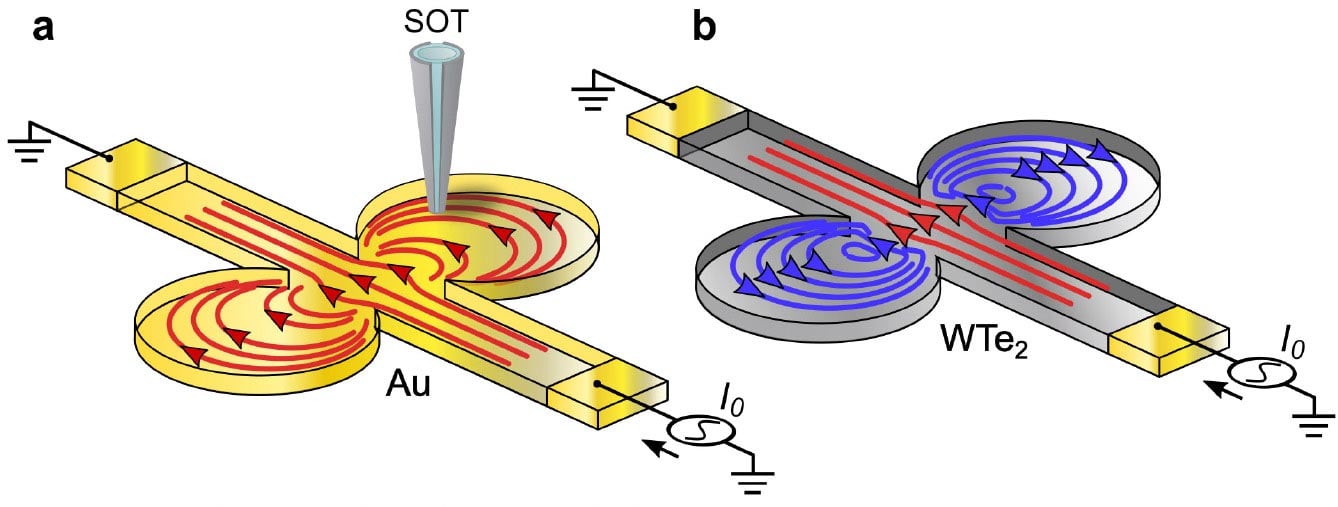
The researchers synthesized pure single crystals of tungsten ditelluride, and exfoliated thin flakes of the material. They then used e-beam lithography and plasma etching techniques to pattern each flake into a center channel connected to a circular chamber on either side. They etched the same pattern into thin flakes of gold — a standard metal with ordinary, classical electronic properties.
They then ran a current through each patterned sample at ultralow temperatures of 4.5 kelvins (about -450 degrees Fahrenheit) and measured the current flow at specific points throughout each sample, using a nanoscale scanning superconducting quantum interference device (SQUID) on a tip. This device was developed in Zeldov’s lab and measures magnetic fields with extremely high precision. Using the device to scan each sample, the team was able to observe in detail how electrons flowed through the patterned channels in each material.
The researchers observed that electrons flowing through patterned channels in gold flakes did so without reversing direction, even when some of the current passed through each side chamber before joining back up with the main current. In contrast, electrons flowing through tungsten ditelluride flowed through the channel and swirled into each side chamber, much as water would do when emptying into a bowl. The electrons created small whirlpools in each chamber before flowing back out into the main channel.
“We observed a change in the flow direction in the chambers, where the flow direction reversed the direction as compared to that in the central strip,” Levitov says. “That is a very striking thing, and it is the same physics as that in ordinary fluids, but happening with electrons on the nanoscale. That’s a clear signature of electrons being in a fluid-like regime.”
The group’s observations are the first direct visualization of swirling vortices in an electric current. The findings represent an experimental confirmation of a fundamental property in electron behavior. They may also offer clues to how engineers might design low-power devices that conduct electricity in a more fluid, less resistive manner.
“Signatures of viscous electron flow have been reported in a number of experiments on different materials,” says Klaus Ensslin, professor of physics at ETH Zurich in Switzerland, who was not involved in the study. “The theoretical expectation of vortex-like current flow has now been confirmed experimentally, which adds an important milestone in the investigation of this novel transport regime.”
Reference: “Direct observation of vortices in an electron fluid” by A. Aharon-Steinberg, T. Völkl, A. Kaplan, A. K. Pariari, I. Roy, T. Holder, Y. Wolf, A. Y. Meltzer, Y. Myasoedov, M. E. Huber, B. Yan, G. Falkovich, L. S. Levitov, M. Hücker and E. Zeldov, 6 July 2022, Nature.
DOI: 10.1038/s41586-022-04794-y
This research was supported, in part, by the European Research Council, the German-Israeli Foundation for Scientific Research and Development, and by the Israel Science Foundation.
Never miss a breakthrough: Join the SciTechDaily newsletter.
Follow us on Google and Google News.
1 Comment
Could you make a Tesla valve into a useful diode with this material?