
By binding photons together to form molecules, scientists from Harvard and MIT have created a never-before-seen form of matter.
Harvard and MIT scientists are challenging the conventional wisdom about light, and they didn’t need to go to a galaxy far, far away to do it.
Working with colleagues at the Harvard-MIT Center for Ultracold Atoms, a group led by Harvard Professor of Physics Mikhail Lukin and MIT Professor of Physics Vladan Vuletic have managed to coax photons into binding together to form molecules – a state of matter that, until recently, had been purely theoretical. The work is described in a September 25 paper in Nature.
The discovery, Lukin said, runs contrary to decades of accepted wisdom about the nature of light. Photons have long been described as massless particles which don’t interact with each other – shine two laser beams at each other, he said, and they simply pass through one another.
“Photonic molecules,” however, behave less like traditional lasers and more like something you might find in science fiction – the lightsaber.
“Most of the properties of light we know about originate from the fact that photons are massless, and that they do not interact with each other,” Lukin said. “What we have done is create a special type of medium in which photons interact with each other so strongly that they begin to act as though they have mass, and they bind together to form molecules. This type of photonic bound state has been discussed theoretically for quite a while, but until now it hadn’t been observed.
“It’s not an in-apt analogy to compare this to lightsabers,” Lukin added. “When these photons interact with each other, they’re pushing against and deflect each other. The physics of what’s happening in these molecules is similar to what we see in the movies.”
To get the normally-massless photons to bind to each other, Lukin and colleagues, including Harvard post-doctoral fellow Ofer Fisterberg, former Harvard doctoral student Alexey Gorshkov, and MIT graduate students Thibault Peyronel and Qiu Liang couldn’t rely on something like the Force – they instead turned to a set of more extreme conditions.
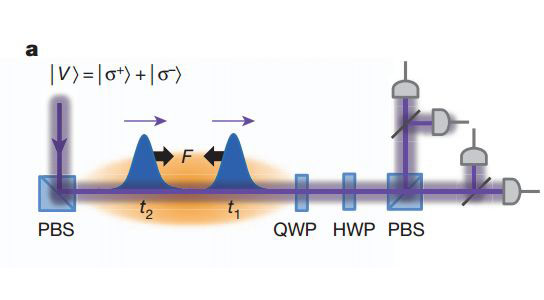
Researchers began by pumping rubidium atoms into a vacuum chamber, then used lasers to cool the cloud of atoms to just a few degrees above absolute zero. Using extremely weak laser pulses, they then fired single photons into the cloud of atoms.
As the photons enter the cloud of cold atoms, Lukin said, its energy excites atoms along its path, causing the photon to slow dramatically. As the photon moves through the cloud, that energy is handed off from atom to atom, and eventually exits the cloud with the photon.
“When the photon exits the medium, its identity is preserved,” Lukin said. “It’s the same effect we see with refraction of light in a water glass. The light enters the water, it hands off part of its energy to the medium, and inside it exists as light and matter coupled together, but when it exits, it’s still light. The process that takes place is the same it’s just a bit more extreme – the light is slowed considerably, and a lot more energy is given away than during refraction.”
When Lukin and colleagues fired two photons into the cloud, they were surprised to see them exit together, as a single molecule.
The reason they form the never-before-seen molecules?
An effect called a Rydberg blockade, Lukin said, which states that when an atom is excited, nearby atoms cannot be excited to the same degree. In practice, the effect means that as two photons enter the atomic cloud, the first excites an atom, but must move forward before the second photon can excite nearby atoms.
The result, he said, is that the two photons push and pull each other through the cloud as their energy is handed off from one atom to the next.
“It’s a photonic interaction that’s mediated by the atomic interaction,” Lukin said. “That makes these two photons behave like a molecule, and when they exit the medium they’re much more likely to do so together than as single photons.”
While the effect is unusual, it does have some practical applications as well.
“We do this for fun, and because we’re pushing the frontiers of science,” Lukin said. “But it feeds into the bigger picture of what we’re doing because photons remain the best possible means to carry quantum information. The handicap, though, has been that photons don’t interact with each other.”
To build a quantum computer, he explained, researchers need to build a system that can preserve quantum information, and process it using quantum logic operations. The challenge, however, is that quantum logic requires interactions between individual quanta so that quantum systems can be switched to perform information processing.
“What we demonstrate with this process allows us to do that,” Lukin said. “Before we make a useful, practical quantum switch or photonic logic gate we have to improve the performance, so it’s still at the proof-of-concept level, but this is an important step. The physical principles we’ve established here are important.”
The system could even be useful in classical computing, Lukin said, considering the power-dissipation challenges chip-makers now face. A number of companies – including IBM – have worked to develop systems that rely on optical routers that convert light signals into electrical signals, but those systems face their own hurdles.
Lukin also suggested that the system might one day even be used to create complex three-dimensional structures – such as crystals – wholly out of light.
“What it will be useful for we don’t know yet, but it’s a new state of matter, so we are hopeful that new applications may emerge as we continue to investigate these photonic molecules’ properties,” he said.
Reference: “Attractive photons in a quantum nonlinear medium” by Ofer Firstenberg, Thibault Peyronel, Qi-Yu Liang, Alexey V. Gorshkov, Mikhail D. Lukin and Vladan Vuletić, 25 September 2013, Nature.
DOI: 10.1038/nature12512
Never miss a breakthrough: Join the SciTechDaily newsletter.
Follow us on Google and Google News.
12 Comments
Lukin Skywalker 🙂
That’s what i thought 😀
first thing I thought of after calling photons “massless particles”.
We clearly need to change that reference.
this. is a step towards teleportation.
A molecule of light? Is it still light? Does it still travel at LS? If it has mass, then can it be moved, deflected, stopped? Much not explained in this article. Although interesting in it’s propositions.
Dilithium crystals?
What about force fields like inertial dampeners for high speed manned spaced travel..
Thank you for your valuable contribution Harvard and MIT Scientists. Here’s a thought experiment that might take such experiments as described in the above article to new levels of investigation. Would it be possible to isolate such molecules within magnetic fields and place them in an acceleration chamber. Then as they are accelerated up to the speed of light, since they can’t achieve faster than light speed, the extra energy of the acceleration is transferred to their mass forming photonic packets of energy with high magnitude of energy, (as measured in electron Volts). Do you think that such photonic engines being extremely dense energy packets aligned in crystal formation could then be suspended within magnetic fields to applied as the engine of a spacecraft. Where the momentum, (speed and direction), of such a photonic engine is stored in the corresponding forcefield. The higher the charge on the photonic engine, the more potential energy stored in the corresponding field. Such that, the craft behaves much like a photon of electromagnetic force zooming between dense energy systems, (star systems), like a surfer on the edge of a wave.
Hello! please compare this to Raman effect where incident monochromatic light photon interacts with the atom of say, Benzene liquid, and the output is the original photon with the same wavelength and two other enhanced and diminished energy photons like Stokes and anti-stokes lines of the same monochromatic light with higher and lesser frequencies.Thus the incident photon has shared the energy of electrons of Benzene. We can call this also photon adhesion or splitting with incident energy with electron of the matter. Here highly condensed light called laser is used to stick together and come out of the medium. I don’t call this as new type of matter at all but only ‘photo-dynamics’ of wavelength of light. After all matter and energy are the two sides of the same coin and they are inter- convertible. The inter-conversion need not be complete. In refraction the energy is only partially given out and absorbed by the medium so that the velocity of light just decreases. The velocity of light is highest only in vacuum. Don’t you feed the infra-red being absorbed by the surrounding medium? Thank You.
“PBS” — on the diagram twice. Ha ha ha — I’m stupid I don’t know what it means except that’s an allegedly educational tv channel.
Fiat lux et lux facta est.
Crystals made entirely our of light?
Hard-light constructs?