
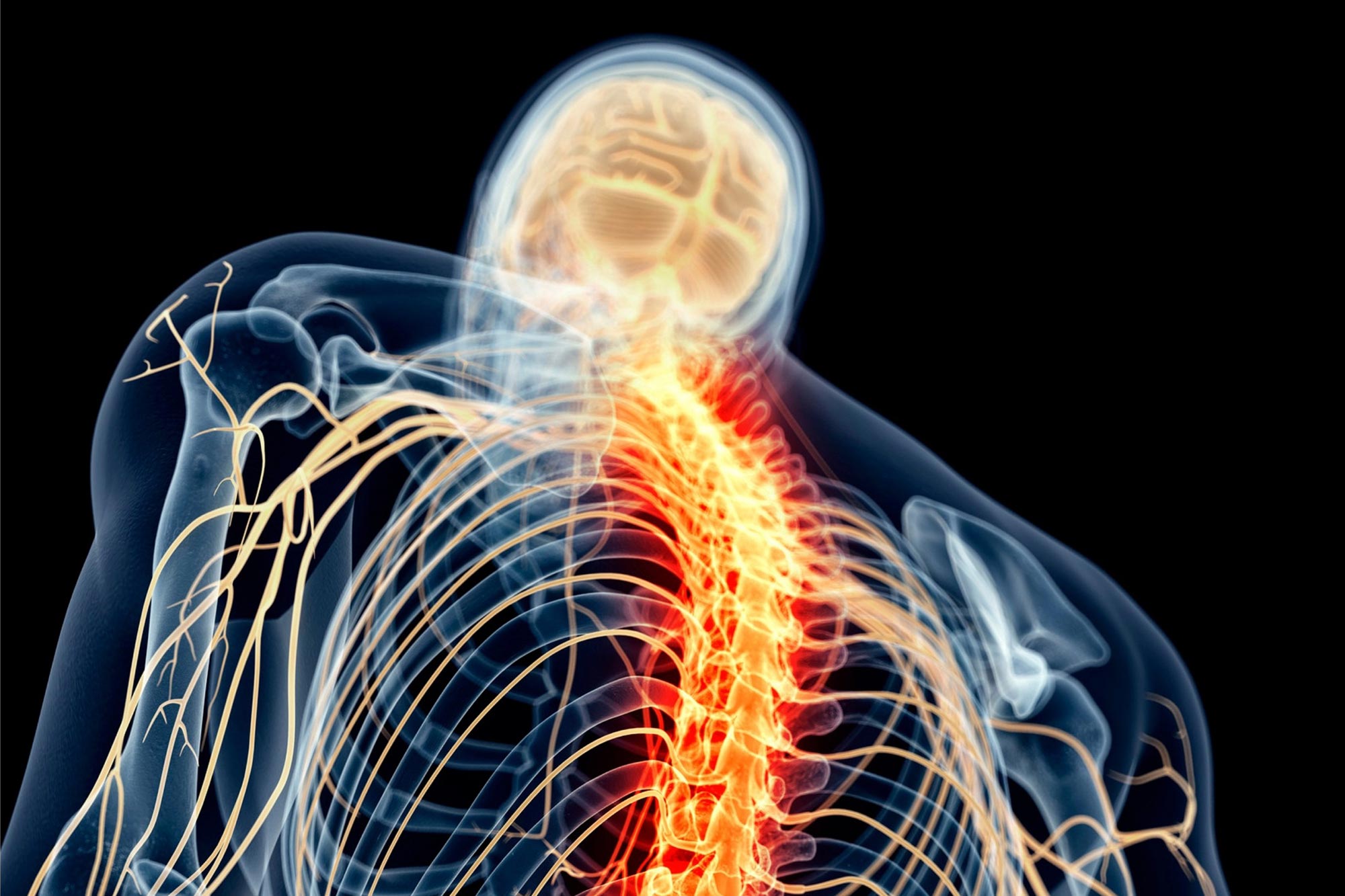
A new electrical stimulation therapy for spinal muscle atrophy (SMA) has shown promise in reactivating motor neurons and improving movement. In a pilot clinical trial, three patients who received spinal cord stimulation for one month experienced increased strength, reduced fatigue, and improved walking ability.
Researchers at the University of Pittsburgh School of Medicine have developed a new, drug-free, minimally invasive treatment that addresses the underlying cause of progressive neural function loss in spinal muscle atrophy (SMA), a genetic neuromuscular disease. This approach involves electrically stimulating sensory spinal nerves to gradually reactivate dormant motor neurons in the spinal cord. The treatment has been shown to improve leg muscle strength and walking ability in adults with SMA. These findings were published in Nature Medicine.

Early results from a pilot clinical trial involving three individuals with spinal muscular atrophy (SMA) indicate that one month of regular neurostimulation sessions led to improved motor neuron function, reduced fatigue, and enhanced strength and walking ability in all participants, regardless of symptom severity. This study is the first to demonstrate that a neurotechnology can be specifically designed to reverse neural circuit degeneration and restore cell function in a human neurodegenerative disease.
“To counteract neurodegeneration, we need two things – stop neuron death and restore the function of surviving neurons,” said co-corresponding author Marco Capogrosso, Ph.D., assistant professor of neurosurgery at Pitt. “In this study we proposed an approach to treat the root cause of neural dysfunction, complementing existing neuroprotective treatments with a new approach that reverses nerve cell dysfunction.”
Understanding SMA and Its Impact
SMA is a genetic neurodegenerative disease that manifests in progressive death and functional decline of motor neurons — nerve cells that control movement by transmitting signals from the brain and the spinal cord to the muscles. Over time, the loss of motor neurons causes gradual muscle weakness, and leads to a variety of motor deficits, including for the participants in this trial, difficulty in walking, climbing stairs, and standing up from chairs.

While there is no cure for SMA, several promising neuroprotective treatments have become available in the last decade. These include gene replacement therapies and medications, both of which stimulate the production of motoneuron-supporting proteins that prevent neuronal death and that slow down – though do not reverse – disease progression.
Studies show that movement deficits in SMA emerge before widespread motoneuron death, suggesting that underlying dysfunction in spinal nerve circuitry may contribute to disease onset and symptom development. According to earlier research on animal models of SMA by study co-author George Mentis, Ph.D., at Columbia University, surviving motor neurons receive fewer stimulation inputs from sensory nerves – fibers that return the information from skin and muscles back to the central nervous system. Compensating for this deficit in neural feedback could, therefore, improve communication between the nervous system and the muscles, aid muscle movement, and combat muscle wasting.
Pitt researchers hypothesized that a targeted epidural electrical stimulation therapy could be used to rescue lost nerve cell function by amplifying sensory inputs to the motor neurons and engaging the degenerated neural circuits. These cellular changes could, in turn, translate into functional improvements in movement capacity.
How the Study Was Conducted
The Pitt study was conducted as part of a pilot clinical trial that enrolled three adults with milder forms of SMA (Type 3 or 4 SMA). During a study period of 29 days, participants were implanted with two spinal cord stimulation (SCS) electrodes that were placed in the lower back region on each side of the spinal cord, directing the stimulation exclusively to sensory nerve roots. Testing sessions lasted four hours each and were conducted five times a week for a total of 19 sessions, until the stimulation device was explanted.
After confirming that the stimulation worked as intended and engaged spinal motor neurons, researchers performed a battery of tests to measure muscle strength and fatigue, changes in gait, range of motion, and walking distance, as well as motoneuron function.

“Because SMA is a progressive disease, patients do not expect to get better as time goes on. But that is not what we saw in our study. Over the four weeks of treatment, our study participants improved in several clinical outcomes with improvements in activities of daily living. For instance, toward the end of the study, one patient reported being able to walk from their home to the lab without becoming tired,” said co-corresponding author Elvira Pirondini, Ph.D., assistant professor of physical medicine and rehabilitation at Pitt.
All participants increased their 6-Minute Walk Test score – a measure of muscle endurance and fatigue – by at least 20 meters, compared to a mean improvement of 1.4 meters over three months of comparable exercise regimen unaided by SCS and a median increase of 20 meters after 15 months of SMA-specific neuroprotective pharmacologic therapy.
These functional gains were mirrored by improved neural function, including a boost in motoneurons’ capacity to generate electrical impulses and transmit them to the muscles.
“Our results suggest that this neurostimulation approach could be broadly applied to treat other neurodegenerative diseases beyond SMA, such as ALS or Huntington’s disease, as long as appropriate cell targets are identified in the course of future research,” said co-corresponding author Robert Friedlander, M.D., chair of neurosurgery at Pitt and co-director of the UPMC Neurological Institute. “We are hoping to continue working with SMA patients and launch another clinical trial to test the long-term efficacy and safety of electrical spinal cord stimulation.”
Reference: “First-in-human study of epidural spinal cord stimulation in individuals with spinal muscular atrophy” by Genís Prat-Ortega, Scott Ensel, Serena Donadio, Luigi Borda, Amy Boos, Prakarsh Yadav, Nikhil Verma, Jonathan Ho, Erick Carranza, Sarah Frazier-Kim, Daryl P. Fields, Lee E. Fisher, Doug J. Weber, Jeffrey Balzer, Tina Duong, Steven D. Weinstein, Mikael J. L. Eliasson, Jacqueline Montes, Karen S. Chen, Paula R. Clemens, Peter Gerszten, George Z. Mentis, Elvira Pirondini, Robert M. Friedlander and Marco Capogrosso, 5 February 2025, Nature Medicine.
DOI: 10.1038/s41591-024-03484-8
Genis Prat-Ortega, Ph.D., Scott Ensel, B.S., and Serena Donadio, B.S., all of Pitt, are co-first authors of the study. Other authors of the study are Amy Boos, M.S., Jacqueline Ho, M.D., Sarah Frazier-Kim, Daryl Fields, M.D., Ph.D., Lee Fisher, Ph.D., Paula Clemens, M.D., and Peter Gerszten, M.D., all of Pitt; Luigi Borda, B.S., Prakarsh Yadav, B.S., Nikhil Verma, B.S., and Douglas Weber, Ph.D., all of Carnegie Mellon University; Tina Duong, Ph.D., of Stanford University; Jacqueline Montes, P.T., Ed.D., and George Mentis, Ph.D., of Columbia University; Steven Weinstein, Mikael Eliasson, of Genentech Roche; and Karen S. Chen, of the Spinal Muscular Atrophy Foundation.
This research was supported by an exploratory research grant from F. Hoffmann–La Roche. Genentech, Inc. (a member of the Roche Group) and the University of Pittsburgh hold rights to IP related to this study. Marco Capogrosso, Genis Prat-Ortega and Mikael Eliasson hold patent applications that relate to this work.
Never miss a breakthrough: Join the SciTechDaily newsletter.
Follow us on Google and Google News.
1 Comment
thank you for this