
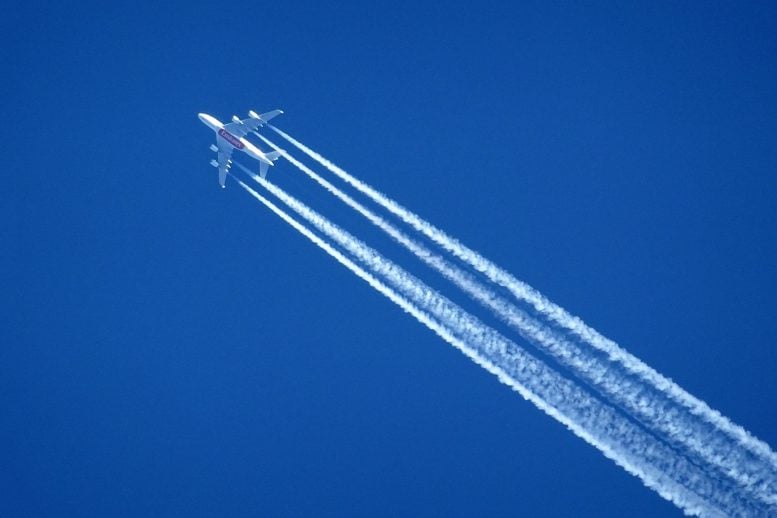
The computer-vision technique behind these maps could help avoid contrail production, reducing aviation’s climate impact.
As COVID-19’s initial wave crested around the world, travel restrictions and a drop in passengers led to a record number of grounded flights in 2020. The air travel reduction cleared the skies of not just jets but also the fluffy white contrails they produce high in the atmosphere.
MIT engineers have mapped the contrails that were generated over the United States in 2020, and compared the results to prepandemic years. They found that on any given day in 2018, and again in 2019, contrails covered a total area equal to Massachusetts and Connecticut combined. In 2020, this contrail coverage shrank by about 20 percent, mirroring a similar drop in U.S. flights.
While 2020’s contrail dip may not be surprising, the findings are proof that the team’s mapping technique works. Their study marks the first time researchers have captured the fine and ephemeral details of contrails over a large continental scale.
Now, the researchers are applying the technique to predict where in the atmosphere contrails are likely to form. The cloud-like formations are known to play a significant role in aviation-related global warming. The team is working with major airlines to forecast regions in the atmosphere where contrails may form, and to reroute planes around these regions to minimize contrail production.
“This kind of technology can help divert planes to prevent contrails, in real time,” says Steven Barrett, professor and associate head of MIT’s Department of Aeronautics and Astronautics. “There’s an unusual opportunity to halve aviation’s climate impact by eliminating most of the contrails produced today.”
Barrett and his colleagues have published their results on March 7, 2022, in the journal Environmental Research Letters. His co-authors at MIT include graduate student Vincent Meijer, former graduate student Luke Kulik, research scientists Sebastian Eastham, Florian Allroggen, and Raymond Speth, and LIDS Director and professor Sertac Karaman.
Trail Training
About half of the aviation industry’s contribution to global warming comes directly from planes’ carbon dioxide emissions. The other half is thought to be a consequence of their contrails. The signature white tails are produced when a plane’s hot, humid exhaust mixes with cool humid air high in the atmosphere. Emitted in thin lines, contrails quickly spread out and can act as blankets that trap the Earth’s outgoing heat.
While a single contrail may not have much of a warming effect, taken together contrails have a significant impact. But the estimates of this effect are uncertain and based on computer modeling as well as limited satellite data. What’s more, traditional computer vision algorithms that analyze contrail data have a hard time discerning the wispy tails from natural clouds.
To precisely pick out and track contrails over a large scale, the MIT team looked to images taken by NASA’s GOES-16, a geostationary satellite that hovers over the same swath of the Earth, including the United States, taking continuous, high-resolution images.
The team first obtained about 100 images taken by the satellite, and trained a set of people to interpret remote sensing data and label each image’s pixel as either part of a contrail or not. They used this labeled dataset to train a computer-vision algorithm to discern a contrail from a cloud or other image feature.
The researchers then ran the algorithm on about 100,000 satellite images, amounting to nearly 6 trillion pixels, each pixel representing an area of about 2 square kilometers. The images covered the contiguous U.S., along with parts of Canada and Mexico, and were taken about every 15 minutes, between January 1, 2018, and December 31, 2020.
The algorithm automatically classified each pixel as either a contrail or not a contrail, and generated daily maps of contrails over the United States. These maps mirrored the major flight paths of most U.S. airlines, with some notable differences. For instance, contrail “holes” appeared around major airports, which reflects the fact that planes landing and taking off around airports are generally not high enough in the atmosphere for contrails to form.
“The algorithm knows nothing about where planes fly, and yet when processing the satellite imagery, it resulted in recognizable flight routes,” Barrett says. “That’s one piece of evidence that says this method really does capture contrails over a large scale.”
Cloudy Patterns
Based on the algorithm’s maps, the researchers calculated the total area covered each day by contrails in the US. On an average day in 2018 and in 2019, U.S. contrails took up about 43,000 square kilometers. This coverage dropped by 20 percent in March of 2020 as the pandemic set in. From then on, contrails slowly reappeared as air travel resumed through the year.
The team also observed daily and seasonal patterns. In general, contrails appeared to peak in the morning and decline in the afternoon. This may be a training artifact: As natural cirrus clouds are more likely to form in the afternoon, the algorithm may have trouble discerning contrails amid the clouds later in the day. But it might also be an important indication about when contrails form most. Contrails also peaked in late winter and early spring, when more of the air is naturally colder and more conducive for contrail formation.
The team has now adapted the technique to predict where contrails are likely to form in real time. Avoiding these regions, Barrett says, could take a significant, almost immediate chunk out of aviation’s global warming contribution.
“Most measures to make aviation sustainable take a long time,” Barrett says. “(Contrail avoidance) could be accomplished in a few years, because it requires small changes to how aircraft are flown, with existing airplanes and observational technology. It’s a near-term way of reducing aviation’s warming by about half.”
The team is now working towards this objective of large-scale contrail avoidance using realtime satellite observations.
Reference: “Contrail coverage over the United States before and during the COVID-19 pandemic” by Vincent R Meijer, Luke Kulik, Sebastian D Eastham, Florian Allroggen, Raymond L Speth, Sertac Karaman and Steven R H Barrett, 7 March 2022, Environmental Research Letters.
DOI: 10.1088/1748-9326/ac26f0
This research was supported in part by NASA and the MIT Environmental Solutions Initiative.
Never miss a breakthrough: Join the SciTechDaily newsletter.
Follow us on Google and Google News.
1 Comment
“In 2020, this contrail coverage shrank by about 20 percent, mirroring a similar drop in U.S. flights.”
And, 2020 was essentially tied with the 2016 El Nino year for the warmest year on record. It would appear that the contrails actually have a net cooling effect, rather than warming as the article claims.
Contrail avoidance? Be careful what you wish for. You may get it.