
Ancient, distinct, continent-sized regions of rocks, isolated since before the collision that created the Moon 4.5 billion years ago, exist hundreds of miles below the Earth’s crust, offering a window into the building blocks of our planet, according to new research.
The new study in the AGU Journal Geochemistry, Geophysics, Geosystems used models to trace the location and origin of volcanic rock samples found throughout the world back to two solid continents in the deep mantle. The new research suggests the specific giant rock regions have existed for 4.5 billion years, since Earth’s beginning.
Previously, scientists theorized that separated continents in the deep mantle came from subducted oceanic plates. But the new study indicates these distinct regions may have been formed from an ancient magma ocean that solidified during the beginning of Earth’s formation and may have survived the massive Moon-creating impact.
Determining the masses’ origin reveals more details about their evolution and composition, as well as clues about primordial Earth’s history in the early Solar System, according to the study’s authors.
It’s amazing that these regions have survived most of Earth’s volcanic history relatively untouched, said Curtis Williams, a geologist at the University of California, Davis, in Davis, California and lead author of the study.
Looking inward
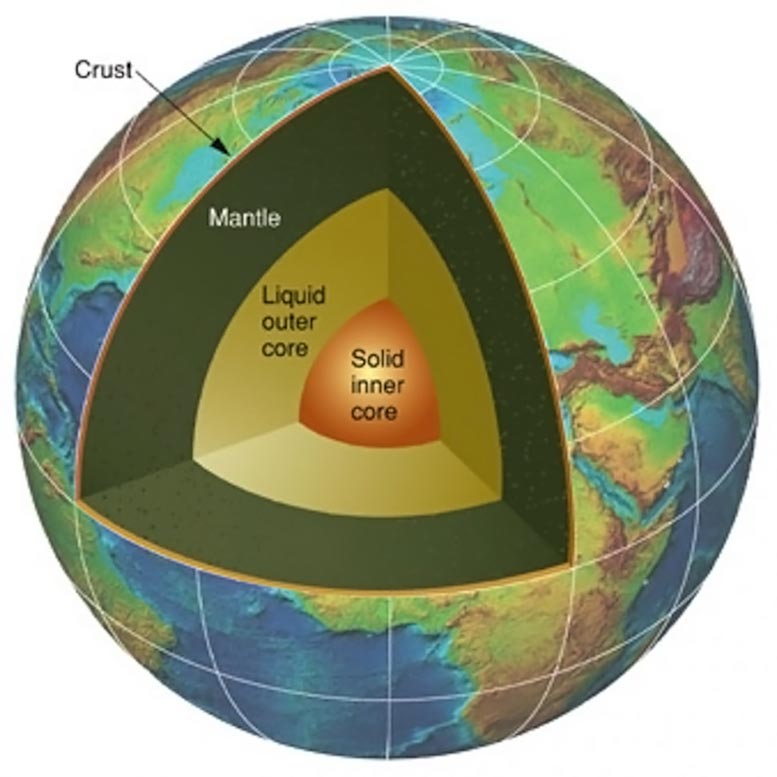
The mantle is a layer of rock, stretching 2,900 kilometers (1,802 miles) down inside the Earth. Earth’s molten, liquid, metallic core lies beneath the mantle. The core-mantle boundary is where the solid mantle meets the metallic liquid core.
Scientists knew from past seismic imaging studies that two individual rock bodies existed near the core-mantle boundary. One solid rock body is under Africa and the other is under the Pacific Ocean.
Seismic waves, the vibrations produced by earthquakes, move differently through these masses than the rest of the mantle, suggesting they have distinct physical properties from the surrounding mantle. But geologists couldn’t determine whether seismic waves moved differently through the core-mantle continents because of differences in their temperature, mineral composition or density, or some combination of these properties. That meant they could only hypothesize about the separate rocky masses’ origin and history.
“We had all of these geochemical measurements from Earth’s surface, but we didn’t know how to relate these geochemical measurements to regions of Earth’s interior. We had all of these geophysical images of the Earth’s interior, but we didn’t know how to relate that to the geochemistry at Earth’s surface,” Williams said.
Primitive material and plumes
Williams and his colleagues wanted to determine the distinct masses’ origin and evolution to learn more about Earth’s composition and past. To do this, they needed to be able to identify samples at Earth’s surface with higher concentrations of primitive material and then trace those samples back to their origins.
Scientists often take rock samples from volcanic regions like Hawaii and Iceland, where deep mantle plumes, or columns of extremely hot rock, rise from the areas near the core, melt in the shallow mantle and emerge far from tectonic fault lines. These samples are made of igneous rock created from cooling lava. The study’s authors used an existing database of samples and also collected new samples from volcanically active areas like the Balleny Islands in Antarctica.
Geologists can measure specific isotopes in igneous rocks to learn more about the origin and evolution of the Earth. Some isotopes, like Helium-3, are primordial, meaning they were created during the Big Bang. Rocks closer to Earth’s crust have less of the isotope than rocks deeper underground that were never exposed to air. Samples with more Helium-3 are thought to come from more primitive rocks in the mantle.
The researchers found some of the samples they studied had more Helium-3, indicating they may have come from primitive rocks deep in the Earth’s mantle.
The researchers then used a new model to trace how these primitive samples could have gotten to the Earth’s surface from the mantle. Geological models assume plumes rise vertically from deep within the mantle to the Earth’s surface. But plumes can move off course, deflected, due to various reasons. The new model took into account this plume deflection, allowing the study’s authors to trace the samples back to the two giant masses near the core-mantle boundary.
The combination of the isotope information and the new model allowed the researchers to determine the composition of the two giant masses and theorize how they may have formed.
Understanding the composition of specific rock masses near the core-mantle boundary helps geologists conceptualize ancient Earth-shaping processes that led to the modern-day mantle, according to the study’s authors.
“It’s a more robust framework to try and answer these questions in terms of not making these assumptions of vertically rising material but rather to take into account how much deflection these plumes have seen,” Williams said.
Reference: “Primitive Helium Is Sourced From Seismically Slow Regions in the Lowermost Mantle” by C. D. Williams, S. Mukhopadhyay, M. L. Rudolph and B. Romanowicz, 31 July 2019, Journal Geochemistry, Geophysics, Geosystems.
DOI: 10.1029/2019GC008437
Never miss a breakthrough: Join the SciTechDaily newsletter.
Follow us on Google and Google News.