
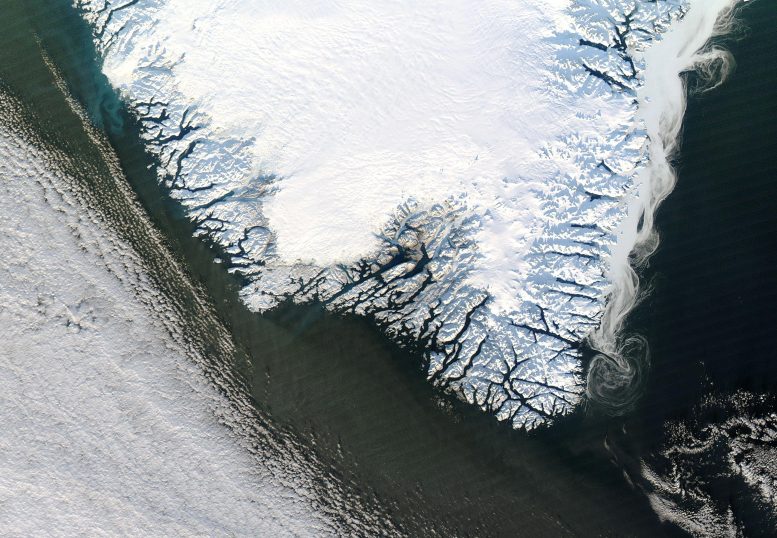
Once we emit about 1000 gigatons of carbon, much of the massive ice sheet will melt irreversibly. We’ve emitted 500 gigatons so far.
The Greenland Ice Sheet covers 1.7 million square kilometers (660,200 square miles) in the Arctic. If it melts entirely, global sea level would rise about 7 meters (23 feet), but scientists aren’t sure how quickly the ice sheet could melt. Modeling tipping points, which are critical thresholds where a system behavior irreversibly changes, helps researchers find out when that melt might occur.
Based in part on carbon emissions, a new study using simulations identified two tipping points for the Greenland Ice Sheet: releasing 1000 gigatons of carbon into the atmosphere will cause the southern portion of the ice sheet to melt; about 2500 gigatons of carbon means permanent loss of nearly the entire ice sheet.
Having emitted about 500 gigatons of carbon, we’re about halfway to the first tipping point.
“The first tipping point is not far from today’s climate conditions, so we’re in danger of crossing it,” said Dennis Höning, a climate scientist at the Potsdam Institute for Climate Impact Research who led the study. “Once we start sliding, we will fall off this cliff and cannot climb back up.”
The study was published in AGU’s journal Geophysical Research Letters, which publishes short-format, high-impact research spanning the Earth and space sciences.
Melting Trends and Contributing Factors
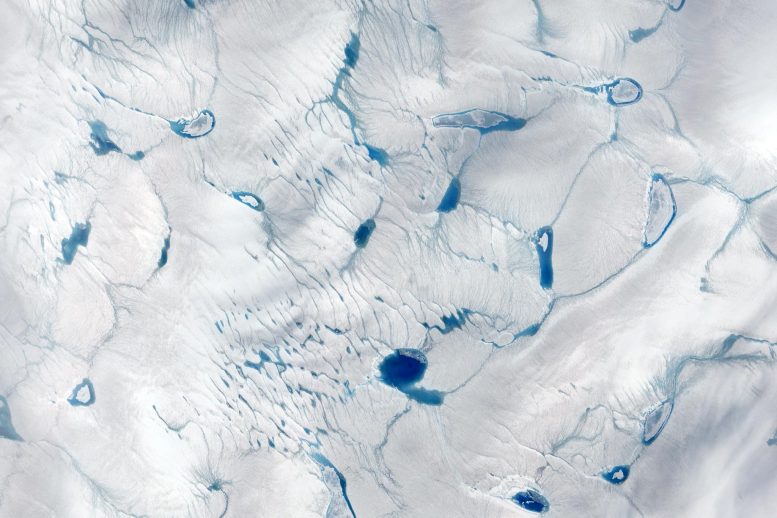
The Greenland Ice Sheet is already melting; between 2003 and 2016, it lost about 255 gigatons (billions of tons) of ice each year. Much of the melt to date has been in the southern part of the ice sheet. Air and water temperature, ocean currents, precipitation, and other factors all determine how quickly the ice sheet melts and where it loses ice.
The complexity of how those factors influence each other, along with the long timescales scientists need to consider for melting an ice sheet of this size, make it difficult to predict how the ice sheet will respond to different climate and carbon emissions scenarios.
Previous research identified global warming of between 1 degree to 3 degrees Celsius (1.8 to 5.4 degrees Fahrenheit) as the threshold beyond which the Greenland Ice Sheet will melt irreversibly.
To more comprehensively model how the ice sheet’s response to climate could evolve over time, Höning’s new study for the first time used a complex model of the whole Earth system, which includes all the key climate feedback processes, paired with a model of ice sheet behavior. They first used simulations with constant temperatures to find equilibrium states of the ice sheet, or points where ice loss equaled ice gain. Then they ran a set of 20,000-year-long simulations with carbon emissions ranging from 0 to 4000 gigatons of carbon.
Carbon Thresholds and Irreversible Feedback Loops
From among those simulations, the researchers derived the 1000-gigaton carbon tipping point for the melting of the southern portion of the ice sheet and the even more perilous 2,500-gigaton carbon tipping point for the disappearance of nearly the entire ice sheet.
As the ice sheet melts, its surface will be at ever-lower elevations, exposed to warmer air temperatures. Warmer air temperatures accelerate melt, making it drop and warm further. Global air temperatures have to remain elevated for hundreds of years or even longer for this feedback loop to become effective; a quick blip of 2 degrees Celsius (3.6 degrees Fahrenheit) wouldn’t trigger it, Höning said. But once the ice crosses the threshold, it would inevitably continue to melt. Even if atmospheric carbon dioxide were reduced to pre-industrial levels, it wouldn’t be enough to allow the ice sheet to regrow substantially.
“We cannot continue carbon emissions at the same rate for much longer without risking crossing the tipping points,” Höning said. “Most of the ice sheet melting won’t occur in the next decade, but it won’t be too long before we will not be able to work against it anymore.”
Reference: “Multistability and Transient Response of the Greenland Ice Sheet to Anthropogenic CO2 Emissions” by Dennis Höning, Matteo Willeit, Reinhard Calov, Volker Klemann, Meike Bagge and Andrey Ganopolski, 27 March 2023, Geophysical Research Letters.
DOI: 10.1029/2022GL101827
Never miss a breakthrough: Join the SciTechDaily newsletter.
Follow us on Google and Google News.
8 Comments
“We cannot continue carbon emissions at the same rate for much longer without risking crossing the tipping points,”
But, we cannot stop using fossil fuels for all of the transportation required to make the transition to renewables and all-electric transportation. 1000 gigatons of CO2 is only 128 parts-per-million. We are already at 420 ppm and the global mean temperature is still less than one degree C. (NOAA, 2021). Tipping points in the past were predicted… but never took place. If one does we can’t stop it anyhow.
Although it is warmer than in glacial periods, people still have to live in heated houses, drive heated cars, work in heated buildings, and wear warm clothes and shoes in the temperate parts of the Earth like the United States and Europe during the winter, and often the spring and fall as well. Humans like the temperature of their skin to be around 85 degrees Fahrenheit but the average temperature in the United States is around 52 degrees, so they have had to find ways to keep warm. https://en.wikipedia.org/wiki/Quaternary_glaciation
“Humans like the temperature of their skin to be around 85 degrees Fahrenheit”
That is very much an American perception to judge by the temperatures I encountered in the buildings at the US McMurdo Station compared with those at NZ’s Scott Base some 45 years ago. We are highly adaptable provided we are comfortable with the discomfort of adapting to different external temperatures, the classic case being perhaps the former Yaghans of southern Patagonia. Likewise some of the European Arctic and Antarctic explorers of the 1600-1960s period, not to mention the assorted sailors who spanned the world since H sapiens took on going to sea for a living.
The geological climate of the Earth is still a 2.58-million-year ice age named the Quaternary Glaciation. The Earth is in a warm interglacial period that happens about every 100,000 years and lasts about 10,000 years which alternates with a cold glacial period that lasts about 90,000 years. The Earth still has around 200,000 glaciers and 11 percent of the land is permafrost. The ice age the Earth is in won’t end and the climate won’t officially change until all the natural ice melts. https://en.wikipedia.org/wiki/Quaternary_glaciation
“tipping points, which are critical thresholds where a system behavior irreversibly changes, …”
Tipping points are a theoretical fantasy. The Earth has been colder and warmer during its 4.5 billion year history and it didn’t get stuck in one of those events, which exceeded the predicted tipping point.
Ice cores from the interior of Greenland reveal that during the Eemian, not only was the ice gone, but soils and plants developed, after apparently having far exceeded the predicted tipping point. Yet, here we are, with abundant ice after having exceeded the “irreversible” threshold!
To be effective at scaring people, it is necessary to use logically consistent definitions, not just re-assign meanings to things that are real, like trees or towers falling over.
You neglect the extremely destructive behaviour of human populations when normal,comfortable conditions change.
“‘it didn’t get stuck in one of those events”. Actually, it did. Oxygenation of our atmosphere. And the development of the eukaryotic cell was another such event.
“As the ice sheet melts, its surface will be at ever-lower elevations, …”
Ice melts at a fixed temperature, which is seldom reached in the interior of the ice sheet. Most of the melting will occur on the edges. Another way of saying this is that the melting across the ice sheet isn’t uniform, and is not directly proportional to the average temperature until the average is below 0 deg C. Citing a big number like “255 gigatons of ice each year” may scare the uncritical reader, but is meaningless without context. The last time I did a back-of-envelope calculation, I came up with a number of about 15,000 years for the ice sheet to melt. By that time, we will probably be back in another glaciation. Does anyone really believe we will still be using large amounts of fossil fuels in even 1,000 years? The outputs of these unvalidated models are highly dependent on unstated assumptions and are fantasy exercises akin to calculating the number of angels that can dance on the head of a pin.
“until the average is below 0 deg C”. Please explain. I have spent many years observing ice melt and it seems to occur when the surface temperature of ice rises above 0 degrees C.