
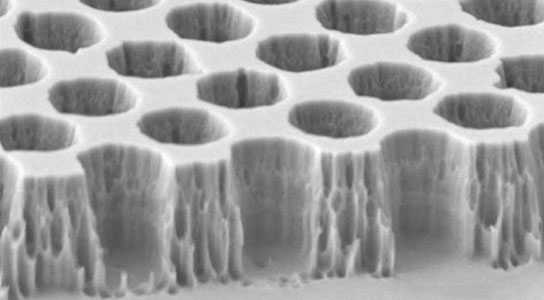
Researchers at MIT have developed a new power source by making a high-temperature version of materials called photonic crystals. By using metals such as tungsten or tantalum, the two-dimensional photonic crystals operate at temperatures up to 1200 degrees Celsius and could be used to power anything from portable electronic devices to NASA spacecraft.
A team of MIT scientists has developed a way of making a high-temperature version of a kind of materials called photonic crystals, using metals such as tungsten or tantalum. The new materials — which can operate at temperatures up to 1200 degrees Celsius — could find a wide variety of applications powering portable electronic devices, spacecraft to probe deep space, and new infrared light emitters that could be used as chemical detectors and sensors.
Compared to earlier attempts to make high-temperature photonic crystals, the new approach is “higher performance, simpler, robust and amenable to inexpensive large-scale production,” says Ivan Celanovic ScD ’06, senior author of a paper describing the work in the Proceedings of the National Academy of Sciences. The paper was co-authored by MIT professors John Joannopoulos and Marin Soljačić, graduate students Yi Xiang Yeng and Walker Chen, affiliate Michael Ghebrebrhan and former postdoc Peter Bermel.
These new high-temperature, two-dimensional photonic crystals can be fabricated almost entirely using standard microfabrication techniques and existing equipment for manufacturing computer chips, says Celanovic, a research engineer at MIT’s Institute for Soldier Nanotechnologies.
While there are natural photonic crystals — such as opals, whose iridescent colors result from a layered structure with a scale comparable to wavelengths of visible light — the current work involved a nanoengineered material tailored for the infrared range. All photonic crystals have a lattice of one kind of material interspersed with open spaces or a complementary material, so that they selectively allow certain wavelengths of light to pass through while others are absorbed. When used as emitters, they can selectively radiate certain wavelengths while strongly suppressing others.
Photonic crystals that can operate at very high temperatures could open up a suite of potential applications, including devices for solar-thermal conversion or solar-chemical conversion, radioisotope-powered devices, hydrocarbon-powered generators or components to wring energy from waste heat at powerplants or industrial facilities. But there have been many obstacles to creating such materials: The high temperatures can lead to evaporation, diffusion, corrosion, cracking, melting or rapid chemical reactions of the crystals’ nanostructures. To overcome these challenges, the MIT team used computationally guided design to create a structure from high-purity tungsten, using a geometry specifically designed to avoid damage when the material is heated.
NASA has taken an interest in the research because of its potential to provide long-term power for deep-space missions that cannot rely on solar power. These missions typically use radioisotope thermal generators (RTGs), which harness the power of a small amount of radioactive material. For example, the new Curiosity rover scheduled to arrive at Mars this summer uses an RTG system; it will be able to operate continuously for many years, unlike solar-powered rovers that have to hunker down for the winter when solar power is insufficient.
Other potential applications include more efficient ways of powering portable electronic devices. Instead of batteries, these devices could run on thermophotovoltaic generators that produce electricity from heat that is chemically generated by microreactors, from a fuel such as butane. For a given weight and size, such systems could allow these devices to run up to 10 times longer than they do with existing batteries, Celanovic says.
Shawn Lin, a professor of physics at Rensselaer Polytechnic Institute who specializes in future chip-making technology, says that research on thermal radiation at high temperatures “continues to challenge our scientific understanding of the various emission processes at sub-wavelength scales, and our technological capability.” Lin, who was not involved in this work, adds, “This particular 2-D tungsten photonic crystal is quite unique, as it is easier to fabricate and also very robust against high-temperature operation. This photonic-crystal design should find important application in solar-thermal energy-conversion systems.”
While it’s always hard to predict how long it will take for advances in basic science to lead to commercial products, Celanovic says he and his colleagues are already working on system integration and testing applications. There could be products based on this technology in as little as two years, he says, and most likely within five years.
In addition to producing power, the same photonic crystal can be used to produce precisely tuned wavelengths of infrared light. This could enable highly accurate spectroscopic analysis of materials and lead to sensitive chemical detectors, he says.
Reference: “Enabling high-temperature nanophotonics for energy applications” by Yi Xiang Yeng, Michael Ghebrebrhan, Peter Bermel, Walker R. Chan, John D. Joannopoulos, Marin Soljačić and Ivan Celanovic, 23 January 2012, Proceedings of the National Academy of Sciences.
DOI: 10.1073/pnas.1120149109
The research was partly supported by the Army Research Office through the Institute for Soldier Nanotechnologies, NASA and an MIT Energy Initiative seed grant, as well as by TeraGrid resources and the MIT S3TEC Energy Research Frontier Center of the U.S. Department of Energy.
Never miss a breakthrough: Join the SciTechDaily newsletter.
Follow us on Google and Google News.