
New Brain Study Shows How Obeying Orders Can Dull Our Empathy
War atrocities are sometimes committed by ‘normal’ people obeying orders. Researchers from the Netherlands Institute for Neuroscience measured brain activity while participants inflicted pain and found that obeying orders reduced empathy and guilt-related brain activity for the inflicted pain. This may explain why people are able to commit immoral acts under coercion.
Many examples in the history of mankind have shown that when people obey orders from an authority, they are able to perform atrocious acts toward others. All the genocides that mankind has known, generally referred to as crimes of obedience, have shown that having a part of the population complying with orders to exterminate other human beings led to the loss of countless lives, cultures, and civilizations. “We wanted to understand why obeying orders impacts moral behavior so much. Why people’s willingness to perform moral transgressions is altered in coerced situations,” says Dr. Emilie Caspar, co-first author of the present study.
Feeling the pain
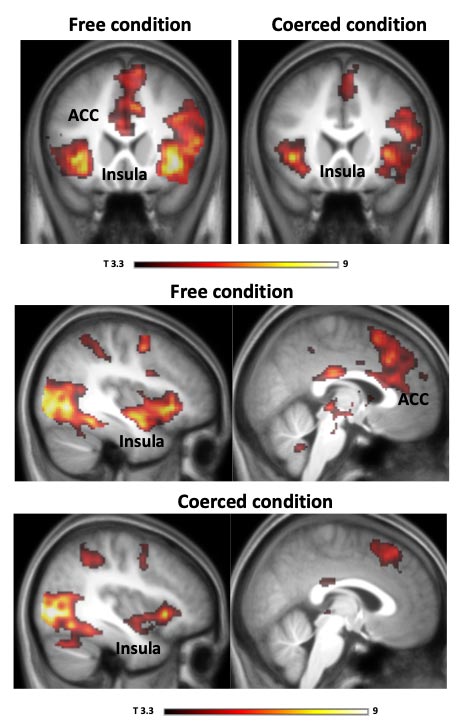
When humans witness another person experiencing pain, be it emotional or physical, they have an empathic reaction, and this is thought to be what makes us averse to harming others. “We can measure that empathy in the brain, because we see that regions normally involved in feeling our own pain, including the anterior insula and the rostral cingulate cortex, become active when we witness the pain of others, and the stronger that activity, the more empathy we experience, and the more we do to prevent harm to others,” explains Dr. Valeria Gazzola, co-senior author of the paper. This process is deeply ingrained in our biology and shared by other mammals, such as rodents or apes. “We evaluated in this study if obeying orders to inflict pain to someone else would reduce the empathic response compared to freely deciding to inflict – or not to inflict – the same pain,” reports professor Christian Keysers, the other co-senior author of the present study.
In the study published in NeuroImage, the authors used pairs of participants, with one being assigned the role of ‘agent’ and the other the role of ‘victim’. Agents were placed in an MRI scanner to record their brain activity during the task. They were told that they had two buttons; one triggering the administration of a real, mildly painful, shock on the victim’s hand in exchange for +0.05€, and another triggering no shock and no money. Over the course of 60 rounds, agents were either free to choose to administer – or not – this shock to the victim, or they received orders from the experimenter to inflict – or not – the same shock. This task was designed to involve a difficult moral decision for agents: increasing one’s own monetary gain by causing pain to another person or not.
Reduced activations
The authors observed that agents sent more shocks to victims when they were coercively instructed than when they freely decided. “Neuroimaging results showed that empathy-related regions were less active when obeying orders compared to acting freely. We also observed that obeying orders reduced activations in brain regions associated with the feeling of guilt,” explains Kalliopi Ioumpa, co-first author of the present study.
The observation that obeying an order to inflict pain reduced activation in empathy and guilt-related brain regions explains, at least partly, why people can commit highly immoral acts towards others under coercion. These results have huge implications in terms of understanding the power that obedience has over human behavior and offer new insights into the possibility of preventing mass-atrocities committed because of a lack of empathy for victims. “The next step will be to understand why so few people resist immoral orders. Is it because their empathy weakens when they are following orders? A better understanding of how the brain processes empathy and instructions may lead to ways to help us resist calls to commit violence in the future,” says Dr. Emilie Caspar.
Reference: “Obeying orders reduces vicarious brain activation towards victims’ pain” by Emilie A. Caspar, Kalliopi Ioumpa, Christian Keysers and Valeria Gazzola, 13 August 2020, NeuroImage.
DOI: 10.1016/j.neuroimage.2020.117251
Never miss a breakthrough: Join the SciTechDaily newsletter.
Follow us on Google and Google News.