
Close Menu
    Facebook X (Twitter) Instagram
    SciTechDaily
    • Biology
    • Chemistry
    • Earth
    • Health
    • Physics
    • Science
    • Space
    • Technology
    Facebook X (Twitter) Pinterest YouTube RSS
    SciTechDaily
    Home»Biology»Researchers Discover Human-Specific Gene for Building a Bigger Brain
    Biology

    Researchers Discover Human-Specific Gene for Building a Bigger Brain

    By Katrin Boes, Max Planck InstituteJanuary 17, 20191 Comment3 Mins Read
    Facebook Twitter Pinterest Telegram LinkedIn WhatsApp Email Reddit
    Share
    Facebook Twitter LinkedIn Pinterest Telegram Email Reddit
    Building a Bigger Brain
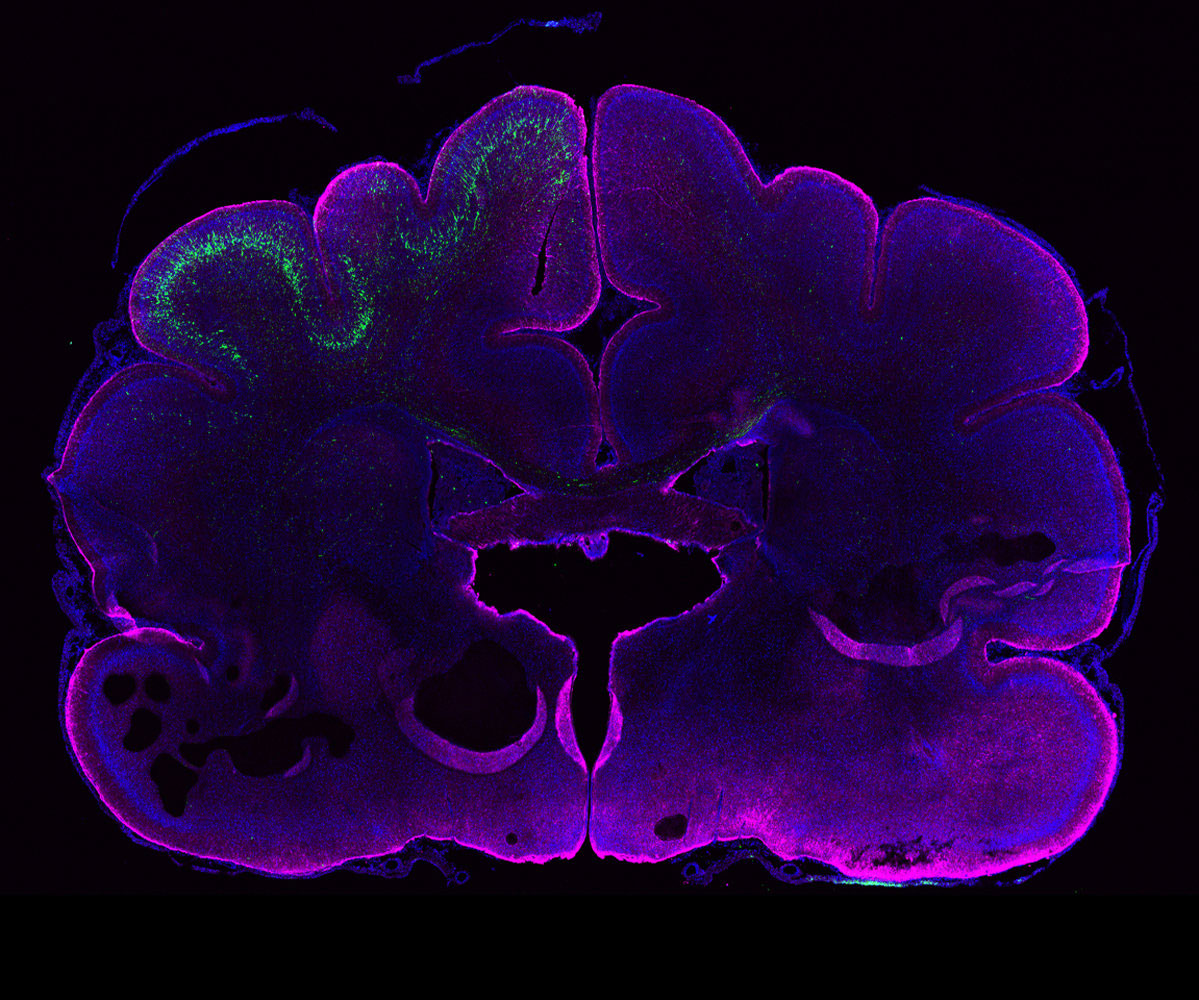
    The picture shows the developing ferret brain. Magenta marks glial cells and clearly shows the outer contour of the brain. The green area consists of neurons that contain ARHGAP11B. © MPI-CBG, Kalebic, Gilardi

    The human brain owes its characteristic wrinkled appearance to its outer layer, the cerebral cortex. During human evolution, the neocortex, the evolutionarily youngest part of the cerebral cortex, expanded dramatically and had to fold into wrinkles to fit inside the restricted space of the skull. The human neocortex supports advanced cognitive skills such as reasoning and language. But how did the human neocortex become so big? The answer may lie in genes that are unique to humans, such as ARHGAP11B. Researchers at the Max Planck Institute of Molecular Cell Biology and Genetics in Dresden found that this human-specific gene, when introduced into the developing brain of ferrets, can cause an enlargement of their neocortex. ARHGAP11B causes neural progenitor cells, which are cells that produce neurons, to make more of themselves for a longer period of time. The result is an expanded neocortex.

    The human neocortex is roughly three times bigger than that of our closest relatives, the chimpanzees, and is the seat of many of the higher cognitive functions that are unique to humans, such as our speech or the ability to learn. A key question for scientists is how in human evolution the neocortex became so big.

    In a 2015 study, the team around Wieland Huttner, research group leader at the Max Planck Institute of Molecular Cell Biology and Genetics, found that under the influence of the human-specific gene ARHGAP11B, mice produced much more neural progenitor cells and could even undergo folding of their normally unfolded neocortex. The results suggested that the gene ARHGAP11B plays a key role in the evolutionary expansion of the human neocortex.

    There are two types of neural progenitors in the mammalian neocortex: apical and basal. A subtype of the latter, called basal radial glial cells, are driving neocortex growth in human development. Unfortunately, mice have very few of them, which makes mice unsuitable to test whether the human-specific gene ARHGAP11B – via its effects on basal radial glial cells – can indeed cause an enlargement of the neocortex.

    A team of researchers from the research group of Wieland Huttner now investigated what ARHGAP11B would bring about in a ferret brain. Ferrets have a larger neocortex than mice and possess more basal radial glial cells. The first author of the study, Nereo Kalebic, explains what he was able to observe: “In ferrets, ARHGAP11B noticeably increased the number of basal radial glial cells. It also extended the time window during which the basal radial glial cells produced neurons. As a result, these ferret brains contained more neurons and thus had a bigger neocortex.” These results suggest that ARHGAP11B may have a similar role in the developing human brain. This study also provides the first evidence of a human-specific gene increasing the number of basal radial glial cells in a folded neocortex.

    Wieland Huttner, who supervised the study, gives an outlook: “Further experiments need to be done to determine whether the ferrets with a larger neocortex also have enhanced cognitive abilities. If they do, testing these animals may provide insights into human cognition.”

    Reference: “Human-specific ARHGAP11B induces hallmarks of neocortical expansion in developing ferret neocortex” by Nereo Kalebic, Carlotta Gilardi, Mareike Albert, Takashi Namba, Katherine R Long, Milos Kostic, Barbara Langen and Wieland B Huttner, 28 November 2018, eLife.
    DOI: 10.7554/eLife.41241

    Never miss a breakthrough: Join the SciTechDaily newsletter.
    Follow us on Google and Google News.

    Cell Biology Evolutionary Biology Genetics Max Planck Institute Neurology
    Share. Facebook Twitter Pinterest LinkedIn Email Reddit

    Related Articles

    Genomic Regions That Set Humans Apart From Other Primates Carry Many Autism-Linked Mutations

    Scientists Discover a Gene for Brain Size

    Ancient DNA Reveals Link between Early Humans & Present-Day Asians and Native Americans

    Gene Flow Between Indian Populations and Australia Occurred 4,000 Years Ago

    Ancient Genome Reveals Relationships Between Denisovans and Present-Day Humans

    Investigating the Evolutionary Model of Muller’s Ratchet

    Bonobo Genome Completed, Differs from Humans by 1.3 Percent

    DNA Jumps Directly From the Cell’s Chloroplasts Into Its Nucleus

    Researchers Complete Genome Sequence of a Denisovan Human Finger Bone

    1 Comment

    1. Suraj Mehar on January 29, 2019 9:01 pm

      What is ARHGAP11B ?

      Reply
    Leave A Reply Cancel Reply

    • Facebook
    • Twitter
    • Pinterest
    • YouTube

    Don't Miss a Discovery

    Subscribe for the Latest in Science & Tech!

    Trending News

    Scientists Uncover Potential Brain Risks of Popular Fish Oil Supplements

    Scientists Discover a Surprising Way To Make Bread Healthier and More Nutritious

    After 60 Years, Scientists Uncover Unexpected Brain Effects of Popular Diabetes Drug Metformin

    New Research Uncovers Hidden Side Effects of Popular Weight-Loss Drugs

    Scientists Rethink Extreme Warming After Surprising Ocean Discovery

    Landmark Study Links Never Marrying to Significantly Higher Cancer Risk

    Researchers Discover Unknown Beetle Species Just Steps From Their Lab

    Largest-Ever Study Finds Medicinal Cannabis Ineffective for Anxiety, Depression, PTSD

    Follow SciTechDaily
    • Facebook
    • Twitter
    • YouTube
    • Pinterest
    • Newsletter
    • RSS
    SciTech News
    • Biology News
    • Chemistry News
    • Earth News
    • Health News
    • Physics News
    • Science News
    • Space News
    • Technology News
    Recent Posts
    • Powerful Lasers Reveal How Matter Becomes Plasma in Trillionths of a Second
    • A Simpler Path to Super-Resolution: Scientists Reinvent Microscopy
    • Scientists Uncover Hidden Genetic Cause of Diabetes in Babies
    • Amazonian Chocolate Could Become the Next Superfood, Scientists Say
    • Challenging the Narrative: New Study Shows U.S. Life Expectancy Is Rising Across All States
    Copyright © 1998 - 2026 SciTechDaily. All Rights Reserved.
    • Science News
    • About
    • Contact
    • Editorial Board
    • Privacy Policy
    • Terms of Use

    Type above and press Enter to search. Press Esc to cancel.