
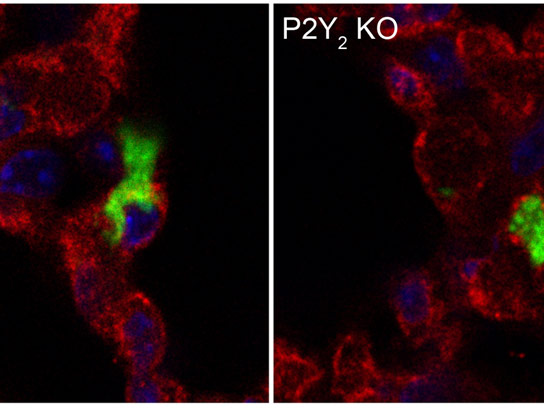
Researchers from the Max Planck Institute have identified the P2Y2 receptor molecule on the cells of the blood platelet wall as the gateway that enables cancer cells to penetrate blood vessels and enter the organs.
Malignant tumors often spread to remote areas of the body. In the majority of cases, metastasis formation develops via the blood-vascular system. The blood platelets thereby provide invaluable help to the tumor cells in penetrating new organs. Scientists from the Max Planck Institute for Heart and Lung Research in Bad Nauheim have identified the P2Y2 receptor molecule on the cells of the blood platelet wall as the gateway that allows the cancer cells to enter the organs. They now aim to prevent the formation of metastases through the targeted blocking of this key molecule.
Blood platelets play a crucial role in hemostasis. When a blood vessel is injured, the platelets ensure the rapid initial closure of the wound. To do this, they quickly adhere to the wall of the injured blood vessel, thereby attracting more platelets which aggregate and form a plug that blocks the opening in the blood vessel wall. To enable the optimal functioning of this “rapid reaction force” in the event of injury to blood vessel walls, the blood platelets release a veritable shower of signal molecules. The cells communicate with each other in this manner. Moreover, the platelets, which normally circulate in the blood stream in an inactive state, are activated in a matter of seconds and fundamentally alter their characteristics.
Malignant tumors, which often spread to previously unaffected organs through the blood stream, use the blood platelets to penetrate the hermetically-sealed blood vessel wall. “It has long been known that metastasizing tumor cells are capable of establishing close contact with blood platelets and activating them. Animal experiments have shown that tumor cells form far fewer metastases in the absence of blood platelets,” says Stefan Offermanns, Director of the Department of Pharmacology at the Bad Nauheim-based Max Planck Institute. In addition, clinical studies have shown that patients who receive long-term treatment with platelet inhibitors like acetylsalicylic acid present a lower risk of developing metastasizing tumors.
Offermanns’ Research Group has succeeded in explaining exactly how this process unfolds. Activated blood cells release a large amount of molecules including adenosine triphosphate (ATP). The scientists observed in cell cultures that blocking ATP release from blood platelets resulted in a significant reduction in the number of tumor cells migrating through the endothelial cells in the blood vessel wall. “We succeeded in demonstrating the same phenomenon in experiments on mice, in which the release of ATP from blood platelets was blocked. In this case too, far fewer tumor cells slipped through the endothelial barrier, and fewer metastases formed,” says Dagmar Schuhmacher, one of the study’s first authors.
However, what exactly happens in the blood vessel wall that enables the tumor cells to penetrate it? The Max Planck researchers were able to demonstrate that ATP from the blood platelets binds with a particular receptor called P2Y2. This docking site is located on the surface of the endothelial cells. “When ATP binds to these receptors, small openings form between the individual endothelial cells. The tumor cells exit the blood vessel through these openings and migrate into the organ,” explains Boris Strilic, also a first author of the study.
With the identification of this hitherto unknown role of blood platelets in metastases formation, the researchers hope to have found possible starting points for a new therapeutic approach. “We will now test whether specific blockers for the P2Y2 receptor or substances that inhibit the release of ATP from blood platelets can suppress tumor cell metastasis in different animal models,” says Offermanns. The specific challenge the scientists must overcome here is to avoid suppressing the actual job of the platelets, namely hemostasis, in the process. If they manage to do this, a better treatment for malignant tumors may become available in the future.
Reference: “Platelet-Derived Nucleotides Promote Tumor-Cell Transendothelial Migration and Metastasis via P2Y2 Receptor” by Dagmar Schumacher, Boris Strilic, Kishor Kumar Sivaraj, Nina Wettschureck and Stefan Offermanns, 27 June 2013, Cancer Cell.
DOI: 10.1016/j.ccr.2013.05.008
Never miss a breakthrough: Join the SciTechDaily newsletter.
Follow us on Google and Google News.
2 Comments
this is fantastic news!
Acetyl Salicylic Acid (ASA-Aspirin) is already prescribed for coronary patients to prevent blood clotting/ It is a great news to find a new use for the same old Aspirin again to prevent Metastasis. The gateway of P2Y2 opening by floating platelet’s ATP to form a pore in epithelial cells gives an exit for cancer cells, which was found to form a company with blood leukocytes as described by an earlier article, paves way for the villainy of metastases. It is good that cancer research is going in the right direction and I hail them well. Thank You.