

Latnija cave discoveries show Mesolithic humans crossed 100 km of sea to reach Malta 1,000 years earlier than previously believed, reshaping views on prehistoric seafaring.
Small, remote islands were once believed to be among the last untouched natural environments, with humans thought to have been unable to reach or settle them before the advent of agriculture and its associated technological developments.
However, a new study published in Nature presents evidence that challenges this view. Researchers have found that hunter-gatherers were crossing at least 100 kilometers (62 miles) of open sea to reach the Mediterranean island of Malta as early as 8,500 years ago—1,000 years before the arrival of the first farmers.
This discovery represents the earliest known example of true long-distance seafaring in the Mediterranean, achieved long before the use of sails. An astonishing feat for these early navigators who likely traveled in simple dugout canoes.
Navigation methods and risks of the journey
“Relying on sea surface currents and prevailing winds, as well as the use of landmarks, stars, and other wayfinding practices, a crossing of about 100 km is likely, with a speed of about 4 km per hour. Even on the longest day of the year, these seafarers would have had over several hours of darkness in open water,” explains Professor Nicholas Vella of the University of Malta, co-investigator of the study

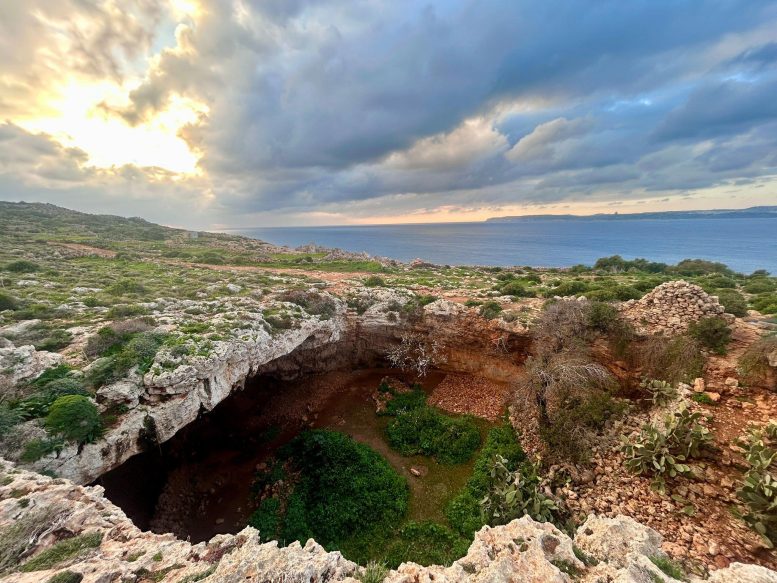
The discoveries were made by a scientific consortium led by Professor Eleanor Scerri of the Max Planck Institute of Geoanthropology (MPI-GEA) and the University of Malta. At the cave site of Latnija in the northern Mellieħa region of Malta, the researchers found the traces of humans in the form of their stone tools, hearths, and cooked food waste.
“We found abundant evidence for a range of wild animals, including Red Deer, long thought to have gone extinct by this point in time,” explains Prof. Scerri. “They were hunting and cooking these deer alongside tortoises and birds, including some that were extremely large and extinct today.”
Diet and exploitation of marine resources
In addition to this, the team of researchers found clear evidence for the exploitation of marine resources. “We found remains of seal, various fish, including grouper, and thousands of edible marine gastropods, crabs, and sea urchins, all indisputably cooked,” adds Dr James Blinkhorn of the University of Liverpool and MPI-GEA, one of the study’s corresponding authors.
These discoveries also raise questions about the extinction of endemic animals on Malta and other small and remote Mediterranean islands, and whether distant Mesolithic communities may have been linked through seafaring.

“The results add a thousand years to Maltese prehistory and force a re-evaluation of the seafaring abilities of Europe’s last hunter-gatherers, as well as their connections and ecosystem impacts,” adds Prof. Scerri.
Reference: “Hunter-gatherer sea voyages extended to remotest Mediterranean islands” by Eleanor M. L. Scerri, James Blinkhorn, Huw S. Groucutt, Mathew Stewart, Ian Candy, Ethel Allué, Aitor Burguet-Coca, Andrés Currás, W. Christopher Carleton, Susanne Lindauer, Robert Spengler, Kseniia Boxleitner, Gillian Asciak, Margherita Colucci, Ritienne Gauci, Amy Hatton, Johanna Kutowsky, Andreas Maier, Mario Mata-González, Nicolette Mifsud, Khady Niang, Patrick Roberts, Joshua de Giorgio, Rochelle Xerri and Nicholas C. Vella, 9 April 2025, Nature.
DOI: 10.1038/s41586-025-08780-y
The research was supported by Malta’s Superintendence of Cultural Heritage, and funded by the European Research Council and the University of Malta’s Research Excellence Award.
Never miss a breakthrough: Join the SciTechDaily newsletter.
Follow us on Google and Google News.
1 Comment
grasping with big lies and, mis dating, there’s a +-6000 non calculated sccepted mistake in carbon dating, meaning nothing is dated correctly. which places this evidence into the correct time period meaning the original view.
carbon dating since its discovery has not been ever reliable in any frame of reference. there’s still major debate after 75yrs.
old school science has been unreliable and at best creating fantasy story models with false prejudiced evidence. and the one agreed upon by other peers becomes the so called accepted proof.
all science is a lie at best.