
Astronomers Discover Closest Black Hole to Earth
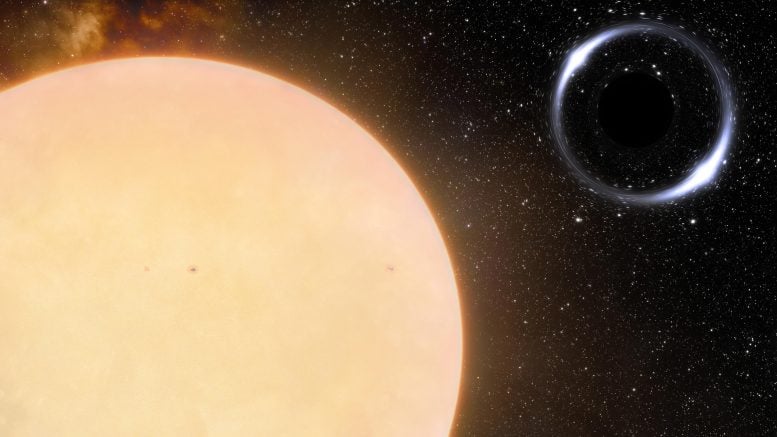
Astronomers have discovered the closest black hole to Earth, which the researchers have dubbed Gaia BH1. The dormant black hole weighs about 10 times the mass of the Sun and is located about 1600 light-years away in the constellation Ophiuchus, making it three times closer to Earth than the previous record holder, an X-ray binary in the constellation of Monoceros.
The discovery was made possible by making exquisite observations of the motion of the black hole’s companion, a Sun-like star that orbits the black hole at about the same distance as the Earth orbits the Sun.
“Take the Solar System, put a black hole where the Sun is, and the Sun where the Earth is, and you get this system,” explains Kareem El-Badry, an astrophysicist at the Center for Astrophysics | Harvard & Smithsonian and the Max Planck Institute for Astronomy, and the lead author of the paper describing this discovery. “While there have been many claimed detections of systems like this, almost all these discoveries have subsequently been refuted. This is the first unambiguous detection of a Sun-like star in a wide orbit around a stellar-mass black hole in our galaxy.”
Black holes are the most extreme objects in the universe. Supermassive versions of these unimaginably dense objects likely reside at the centers of all large galaxies. Stellar-mass black holes — which weigh approximately five to 100 times the mass of the Sun — are much more common, with an estimated 100 million in the Milky Way alone. Only a handful have been confirmed to date, however, and nearly all of these are ‘active,’ meaning they shine brightly in X-rays as they consume material from a nearby stellar companion, unlike dormant black holes which do not.
Though there are likely millions of stellar-mass black holes roaming the Milky Way Galaxy, those few that have been detected were uncovered by their energetic interactions with a companion star. As material from a nearby star spirals in toward the black hole, it becomes superheated and generates powerful X-rays and jets of material. If a black hole is not actively feeding (i.e., it is dormant) it simply blends in with its surroundings.
A Breakthrough in Detecting Hidden Black Holes
“I’ve been searching for dormant black holes for the last four years using a wide range of datasets and methods,” says El-Badry. “My previous attempts — as well as those of others — turned up a menagerie of binary systems that masquerade as black holes, but this is the first time the search has borne fruit.”
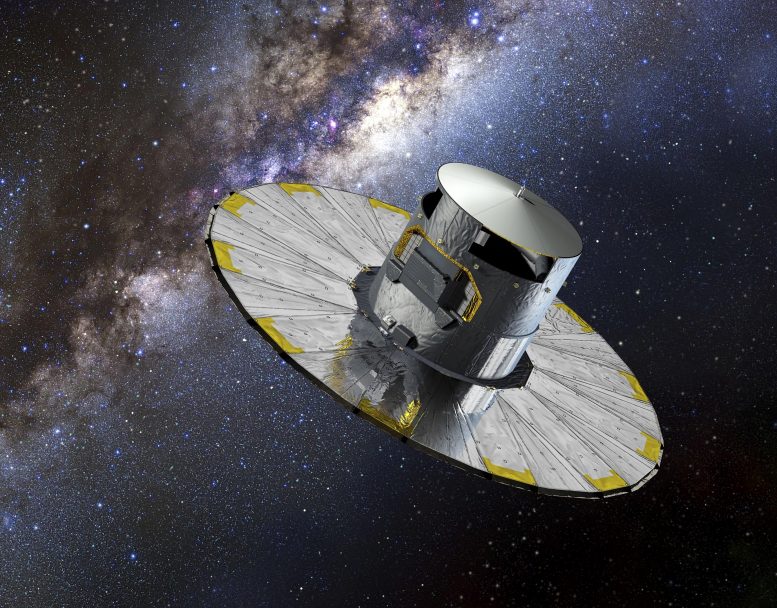
The team originally identified the system as potentially hosting a black hole by analyzing data from the European Space Agency’s Gaia spacecraft. Gaia captured the minute irregularities in the star’s motion caused by the gravity of an unseen massive object.
To explore the system in more detail, the team followed up with 39 observations over the course of four months, taken with six different telescopes around the world.
The first observation was carried out in July through a Center for Astrophysics telescope allocation using the 6.5m Magellan Baade telescope at Las Campanas Observatory in Chile. After this observation suggested that the binary might contain a black hole, the team submitted several director’s discretionary time proposals — or time-critical observing requests — to study the system with other telescopes, which would offer a variety of advantages including higher spectral resolution and sensitivity to ultraviolet and near-infrared wavelengths.
One such telescope the team turned to was the Gemini Multi-Object Spectrograph instrument on Gemini North, a telescope in Hawai’i that is operated by NSF’s NOIRLab. Gemini follow-up observations helped constrain the orbital motion and hence, masses of the two components in the binary system, allowing the team to identify the central body as a black hole roughly 10 times as massive as our Sun.
“Our Gemini follow-up observations confirmed beyond reasonable doubt that the binary contains a normal star and at least one dormant black hole,” El-Badry explains. “We could find no plausible astrophysical scenario that can explain the observed orbit of the system that doesn’t involve at least one black hole.”
The data from these observations brought the system into focus and ruled out all models not involving a black hole.
Challenging Binary Evolution Models
Astronomers’ current models of the evolution of binary systems are hard-pressed to explain how the peculiar configuration of Gaia BH1 system could have arisen. Specifically, the progenitor star that later turned into the newly detected black hole would have been at least 20 times as massive as our Sun. This means it would have lived only a few million years. If both stars formed at the same time, this massive star would have quickly turned into a supergiant, puffing up and engulfing the other star before it had time to become a proper, hydrogen-burning, main-sequence star like our Sun.
It is not at all clear how the solar-mass star could have survived that episode, ending up as an apparently normal star, as the observations of the black hole binary indicate. Theoretical models that do allow for survival all predict that the solar-mass star should have ended up on a much tighter orbit than what is actually observed.
This could indicate that there are important gaps in scientists’ understanding of how black holes form and evolve in binary systems, and also suggests the existence of an as-yet-unexplored population of dormant black holes in binaries.
“It is interesting that this system is not easily accommodated by standard binary evolution models,” El-Badry concludes. “It poses many questions about how this binary system was formed, as well as how many of these dormant black holes there are out there.”
For more on this research, see Astronomers Discover Closest Black Hole to Earth.
Reference: “A Sun-like star orbiting a black hole” by Kareem El-Badry, Hans-Walter Rix, Eliot Quataert, Andrew W Howard, Howard Isaacson, Jim Fuller, Keith Hawkins, Katelyn Breivik, Kaze W K Wong, Antonio C Rodriguez, Charlie Conroy, Sahar Shahaf, Tsevi Mazeh, Frédéric Arenou, Kevin B Burdge, Dolev Bashi, Simchon Faigler, Daniel R Weisz, Rhys Seeburger, Silvia Almada Monter and Jennifer Wojno, 2 November 2022, Monthly Notices of the Royal Astronomical Society.
DOI: 10.1093/mnras/stac3140
Never miss a breakthrough: Join the SciTechDaily newsletter.
Follow us on Google and Google News.
2 Comments
More from “the researchers” who suggested that the binary “might” contain a…
That was quite enough for me.
Somewhat sensationalist, backyard at 1600 LY.
Please don’t do this, or I’m gone.