
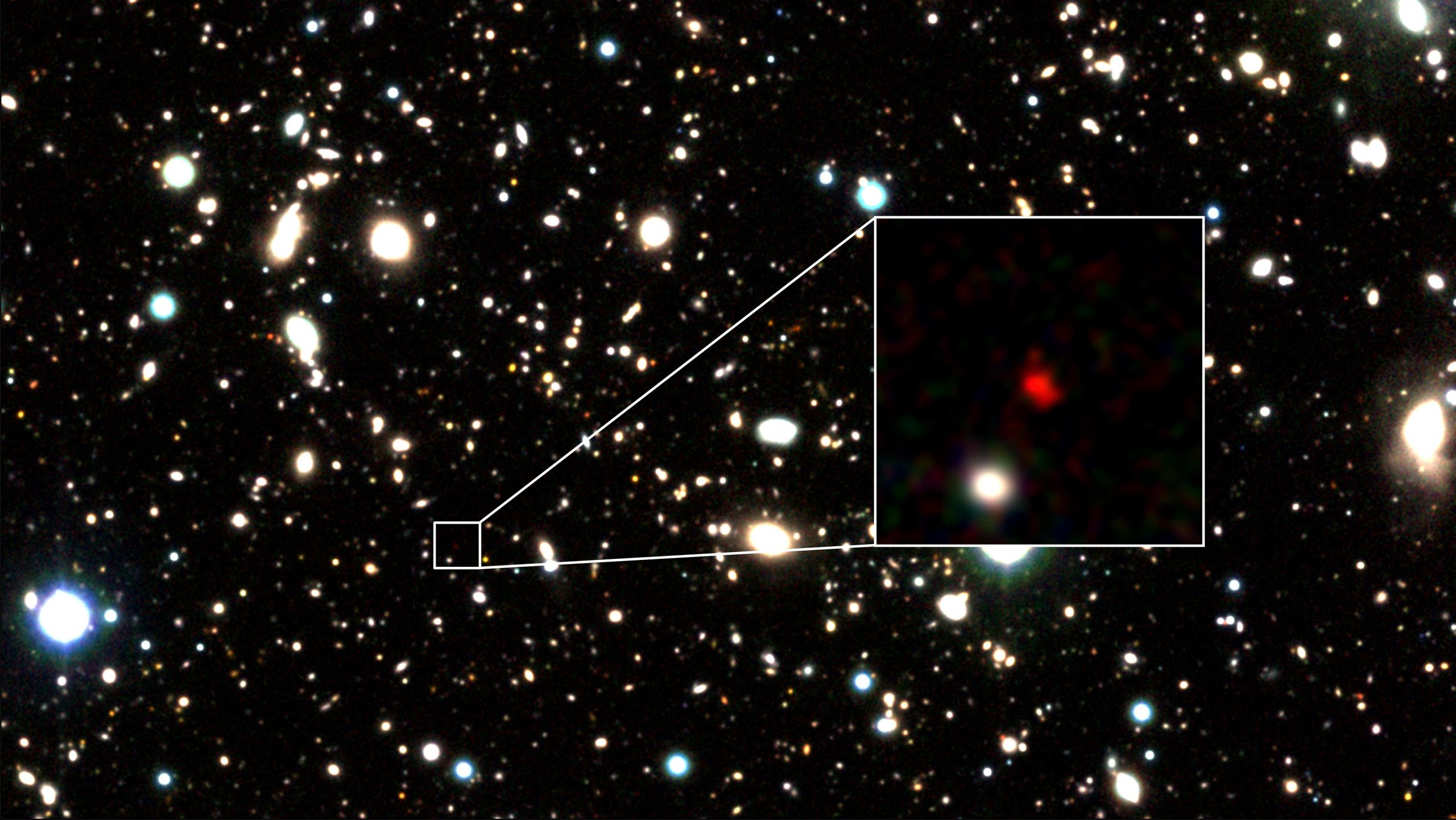
Shining only ~300 million years after the Big Bang, it may be home to the oldest stars in the universe, or a supermassive black hole.
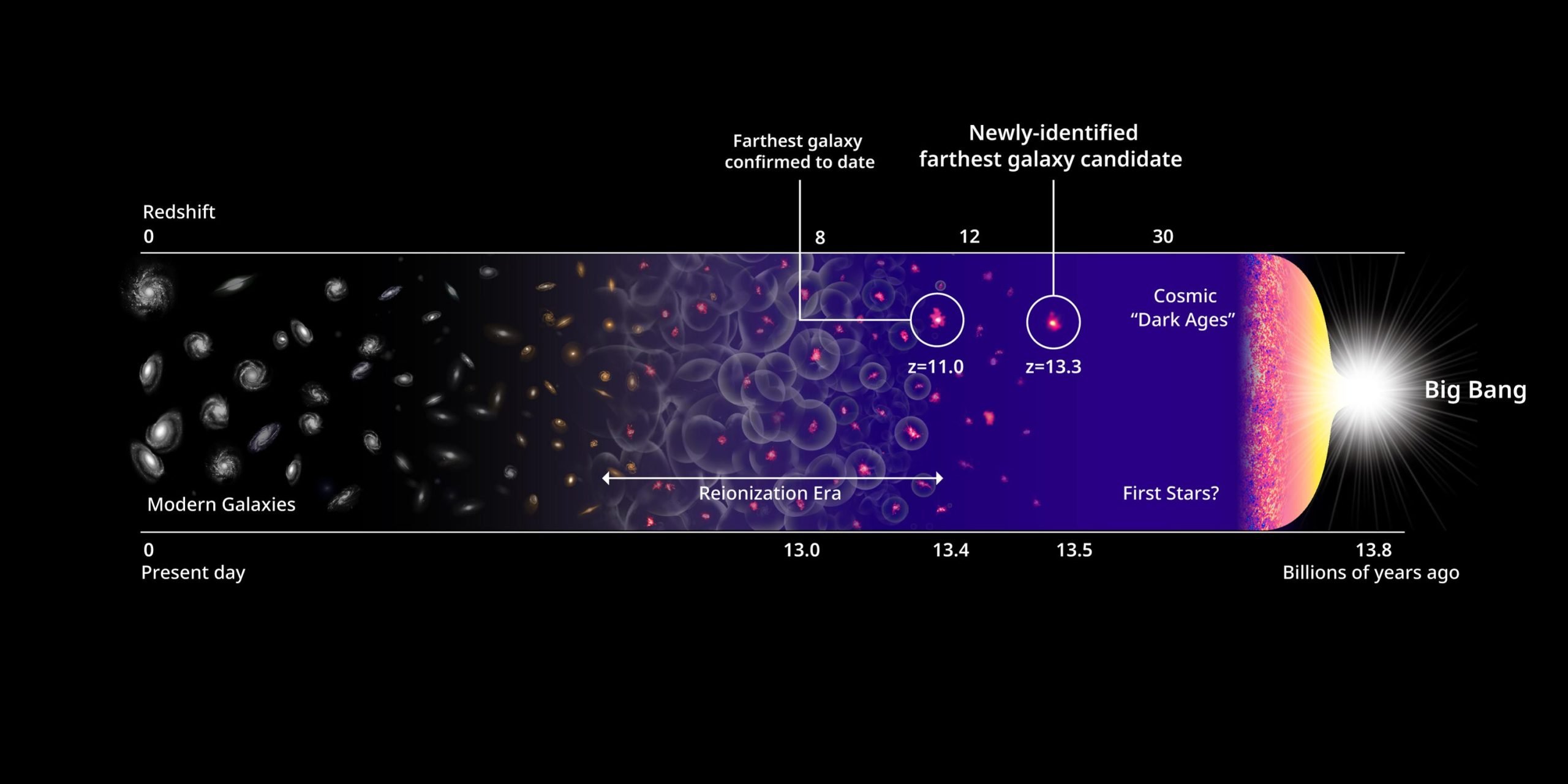
A group of astronomers from across the world, including those from the Center for Astrophysics | Harvard & Smithsonian, has discovered the most distant astronomical object ever: a galaxy. The galaxy candidate, known as HD1, is 13.5 billion light-years distant and was first detailed in The Astrophysical Journal on April 7, 2022. A supermassive black hole 100 million times the mass of our Sun might exist inside the galaxy. HD1 will be the most distant — and oldest — galaxy ever discovered, if current estimations are true. It is 100 million light-years away from the current world record holder, GN-z11. Scientists have begun to hypothesize about what the galaxy is in an accompanying piece published in the Monthly Notices of the Royal Astronomical Society Letters.
The group has two ideas: HD1 might be creating stars at an incredible pace, and it could even be home to Population III stars, the universe’s earliest stars, which have never been seen before. HD1 might also be home to a supermassive black hole with a mass 100 million times that of our Sun.
“Answering questions about the nature of a source so far away can be challenging,” says Fabio Pacucci, principal author of the MNRAS investigation, co-author of the ApJ discovery paper, and astronomer at the Center for Astrophysics. “It’s like guessing the nationality of a ship from the flag it flies, while being faraway ashore, with the vessel in the middle of a gale and dense fog. One can maybe see some colors and shapes of the flag, but not in their entirety. It’s ultimately a long game of analysis and exclusion of implausible scenarios.”
In ultraviolet light, HD1 is exceptionally bright. To explain this, Pacucci claims that “some energetic processes are occurring there or, better yet, did occur some billions of years ago.”
Starburst Galaxy or Population III Stars?
Initially, the researchers thought HD1 was a typical starburst galaxy, one that generates stars at a rapid pace. But after calculating how many stars HD1 was producing, they obtained “an incredible rate — HD1 would be forming more than 100 stars every single year. This is at least 10 times higher than what we expect for these galaxies.”
That’s when the team began suspecting that HD1 might not be forming normal, everyday stars.
“The very first population of stars that formed in the universe were more massive, more luminous and hotter than modern stars,” Pacucci says. “If we assume the stars produced in HD1 are these first, or Population III, stars, then its properties could be explained more easily. In fact, Population III stars are capable of producing more UV light than normal stars, which could clarify the extreme ultraviolet luminosity of HD1.”
A supermassive black hole, however, could also explain the extreme luminosity of HD1. As it gobbles down enormous amounts of gas, high energy photons may be emitted by the region around the black hole.
If that’s the case, it would be by far the earliest supermassive black hole known to humankind, observed much closer in time to the Big Bang compared to the current record-holder.
Breaking the Record for Quasars and Black Holes
“HD1 would represent a giant baby in the delivery room of the early universe,” says Avi Loeb an astronomer at the Center for Astrophysics and co-author on the MNRAS study. “It breaks the highest quasar redshift on record by almost a factor of two, a remarkable feat.”
HD1 was discovered after more than 1,200 hours of observing time with the Subaru Telescope, VISTA Telescope, UK Infrared Telescope, and Spitzer Space Telescope.
“It was very hard work to find HD1 out of more than 700,000 objects,” says Yuichi Harikane, an astronomer at the University of Tokyo who discovered the galaxy. “HD1’s red color matched the expected characteristics of a galaxy 13.5 billion light-years away surprisingly well, giving me a little bit of goosebumps when I found it.”
The team then conducted follow-up observations using the Atacama Large Millimeter/submillimeter Array (ALMA) to confirm the distance, which is 100 million light-years further than GN-z11, the current record-holder for the furthest galaxy.
Using the James Webb Space Telescope, the research team will soon once again observe HD1 to verify its distance from Earth. If current calculations prove correct, HD1 will be the most distant — and oldest — galaxy ever recorded.
The same observations will allow the team to dig deeper into HD1’s identity and confirm if one of their theories is correct.
“Forming a few hundred million years after the Big Bang, a black hole in HD1 must have grown out of a massive seed at an unprecedented rate,” Loeb says. “Once again, nature appears to be more imaginative than we are.”
References:
“A Search for H-Dropout Lyman Break Galaxies at z~12-16” by Yuichi Harikane, Akio K. Inoue, Ken Mawatari, Takuya Hashimoto, Satoshi Yamanaka, Yoshinobu Fudamoto, Hiroshi Matsuo, Yoichi Tamura, Pratika Dayal, L. Y. Aaron Yung, Anne Hutter, Fabio Pacucci, Yuma Sugahara and Anton M. Koekemoer, 8 April 2022, The Astrophysical Journal.
DOI: 10.3847/1538-4357/ac53a9
arXiv:2112.09141
“Are the Newly-Discovered z∼13 Drop-out Sources Starburst Galaxies or Quasars?” by Fabio Pacucci, Pratika Dayal, Yuichi Harikane, Akio K. Inoue and Abraham Loeb, 7 April 2022, Monthly Notices of the Royal Astronomical Society Letters.
DOI: 10.1093/mnrasl/slac035
arXiv:2201.00823
About the Center for Astrophysics | Harvard & Smithsonian
The Center for Astrophysics | Harvard & Smithsonian is a collaboration between Harvard and the Smithsonian designed to ask—and ultimately answer—humanity’s greatest unresolved questions about the nature of the universe. The Center for Astrophysics is headquartered in Cambridge, MA, with research facilities across the U.S. and around the world.
Never miss a breakthrough: Join the SciTechDaily newsletter.
Follow us on Google and Google News.
19 Comments
So if it’s 3.5B in the past, why can’t we see this in a more recent timeframe. Lie where did it all go after 3,5B? Or is this one of those time’s not really real kinda things? Or it both is and is not? But let’s leave the cats outta this!
I am assuming that after the Big Bang the Universe started expanding in all directions. So shouldn’t “the farthest galaxy” from us not be near the Big Bang, but instead the furthest one in the opposite direction, more than 27 billion light years away?
Som lekman tycker jag påståendet låter vettigt ja!
It’s 13.5 billion years in the past. You are an imbecile.
… sorry, I am bit cot in a moment with this Snow Tha Product || BZRP Music Sessions #39… well, the Albert will be right again, or perhaps… no perhaps there…
Oh, oooops! It’s 13.5 B not 3.5! So what’s another 10B, eh?
Hold on… Subaru telescope! WTF? Is it all-wheel-drive, too?
If the universe is infinite, then we have only begun to scratch the surface. Ergo, it is preposterous that your headline says these may be the oldest stars in the universe.
And if it is, what’s on the opposite side?
When the James web tellscpoe .can see back to the being of universa what will you have to say then
I think science about the universe is going in the wrong direction. Because something is very far from us doesn’t have to make it the earliest. Since the universe is expanding in all directions, stars could have formed at any part of it.
And I thought they’ve already mapped out our known universe so why is something still surprising?.
It may be the oldest in the farthest portion of the universe that we can see. I think there are far more distant portions of the universe that would make our big bang look like a golf ball on Earth, with trillions of other big bang golf balls that each had their own big bang billions of years apart. Sometimes, the matter and energy from one of the big bangs spills over into another, creating a new big bang. It is quite egotistical to believe that all there ever was is our own big bang and that it is only 14 billion years old, just because we have no evidence of anything other than our own big bang. Look how much has changed in the last 100 years in what we know about the universe, and how much will change in the next 100 or 1,000 years.
… The Universes is never ending,if we try to move forward in a going going… Zillions++km/miles,but what furthest Distances,humans av travel till now?… Help!
Okay everyone, it’s time for a quick “The Universe for Dummies” lesson… Not saying anyone is a dummy, just a nod at their unparalleled ability to take complicated and break it down for everyone, while remaining factual. I digress….
So, they are observing a galaxy that is 13.5B light-years away. The part we’re going to focus on first is the term “light-years”…. It’s not like miles, or kilometers, it any measure of distance. Instead, it is a measure of “space-time” : space (distance) & time (time) are one in the same in space. Now what this means to us is this: when you view an object at 13.5B light-years away, what it means is it’s distance is that of which it would take light itself 13.5B years to travel – or – the image we are viewing took 13.5B years to reach us – which ultimately means = WE ARE LOOKING AT WHAT THAT OBJECT LOOKED LIKE 13.5B YEARS AGO!!!
We have no idea what it may or may not look like right now, and because of the expansion, you could even say we have no idea WHERE it is, of if it even still exists! But we now that the universe began 13.8B years ago, so finding an object that formed a mere 0.3B (300million) years after it went boom means we are looking into the past the furthest “past” possible, so far in fact that we are seeing THE DAWN OF THE EXISTENCE OF ANYTHING WHATSOEVER, PERIOD.
-Nic
Hi Nic !
You are correct that light years give us a measurement of time, but light years also give us a completely accurate measurement of distance as well. The speed of light never changes, it’s the same throughout the entire universe : 186,000 miles per second, or about 6 million miles per hour, or about 6 TRILLION miles per year. So a galaxy that is 13.5 billion years old, will be at a distance of 6 trillion miles ( 1 light year ) multiplied by 13.5 billion, which turns out to be such a huge number of miles that it’s simply easier to refer to the extremely large amount of miles in terms of the number of miles traveled by light in one year ( 6 trillion, or 1 light year ). The closest star to our sun is “only” 4 light years away, which in miles is still unbelievably far away : 6 trillion miles x 4
This also means that if humans could travel, let’s say in a spacecraft, at the speed of light, it would still take 4 years to get to this nearest star to our sun. Now, I’m not saying you didn’t know this, I have no doubt that you already know the information that I’ve just written about. To be honest, I couldn’t resist writing what I just wrote, because I find it endlessly fascinating and cool ! All the best !
Leo
Well said.
Som lekman tycker jag påståendet låter vettigt ja!
What if I told you I sat at the being office and watched god make the universe! And I told the hole world there was never a big bang. You see god had already created the angels before me. I watched as he put every thing into existence. With the help of the Angel’s and the ones who have fallen . You see Yhwh had all the angels help in the creation period.Even the one called satan before he was evil. The other is everything in the universe has a place. Also humans only go by time. I do not. And neither does god or the rest of creation. You are all running on a time clock that was put in place.to rule.over you all. When you people wake up, and see that time is the humans down fall because only evil rich people use thos to control your lives. I will tell you all that vibrations are what god uses to keep all creations in place. 3,6,9,. Are only.one of the oaths used to keep the earth.from dying.god bless you all.
Hlo just look the creation created by our lord Allah Almighty he can give life the dead he can resurrect all mankind all he reckon all every people on the heavens and earth come before as slave