
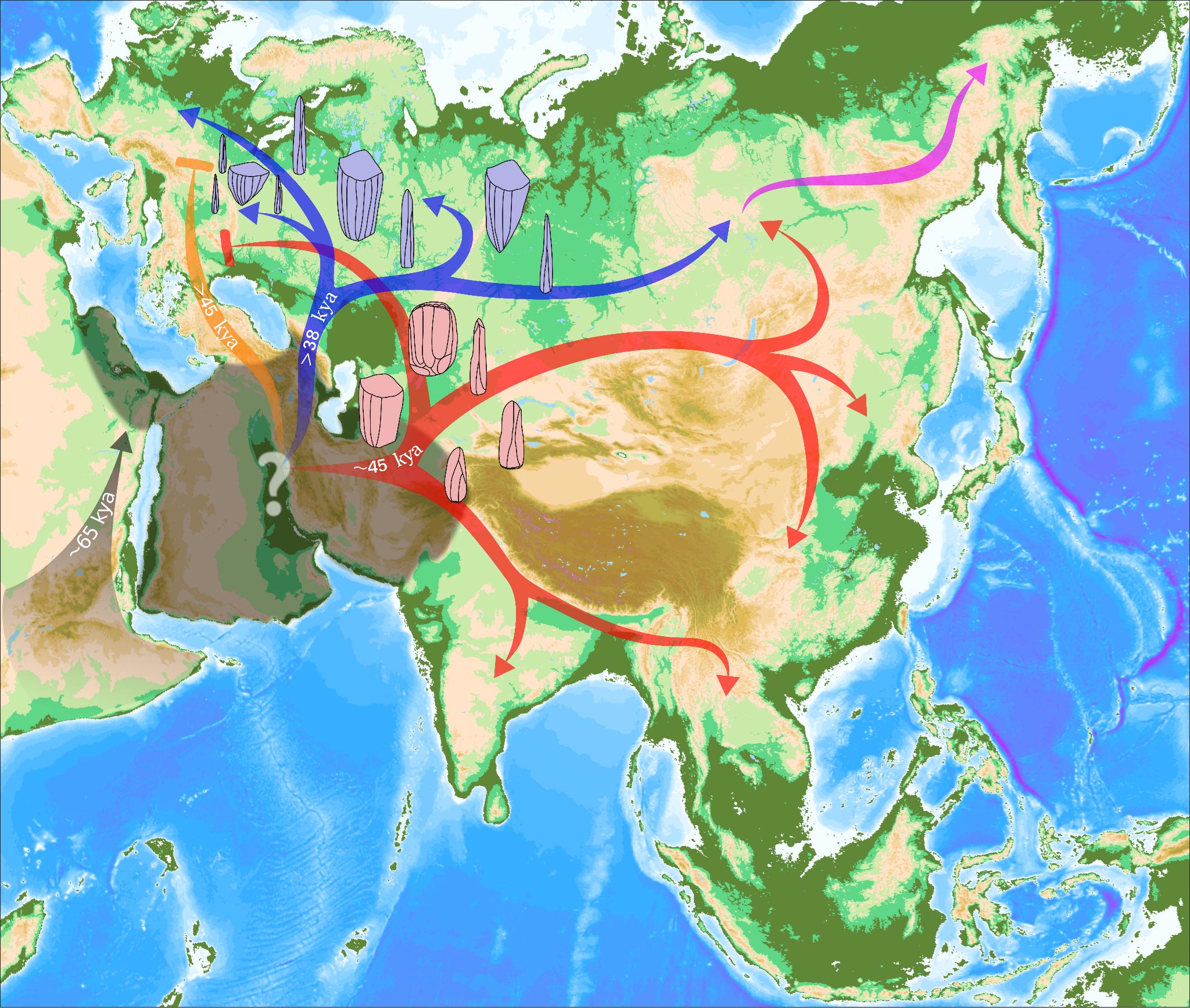
Ancient human remains in Bulgaria revealed genetic ties to East Asians. A study suggests that multiple human migrations from a central Hub led to survival in East Asia but extinction in Europe, followed by later re-colonization of Europe.
The ancient human remains unearthed in the Bacho Kiro cave (in present-day Bulgaria) and recently genetically described were surprisingly reported to be more closely related to contemporary East Asians than contemporary Europeans. Several scenarios were proposed to account for the finding, but this puzzling result so far raised more questions than answers concerning the underlying ancient population movements that could explain the presence of genetically East Asian individuals in Europe ~45.000 years ago.
A study published in Genome Biology and Evolution attempted to solve this mystery, by putting those individuals in the wider context of Eurasian Palaeolithic human genomes and co-analyzing genetics and archaeological evidence. The study was led by Leonardo Vallini and by Prof. Luca Pagani, from the University of Padova in collaboration with Dr. Giulia Marciani and Prof. Stefano Benazzi from the University of Bologna, Italy.
Population Hub and Early Human Migration
In the scenario put forward by the authors, the colonization of East and West Eurasia was characterized by several events of expansion and local extinction from a population Hub, where the ancestors of all Eurasians thrived after they first ventured out of Africa ~70-60 thousand years ago.
An early, failed Homo sapiens expansion took place sometime earlier than 45 thousand years ago. The only representative of that migration, that is related to neither modern Europeans nor to modern Asians, has been recovered from Zlatý kun, in present day Czech Republic and it is yet unclear how widespread it was.
“Then, around 45 kya, a new expansion emanated from the Hub and colonized a wide area spanning from Europe to East Asia and Oceania and is associated with a mode of producing stone tools known as Initial Upper Paleolithic,” says Leonardo Vallini, first Author of the study.
Decline of Early European Settlers and Neanderthals’ Extinction
The fate of these settlers was different in East Asia and in Europe: while in the former they endured and ultimately led to the formation of the modern populations of East Asia, the European representatives of this expansion declined and largely disappeared, leaving the Bacho Kiro, the elusive Oase individual from Romania and a few other remains as the only witness of this early peopling of Europe.
“It is curious to note that, around the same time, also the last Neanderthals went extinct,” says Giulia Marciani, from the University of Bologna and coauthor of the study.
“Finally, one last expansion occurred sometime earlier than 38 kya and re-colonized Europe from the same population Hub, whose location is yet to be clarified,” summarises Luca Pagani, senior author of the study. “Although even in Europe there were occasional interactions with survivors of the previous wave, an extensive and generalized admixture between the two waves only took place in Siberia where it gave rise to a peculiar ancestry known as Ancestral North Eurasian, which eventually contributed to the ancestry of Native Americans.”
Genetic and Cultural Insights Align
This migration is associated with a different cultural assembly named Upper Paleolithic, which characterizes the main European paleolithic sites. “It is noteworthy that, from a cultural perspective, these novel stone tools have often been depicted as an independent assembly rather than a local development of pre-existing technologies in Europe: it is refreshing to see that genetic and cultural information can be reconciled under a comprehensive scenario,” concludes Telmo Pievani, from the University of Padova and coauthor of the study.
The authors conclude that further efforts should be directed into clarifying the geographic whereabouts of the Hub, and to identify both the internal and external causes underlying these ancient population movements, as well as the associated cultural dynamics.
Reference: “Genetics and material culture support repeated expansions into Paleolithic Eurasia from a population Hub out of Africa” by Leonardo Vallini, Giulia Marciani, Serena Aneli, Eugenio Bortolini, Stefano Benazzi, Telmo Pievani and Luca Pagani, 7 April 2022, Genome Biology and Evolution.
DOI: 10.1093/gbe/evac045
Never miss a breakthrough: Join the SciTechDaily newsletter.
Follow us on Google and Google News.