
Close Menu
    Facebook X (Twitter) Instagram
    SciTechDaily
    • Biology
    • Chemistry
    • Earth
    • Health
    • Physics
    • Science
    • Space
    • Technology
    Facebook X (Twitter) Pinterest YouTube RSS
    SciTechDaily
    Home»Technology»Scientists Develop ‘Nanochains’ to Increase Lithium-Ion Battery Capacity
    Technology

    Scientists Develop ‘Nanochains’ to Increase Lithium-Ion Battery Capacity

    By Kayla Wiles, Purdue UniversitySeptember 19, 2019No Comments3 Mins Read
    Facebook Twitter Pinterest Telegram LinkedIn WhatsApp Email Reddit
    Share
    Facebook Twitter LinkedIn Pinterest Telegram Email Reddit
    Coin Cell Battery
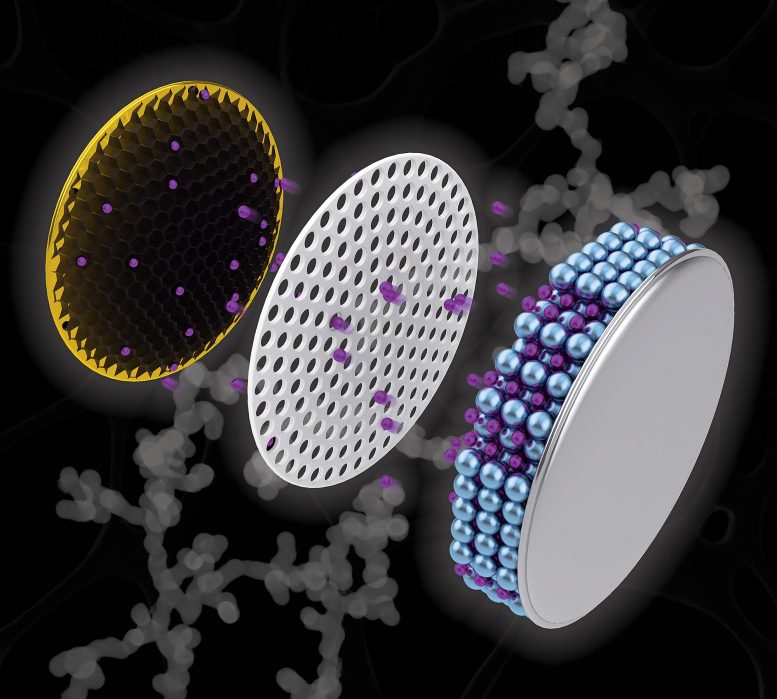
    Artistic depiction of a coin cell battery with a copper electrode (left) containing a black nanochain structure, which researchers have discovered could increase the capacity of a battery and cut charging time. Credit: Purdue University illustration/Henry Hamann

    How long the battery of your phone or computer lasts depends on how many lithium ions can be stored in the battery’s negative electrode material. If the battery runs out of these ions, it can’t generate an electrical current to run a device and ultimately fails.

    Materials with a higher lithium-ion storage capacity are either too heavy or the wrong shape to replace graphite, the electrode material currently used in today’s batteries.

    Purdue University scientists and engineers have introduced a potential way that these materials could be restructured into a new electrode design that would allow them to increase a battery’s lifespan, make it more stable and shorten its charging time.

    The study, appearing as the cover of the September issue of Applied Nano Materials, created a net-like structure, called a “nanochain,” of antimony, a metalloid known to enhance lithium-ion charge capacity in batteries.

    The researchers compared the nanochain electrodes to graphite electrodes, finding that when coin cell batteries with the nanochain electrode were only charged for 30 minutes, they achieved double the lithium-ion capacity for 100 charge-discharge cycles.

    Some types of commercial batteries already use carbon-metal composites similar to antimony metal negative electrodes, but the material tends to expand up to three times as it takes in lithium ions, causing it to become a safety hazard as the battery charges.

    “You want to accommodate that type of expansion in your smartphone batteries. That way you’re not carrying around something unsafe,” said Vilas Pol, a Purdue associate professor of chemical engineering.

    Nanocharin Battery Electrodes
    A new method could allow better materials to make up battery electrodes by converting them into a nanochain structure, the black material on this copper electrode of a coin cell. Credit: Purdue University image/Kayla Wiles

    Through applying chemical compounds – a reducing agent and a nucleating agent – Purdue scientists connected the tiny antimony particles into a nanochain shape that would accommodate the required expansion. The particular reducing agent the team used, ammonia-borane, is responsible for creating the empty spaces – the pores inside the nanochain – that accommodate expansion and suppress electrode failure.

    The team applied ammonia-borane to several different compounds of antimony, finding that only antimony-chloride produced the nanochain structure.

    “Our procedure to make the nanoparticles consistently provides the chain structures,” said P. V. Ramachandran, a professor of organic chemistry at Purdue.

    The nanochain also keeps lithium-ion capacity stable for at least 100 charging-discharging cycles. “There’s essentially no change from cycle 1 to cycle 100, so we have no reason to think that cycle 102 won’t be the same,” Pol said.

    Henry Hamann, a chemistry graduate student at Purdue, synthesized the antimony nanochain structure and Jassiel Rodriguez, a Purdue chemical engineering postdoctoral candidate, tested the electrochemical battery performance.

    The electrode design has the potential to be scalable for larger batteries, the researchers say. The team plans to test the design in pouch cell batteries next.

    ###

    This work was financially supported by the Herbert C. Brown Center for Borane Research.

    Reference: “Three-Dimensional Antimony Nanochains for Lithium-Ion Storage” by Jassiel R. Rodriguez, Henry J. Hamann, Garrett M. Mitchell, Volkan Ortalan, Vilas G. Pol and P. Veeraraghavan Ramachandran, 12 August 2019, ACS Applied Nano Materials.
    DOI: 10.1021/acsanm.9b01316

    Never miss a breakthrough: Join the SciTechDaily newsletter.
    Follow us on Google and Google News.

    Battery Technology Nanomaterials Purdue University
    Share. Facebook Twitter Pinterest LinkedIn Email Reddit

    Related Articles

    The Sodium Solution: Reducing Costs and Complexity in Batteries

    MXene Nanomaterial Offers Flexible and Stretchable High-Capacity Energy Storage

    Researchers Produce Uniform Antimony Nanocrystals for the First Time

    Automated System Has Promising Uses in Battery and Fuel Cell Production

    Analyzing the Environmental Costs and Impacts of Technology

    Nanoparticles in 3-D Atomic-Scale Resolution

    Quantum Computers to Arrive with Single-Atom-Sized Transistors

    MIT Researchers Design Inexpensive Liquid Batteries With Distinct Layers

    Lithium Iron Phosphate Batteries Could Lead to Cheaper, More Efficient Solar Energy

    Leave A Reply Cancel Reply

    • Facebook
    • Twitter
    • Pinterest
    • YouTube

    Don't Miss a Discovery

    Subscribe for the Latest in Science & Tech!

    Trending News

    289-Million-Year-Old Reptile Mummy Reveals Origin of Human Breathing System

    New Brain Discovery Challenges Long-Held Theory of Teenage Brain Development

    Scientists Discover Plants “Scream” – We Just Couldn’t Hear Them Until Now

    Scientists Discover a Surprising Reason Intermittent Fasting Extends Life

    This Simple Fruit Wash Could Make Produce Safer and Last Days Longer

    Scientists Say Adding This Unusual Seafood to Your Diet Could Reverse Signs of Aging

    Scientists Say a Hidden Structure May Exist Inside Earth’s Core

    Doctors Surprised by the Power of a Simple Drug Against Colon Cancer

    Follow SciTechDaily
    • Facebook
    • Twitter
    • YouTube
    • Pinterest
    • Newsletter
    • RSS
    SciTech News
    • Biology News
    • Chemistry News
    • Earth News
    • Health News
    • Physics News
    • Science News
    • Space News
    • Technology News
    Recent Posts
    • Scientists Propose Radical New Way To Detect Alien Life – Without Traditional Biosignatures
    • Scientists Just Discovered Light Can Actually Slow Plant Growth
    • Scientists Finally Solved One of Water’s Biggest Mysteries
    • 7,000-Year-Old DNA Rewrites the Story of the “Neolithic Revolution”
    • Missing Medieval Relic of Legendary English King Found After Being Missing for 40 Years
    Copyright © 1998 - 2026 SciTechDaily. All Rights Reserved.
    • Science News
    • About
    • Contact
    • Editorial Board
    • Privacy Policy
    • Terms of Use

    Type above and press Enter to search. Press Esc to cancel.