
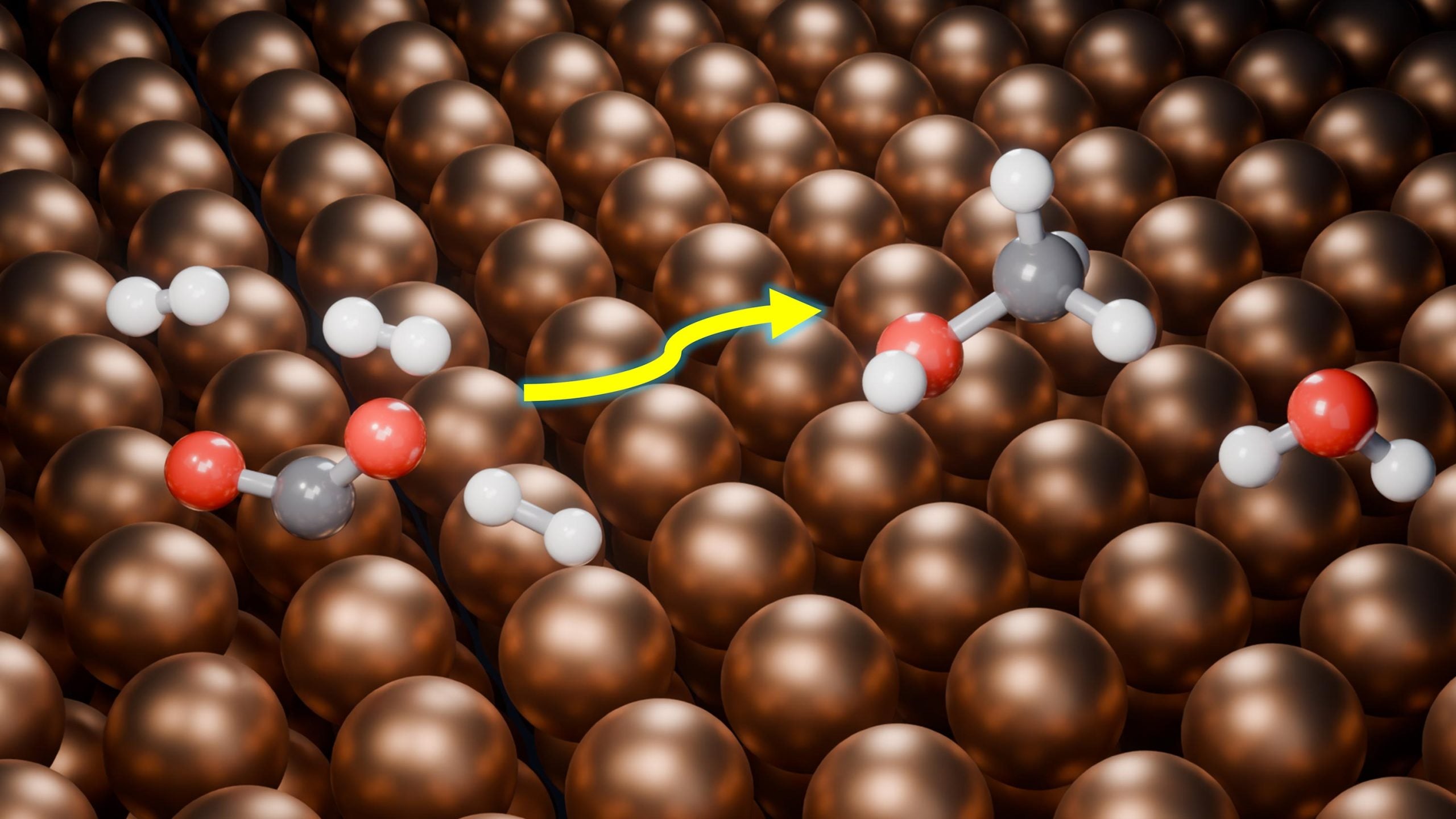
Scientists have uncovered an unexpected pathway for hydrogen transfer during catalytic CO2 conversion.
A computer model designed to predict how carbon dioxide becomes useful chemicals produced a surprising error: It identified formic acid as the main product instead of methanol. When scientists expanded the model to account for thousands of previously overlooked reactions, its predictions changed dramatically and aligned much more closely with experimental results.
Researchers at the Indian Institute of Science (IISc) developed a computational framework that maps 9,389 chemical reactions involved in converting CO2 into fuels and chemicals on a copper catalyst. Compared with a smaller model containing just 152 reactions, the expanded network predicted approximately 40 times more CO2 conversion and correctly identified methanol and carbon monoxide as major products. The research was published in Nature Communications.
Why Conventional Models Miss Important Reactions
CO2 hydrogenation uses hydrogen and a catalyst to transform carbon dioxide into substances such as methanol, a chemical used in fuels and industrial manufacturing. These transformations involve numerous intermediate compounds and competing reactions on the catalyst’s surface. Modeling every possible step with quantum mechanics requires enormous computing resources, so researchers typically concentrate on a limited selection of reactions.
“We began with a worry familiar to anyone who does mechanistic modeling: How do you know that your reaction network has not omitted the one step that matters?” says first author Anand Mohan Verma, who conducted the research as a CV Raman Postdoctoral Fellow at IISc and is now an Assistant Professor at the Motilal Nehru National Institute of Technology Allahabad (MNNIT Allahabad).
To investigate the missing chemistry, the team first used quantum-mechanical simulations to build a carefully verified database of 152 reactions. They then trained machine learning models to estimate activation energy barriers, which determine how readily chemical reactions can proceed. Automated tools identified possible reactions involving 105 chemical species on the catalyst surface and determined which transformations could occur in a single step, expanding the network to 9,389 elementary reactions.
Thousands of Reactions Change the Predictions
“When we modeled the process using the 152 reactions considered initially, the network wrongly predicted formic acid, not methanol, as the major product, and underestimated how much CO2 gets converted. Only when we expanded the network to include thousands of additional, previously overlooked reactions did the predictions fall in line with what we and others see experimentally,” explains corresponding author Ananth Govind Rajan, Associate Professor in the Department of Chemical Engineering at IISc.
The researchers incorporated the expanded reaction network into a kinetic model to calculate how the chemical system would behave. Experimental validation was carried out by G Valavarasu and Santhosh Kotni at Hindustan Petroleum Corporation Limited’s Green Research and Development Centre, along with Amol Amrute and colleagues at the Agency for Science, Technology, and Research in Singapore. Ambedkar Dukkipati, Professor in IISc’s Department of Computer Science and Automation, contributed to the machine learning models.
An Unexpected Pathway for Hydrogen
The larger reaction network also uncovered a mechanism that conventional models can miss. In several important reactions, hydrogen could be transferred to intermediate compounds directly from molecular H2, rather than exclusively through separate hydrogen atoms. Additional quantum-mechanical calculations confirmed that this pathway can be particularly favorable when hydrogen is transferred to oxygen-containing intermediates.
“The idea that hydrogen can transfer as an intact molecule, without first splitting into atoms, runs against what most of us were taught,” says co-author Shivam Chaturvedi, a PhD student in IISc’s Department of Chemical Engineering.
“This surfaced only because the network was large enough to allow for it, and the observation held up when we went back and computed those steps explicitly. This also suggests that catalysts that interact more strongly with H2 could potentially enhance pathways leading to methanol.”
The results point toward possible strategies for improving catalyst design, although the proposed benefits of stronger H2 interactions still require further investigation. The researchers also suggest that their framework, which combines quantum mechanics, machine learning, automated reaction mapping, and kinetic modeling, could be adapted to other industrially important processes, including CO2 reduction on different catalysts, nitrogen reduction, and water splitting.
Reference: “Data-driven massive reaction networks reveal mechanistic pathways underlying catalytic CO2 hydrogenation” by Anand M. Verma, Shivam Chaturvedi, Swastik Paul, Srinibas Nandi, Rahul Sheshanarayana, Kotni Santhosh, G. Valavarasu, Ambedkar Dukkipati, Chuandayani Gunawan Gwie, Pei Ying Moo, Chun Qi Joy Ng, Amol Amrute and Ananth Govind Rajan, 17 September 2026, Nature Communications.
DOI: 10.1038/s41467-026-77080-4
Never miss a breakthrough: Join the SciTechDaily newsletter.
Follow us on Google and Google News.