
Close Menu
    Facebook X (Twitter) Instagram
    SciTechDaily
    • Biology
    • Chemistry
    • Earth
    • Health
    • Physics
    • Science
    • Space
    • Technology
    Facebook X (Twitter) Pinterest YouTube RSS
    SciTechDaily
    Home»Earth»Scientists Discover How Tiny Tremors May Trigger Earthquakes Thousands of Miles Away
    Earth

    Scientists Discover How Tiny Tremors May Trigger Earthquakes Thousands of Miles Away

    By The University of Hong KongNovember 29, 2026No Comments3 Mins Read
    Facebook Twitter Pinterest Telegram LinkedIn WhatsApp Email Reddit
    Share
    Facebook Twitter LinkedIn Pinterest Telegram Email Reddit
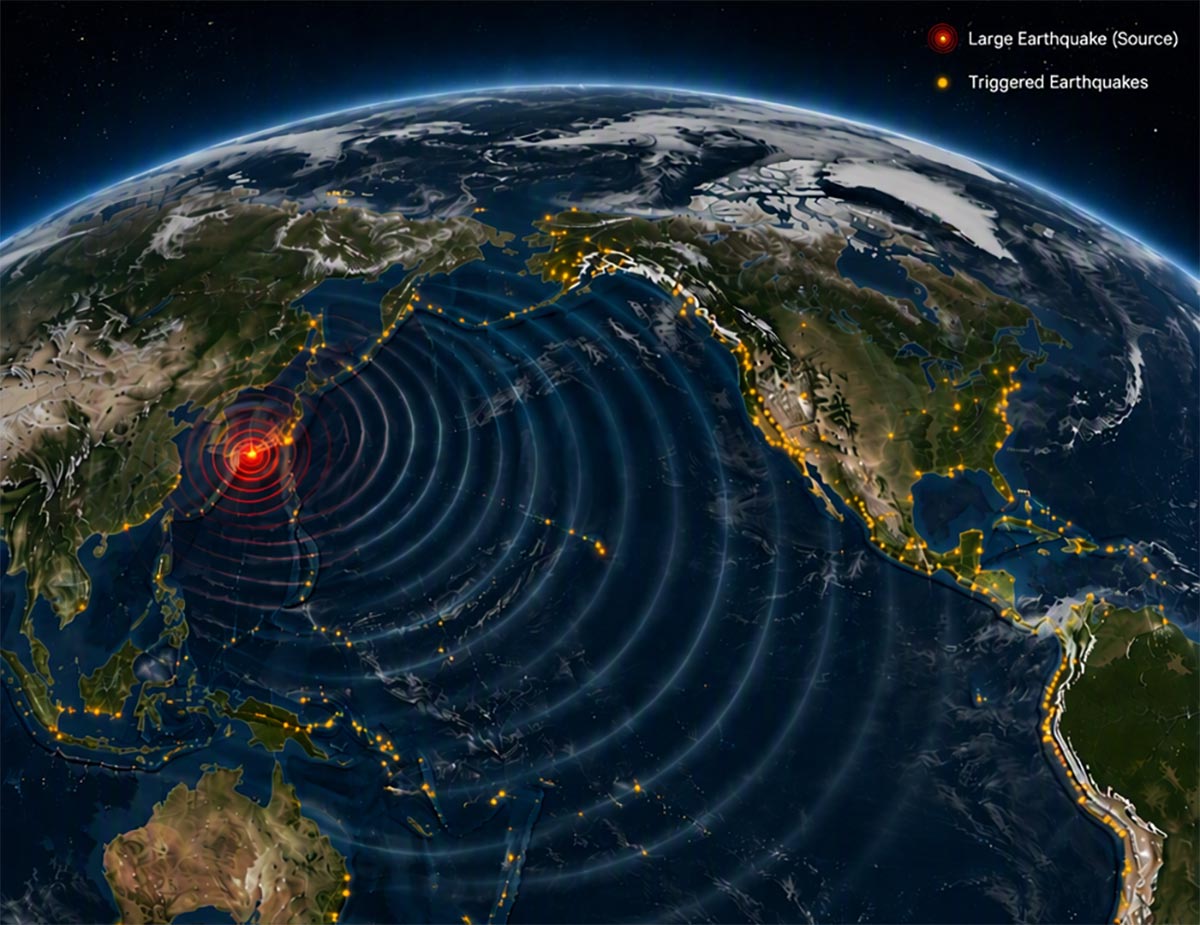
    Illustration of Seismic Waves Spreading Across the Pacific Ocean
    An illustration of how seismic waves from a large earthquake can travel across the globe, potentially triggering additional earthquakes thousands of kilometers from their source. Credit: HKU

    Even tiny stresses from passing earthquake waves may gradually weaken distant faults by increasing fluid pressure inside the crushed rock lining them, researchers’ simulations suggest.

    Earthquake waves can trigger seismic activity thousands of kilometers away, sometimes long after the shaking has stopped.

    A study led by Professor Jun Yang and his team at the Department of Civil Engineering, Faculty of Engineering, The University of Hong Kong (HKU), offers an explanation for this delayed triggering and a long-standing puzzle about why some seismic waves are more effective than others.

    A fault’s porous lining holds the clue

    The researchers focused on fault gouge, a porous, granular material that lines fault surfaces. Using a new analysis framework based on critical-state soil mechanics, they simulated how this material responds to the stress changes caused by passing seismic waves.
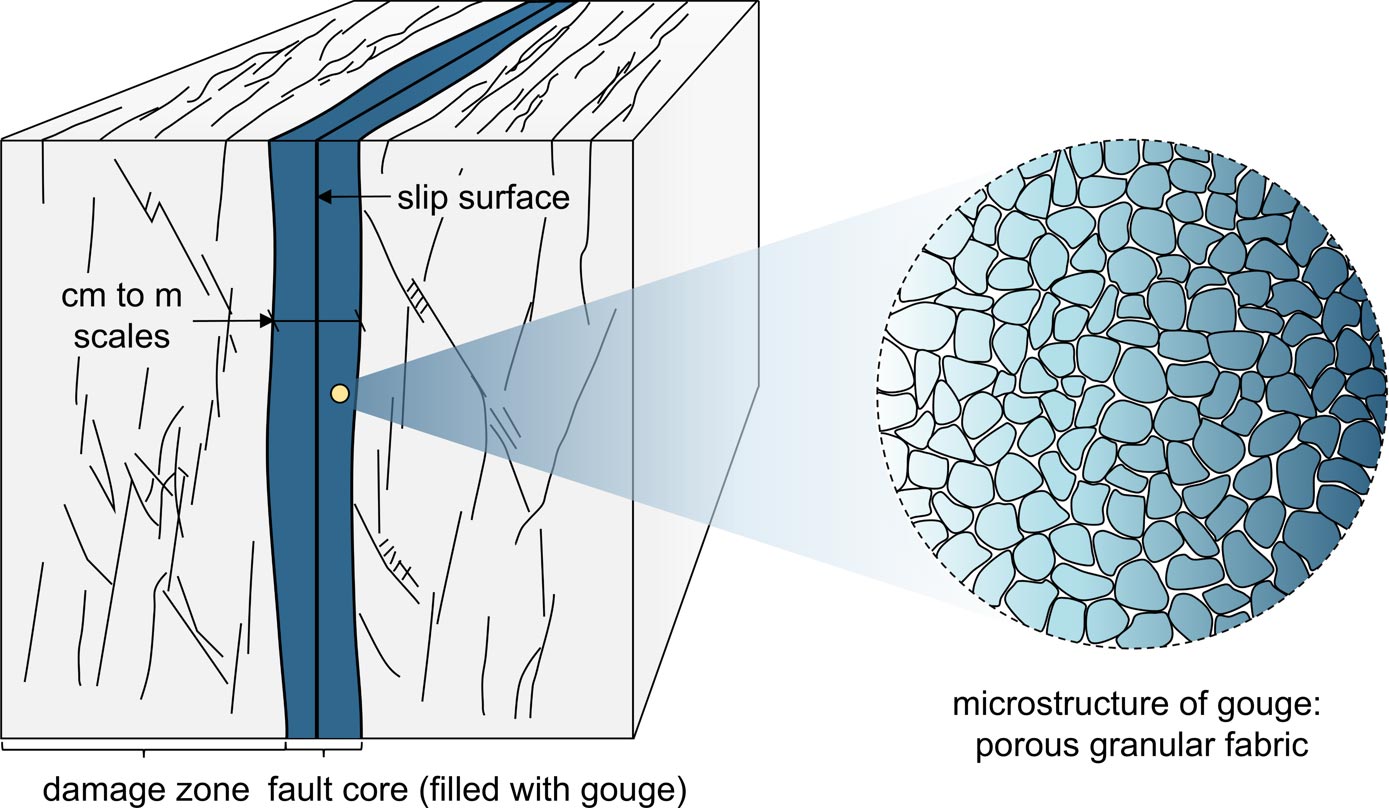
    Diagram of Fault Gouge and Its Granular Microstructure
    A schematic showing the internal structure of a geological fault and the porous, granular material known as fault gouge, where fluid pressure can build up and weaken the fault. Credit: HKU

    Even tiny wave-induced stresses caused fluid pressure, known as pore pressure, to build up gradually inside the gouge. As pressure increased, it reduced the effective normal stress, the force pressing the two sides of a fault together. This weakened the fault and made it more susceptible to rupture.

    The findings offer an alternative to the traditional view that seismic waves must generate enough direct stress to push an already vulnerable fault into failure. Instead, waves may trigger earthquakes indirectly by increasing pore pressure. Because that pressure does not disappear immediately after the waves pass, the fault can remain weakened long enough for an earthquake to occur later.
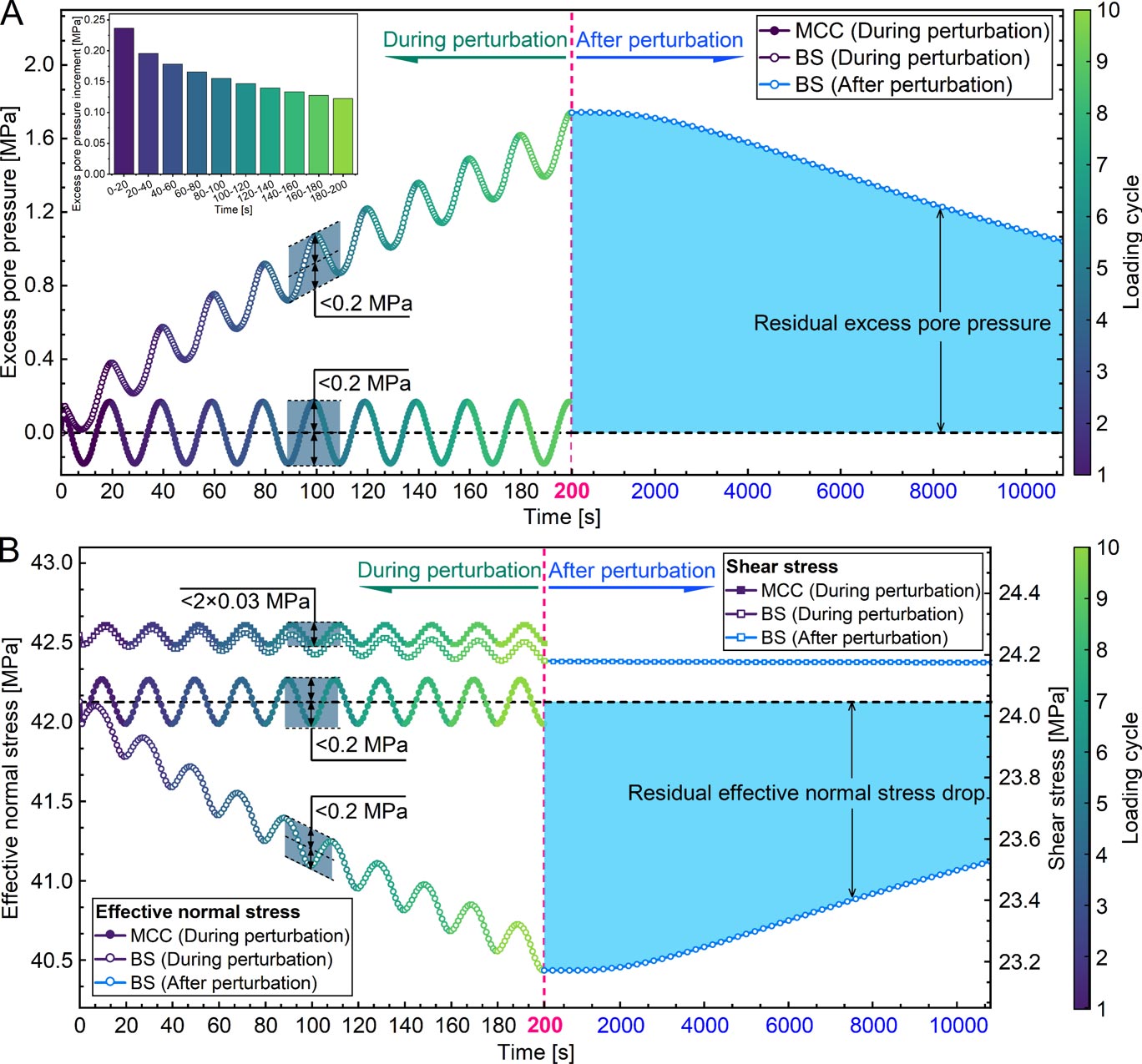
    Graph of Pore Pressure and Stress Changes During Seismic Perturbation
    Numerical simulations showing how small seismic disturbances can progressively increase pore pressure (A) and reduce effective normal stress (B). These effects persist long after the shaking stops, potentially explaining delayed earthquake triggering. Credit: HKU

    Compression may explain Rayleigh waves’ advantage

    The simulations also help explain why Rayleigh waves appear more effective at triggering distant earthquakes than Love waves, despite the latter producing stronger theoretical shear stresses. The researchers found that the compressional, or dilatational, component of seismic waves builds pore pressure much more efficiently than their shear component.

    “The core significance of this work extends beyond proposing a novel remote triggering mechanism,” Professor Yang explained. “It transforms the remote-triggering problem from a classical stress-amplitude question into a coupled problem involving material rheology, fluid dynamics, and wave propagation.”

    Reference: “What triggers seismicity thousands of kilometers away from a mainshock?” by Chao Huang and Jun Yang, 24 June 2026, Science Advances.
    DOI: 10.1126/sciadv.aec4754

    Support from Research Grants Council of Hong Kong under grant nos. 17214724 and N-HKU723/23 (awarded to J.Y.).

    Never miss a breakthrough: Join the SciTechDaily newsletter.
    Follow us on Google and Google News.

    Earth Science Earthquakes Geophysics Seismology The University of Hong Kong
    Share. Facebook Twitter Pinterest LinkedIn Email Reddit

    Related Articles

    This Clever Math Trick Could Change How Scientists Study Earthquakes

    Decades-Old Earthquake Mystery Finally Solved by New Model

    Seismic Signals From Space: Intriguing Correlation Between Earthquakes and Cosmic Radiation Discovered

    Revolutionizing Disaster Prevention: New Earthquake Prediction Model Unveiled by Scientists

    Predicting Earthquakes: Slight Shifts in Magnetic Field Preceded California Quakes

    Quake-Ception – Groundbreaking Earthquake Discovery: Risk Models Overlook an Important Element

    Geophysicists Reveal Megathrust Fault Off Costa Rica

    Fracking Wastewater Injection Wells Linked to Earthquakes

    Unusual Indian Ocean Earthquakes May Signal Tectonic Breakup

    Leave A Reply Cancel Reply

    • Facebook
    • Twitter
    • Pinterest
    • YouTube

    Don't Miss a Discovery

    Subscribe for the Latest in Science & Tech!

    Trending News

    Astronomers Discover the Sun Contains 55% More Silver Than Previously Thought

    Scientists Discover a Unique Gut Microbe Signature in People Who Live to 100

    Alzheimer’s Breakthrough? Experimental Nose Drops Restore Youthful Memory in Mice

    Scientists Discover Strange Dinosaur That Evolved To Eat Fruit

    Why Some Farts Can Clear a Room While Others Barely Smell

    Mathematicians Find a Brilliant Shortcut to a 174-Year-Old Math Puzzle

    Semiconductor Breakthrough Cracks a Longstanding Solar Energy Problem

    Experimental Drug Shrinks Tumors in Two of the Hardest-To-Treat Cancers

    Follow SciTechDaily
    • Facebook
    • Twitter
    • YouTube
    • Pinterest
    • Newsletter
    • RSS
    SciTech News
    • Biology News
    • Chemistry News
    • Earth News
    • Health News
    • Physics News
    • Science News
    • Space News
    • Technology News
    Recent Posts
    • Scientists Discover How Tiny Tremors May Trigger Earthquakes Thousands of Miles Away
    • Harvard Scientists Develop Incredibly Thin Lenses That Could Transform the Future of Optics
    • Scientists Create Remarkable New Material That Gets Stronger the More You Use It
    • Even With Your Phone Turned Off, WiFi Can Still Identify You With Near-Perfect Accuracy
    • A Single Protein May Hold the Key to Reducing Alzheimer’s-Related Nerve Damage
    Copyright © 1998 - 2026 SciTechDaily. All Rights Reserved.
    • Science News
    • About
    • Contact
    • Editorial Board
    • Privacy Policy
    • Terms of Use

    Type above and press Enter to search. Press Esc to cancel.