
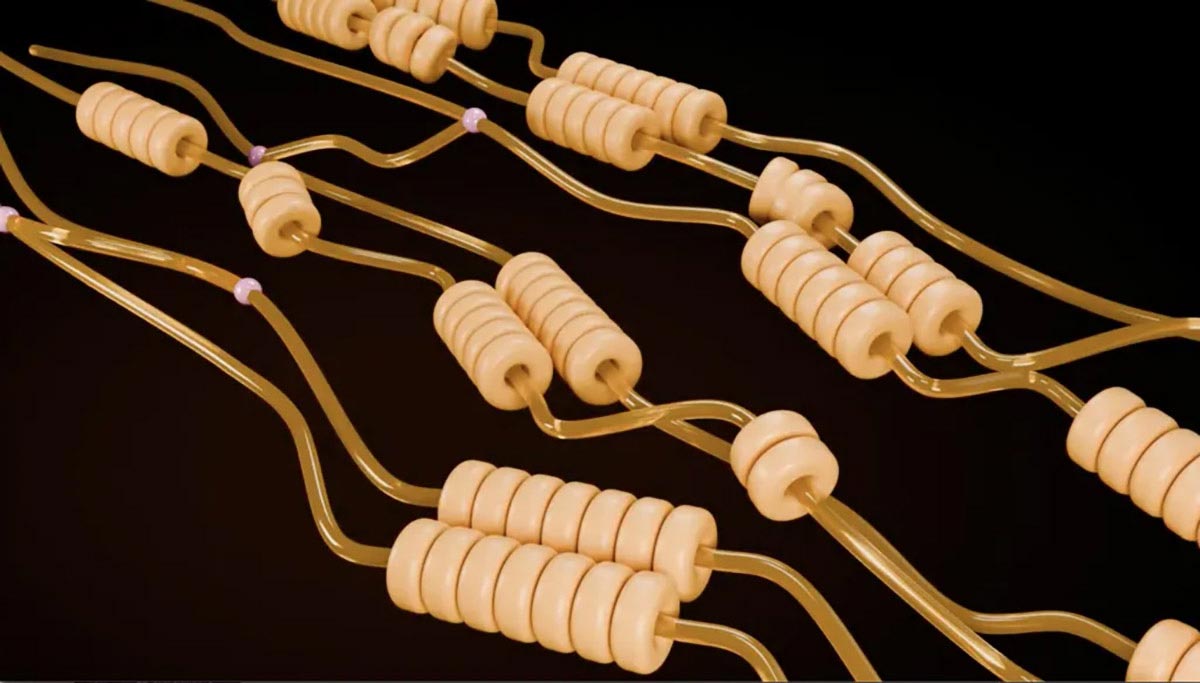
A collagen-inspired polymer could make future medical devices stronger without sacrificing flexibility.
Most materials become weaker the more they are used. A new polymer developed at Washington University in St. Louis could turn that expectation on its head. Repeated bending and stretching actually make the material stronger, reinforcing the areas under the most strain while leaving the rest flexible. The unusual behavior could eventually prove useful in artificial joints, tissue repair, and other medical applications.
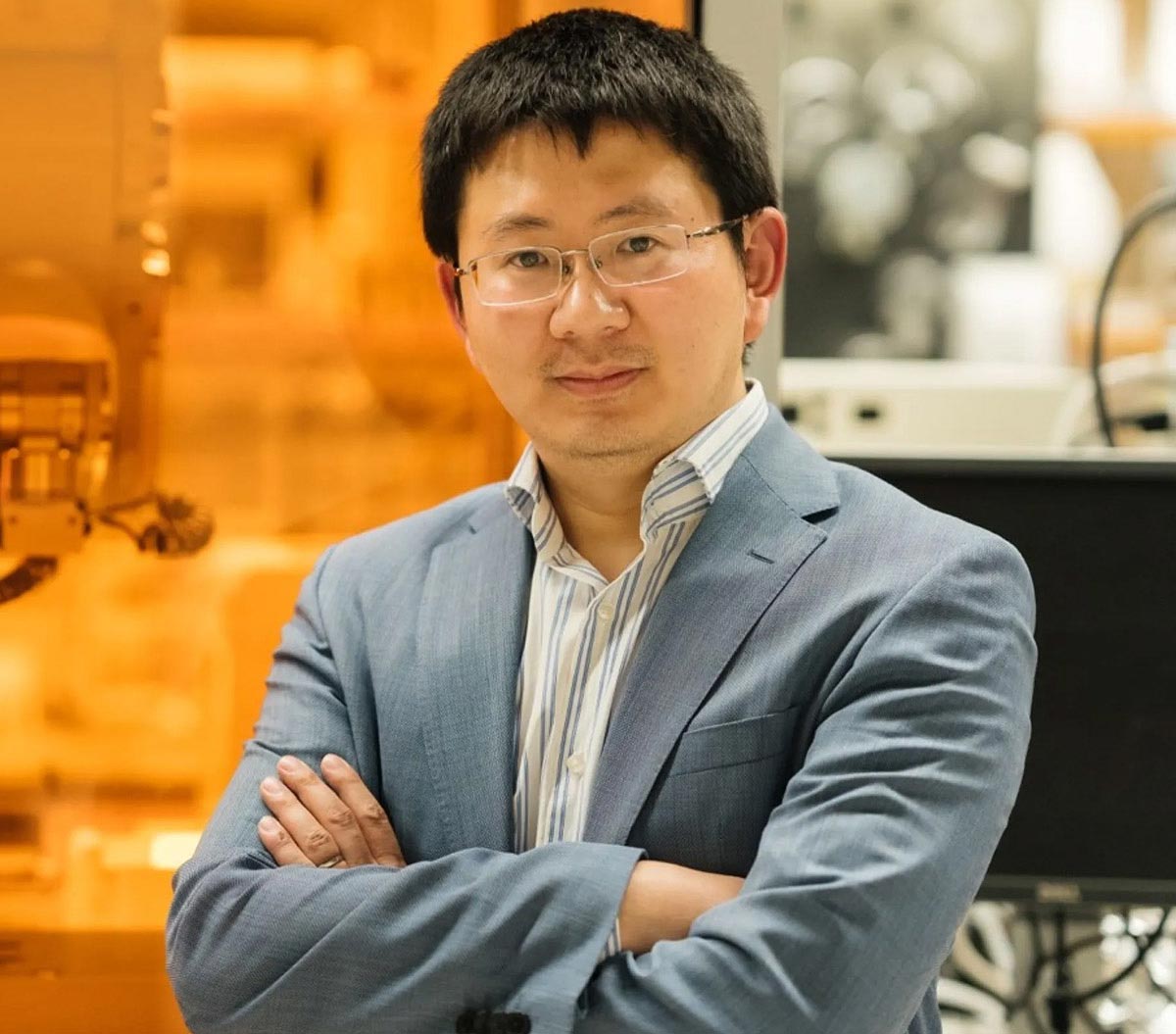
“Our smart material actually gets stronger the more it’s bent and strained,” said Chenfeng Ke, a professor of chemistry in Arts & Sciences at Washington University in St. Louis. “It has properties we have never seen before. It can remember, adapt, learn, and grow. We’re excited to think about the possible applications.”
Sugar rings reinforce stressed areas
The patented polymer is made from a biodegradable blend of sugar crystals and polyethylene glycol, a compound commonly used in laxatives and other health products. Together, the ingredients form a hydrogel, a flexible material that absorbs and retains large amounts of water. The mixture is also compatible with 3D printing.
Its unusual behavior comes from cyclodextrin, a sugar-based compound that forms ring-shaped structures. When the polymer bends or stretches, these rings slide into position, reinforcing the areas experiencing the greatest strain. The result is a material that becomes stronger precisely where repeated movement puts it under pressure.
Ke and his team tested the polymer using a flexible, knee-like joint, bending it 10,000 times. The repeated movement helped organize the polymers within the hydrogel, strengthening the stressed areas.
“We bent it 10,000 times, and the material performed just as we predicted,” Ke said. “The polymers in the hydrogel become more uniform and organized, making it stronger in exactly the places where the strain is happening.”
The design draws inspiration from biological materials such as collagen, the protein that gives skin its strength and elasticity.
“Some of the most impressive smart materials are found in biology,” Ke said. “We used nature for inspiration.”
Medical applications still need expert testing
Ke sees particular promise in medicine, where materials must provide support without becoming unnecessarily rigid. The polymer could potentially help support artificial joints or repair damaged tissues, with areas exposed to repeated stress becoming stronger while surrounding sections remain pliable.
“Because it’s made of sugar and polyethylene glycol, it’s completely compatible with biological tissues,” Ke said. “We expect this material to attract interest from surgeons or orthopedic medical device companies who are looking for new approaches.”
“If you’re putting material into a body, you don’t necessarily want it to be completely rigid,” Ke said. “The material gets stronger only where it’s needed.”
Those applications will require further exploration. Ke is a chemist rather than an orthopedist or medical device specialist, and he hopes to collaborate with experts who can identify practical uses for the material.
“We want to work with experts at WashU Medicine and elsewhere to explore the possibilities,” Ke said. “Hopefully this paper will help us get the word out to researchers and potential investors.”
From small batches to wider production
The research, published online in Nature Materials, also involved graduate students Yufei Chen and Mingliang Bai, along with postdoctoral researcher Dan Zheng. The team currently produces the material in batches of just tens of grams, although Ke believes production could eventually be scaled up.
The work builds on Ke’s broader research into materials inspired by nature. In April 2025, he proposed a new generation of smart fabrics at A&S Innovates, Arts & Sciences’ inaugural research pitch competition.
“We’ve shown it’s possible to produce smart materials with a 3D printer and the right chemistry,” Ke said. “We see a lot of possibilities.”
Reference: “Mechanical adaptation drives out-of-equilibrium network reorganization and self-strengthening in adapt-ring networks” by Dan Zheng, Zhaohan Yu, Yufei Chen, Cameron D Smith, Mingliang Bai, Esther H R Tsai, Jiabin Liu, Wenlin Zhang, Shaoting Lin and Chenfeng Ke, 5 November 2026, Nature materials.
DOI: 10.1038/s41563-026-02795-0
This research was supported by funding from the National Science Foundation (2413579, CAREER 2338747) and the U.S. Department of Energy (DE-SC0012704, DE-SC0022267).
Never miss a breakthrough: Join the SciTechDaily newsletter.
Follow us on Google and Google News.