
Earthquakes may be unpredictable, but their impacts are not entirely mysterious. New modeling techniques are offering a clearer view beneath the surface.
On Saturday, December 6, 2025, a magnitude 7.0 earthquake struck Alaska. Events of this size are relatively rare, but smaller earthquakes occur constantly around the world. The United States Geological Survey (USGS) estimates that roughly 55 earthquakes happen each day, adding up to about 20,000 each year.
Typically, one earthquake annually reaches magnitude 8.0 or higher, while about 15 others fall within the magnitude 7 range on the Richter scale, which measures earthquakes based on the energy they release. In 2025, for instance, an offshore magnitude 8.8 earthquake near Russia’s Kamchatka Peninsula ranked among the 10 largest earthquakes ever recorded, according to USGS.
The consequences of earthquakes can be severe, including loss of life, destruction of buildings and infrastructure, and widespread economic disruption. Many people also experience long-term psychological effects after living through a major quake.
These events are becoming increasingly expensive, according to a 2023 report from the USGS and the Federal Emergency Management Agency (FEMA), partly because more people now live in regions with high seismic risk. The report estimates that earthquakes cost the United States approximately $14.7 billion each year.
Why Predicting Earthquakes Remains Elusive
Being able to predict when and where major earthquakes will occur, and how intense their effects might be, would greatly improve preparedness and reduce damage. Despite decades of research, however, reliably forecasting earthquakes before they happen remains beyond the reach of current science.
However, knowing what the earth subsurface looks like can help better assess the risks, says Kathrin Smetana, Assistant Professor in the Department of Mathematical Sciences at Stevens. “You may have layers of solid rock, or you may have sand or clay,” she says, and waves behave differently in different materials, which in turn affects the movement at the surface.
To better understand the composition of this geological layer, scientists run special simulations called Full Waveform Inversion, a seismic imaging technique that reconstructs how the subsurface looks. Then, they model synthetic earthquakes, simulating the propagation of seismic waves caused by synthetic earthquakes on a computer, and evaluate seismic waves at the locations of the seismographs on the surface.
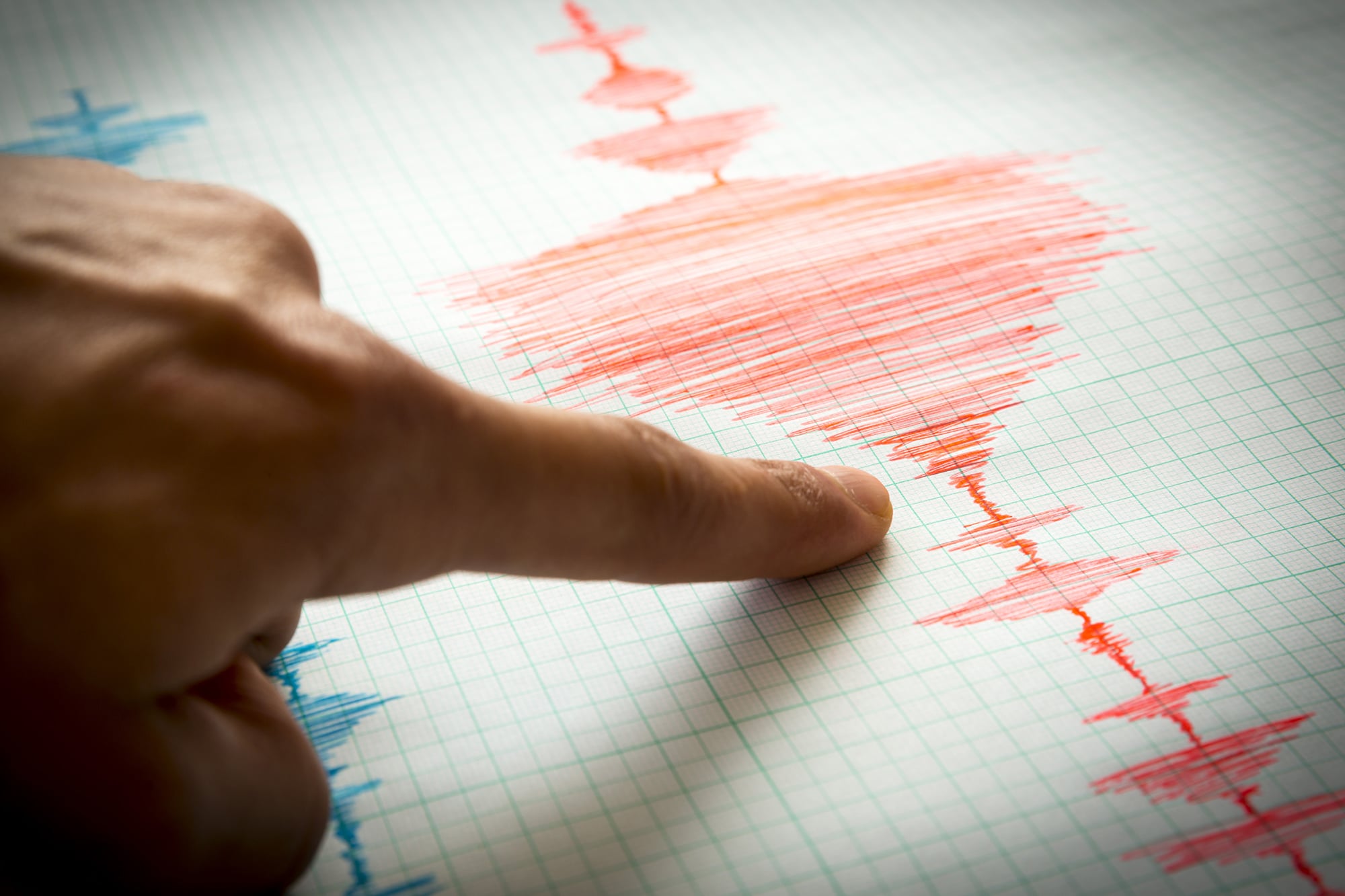
These evaluations are then compared with seismograms — graph outputs of seismographs and visual records of ground motion for real earthquakes. When, after numerous iterations, the synthetic earthquake data is close to the real seismic data, scientists have a better idea of what the subsurface looks like.
Simulating Earthquakes on a Computer
Essentially, scientists start with their best guess of how the subsurface would look in a particular region, and then keep running simulations, improving the model with every iteration until it matches the data from a real event.
“You compare the data from your computer simulation with actual data that you got from earthquakes,” says Smetana. “This allows you to find out what the subsurface looks like and what effect an earthquake has on the composition of the subsurface — and that ultimately, helps determine the risk for an earthquake at a certain location.”
That technique is key for developing monitoring and prediction tools, but it requires running thousands of simulations that use millions of input parameters, which takes a long time and is resource-intensive. “With existing techniques, just one single simulation may last several hours on a powerful computer cluster,” says Smetana. “Running so many simulations that are needed for monitoring can be prohibitively expensive.”
A Faster Way Forward
To address this problem, Smetana is collaborating with computational seismologists Rhys Hawkins and Jeannot Trampert from the Department of Earth Sciences at Utrecht University and Matthias Schlottbom and Muhammad Hamza Khalid from the Department of Applied Mathematics at the University of Twente in the Netherlands.
The team was able to build a reduced model that can be used to simulate seismic waves caused by an earthquake for various parameter configurations much faster than existing methods.
“Essentially, we reduced the size of the system that you need to solve by about 1000 times,” Smetana says. “It was a very interdisciplinary project, and we found a clever way to construct the reduced model while still maintaining the accuracy of the prediction. “I really enjoy interdisciplinary collaborations and this one in particular because you learn to see things with a new perspective, which, in my opinion, ultimately helps finding creative and novel approaches to solve a problem in an interdisciplinary team.”
The team’s findings are described in the paper recently published in the SIAM Journal on Scientific Computing.
What This Means for Earthquake Risk
Although the teams’ model can’t predict when earthquakes may happen, it might ultimately be used to assess the risk of an earthquake occurrence. “If you get a good picture of the subsurface, you have a better idea of assessing the risk of future earthquakes,” Smetana explains.
Another area where the team’s work might potentially be helpful in the future is simulating tsunamis, which may form when earthquakes happen below the sea. However, depending on the location of the earthquake, it may take at least an hour for them to reach the land, providing time to perform simulations.
Having realistic images of the subsurface will allow for a better assessment of earthquake risks. “There’s no way to predict earthquakes at this time,” Smetana says. “But our work can help generate a realistic view of the subsurface with less computational power, which would make our models more practical and help us be more earthquake resilient.”
Reference: “Model Order Reduction for Seismic Applications” by Rhys Hawkins, Muhammad Hamza Khalid, Matthias Schlottbom and Kathrin Smetana, 17 September 2025, SIAM Journal on Scientific Computing.
DOI: 10.1137/24M1667737
Never miss a breakthrough: Join the SciTechDaily newsletter.
Follow us on Google and Google News.