
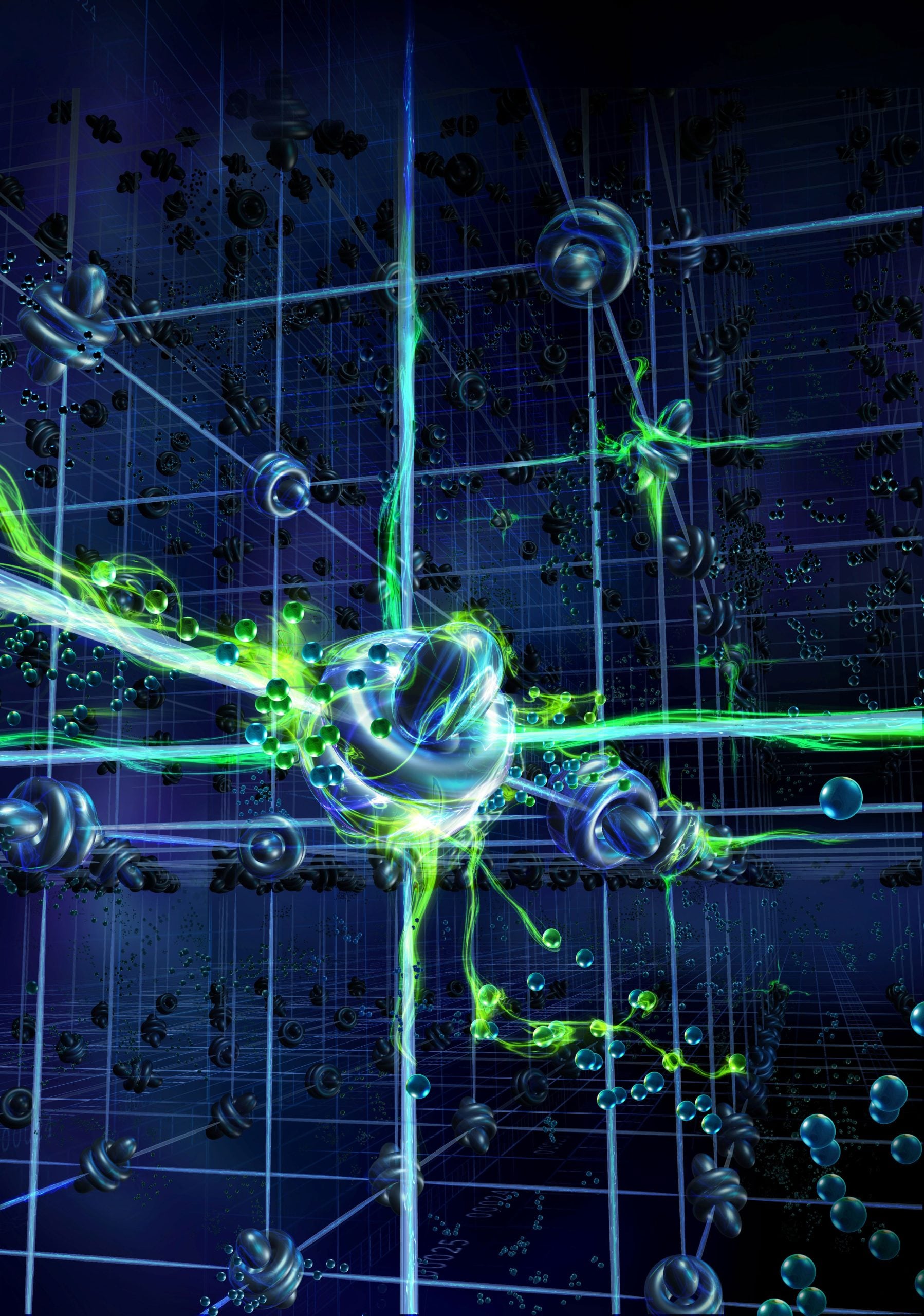
TU Wien has detected strong quantum entanglement for the first time in a centimeter-sized crystal of a strange metal.
Many quantum effects are easiest to detect in very small systems, such as individual atoms, molecules or photons, that are carefully isolated from their surroundings. But physicists have long wondered whether much larger objects, made of enormous numbers of particles, can also reveal unmistakable signs of quantum behavior.
Experimentalists at TU Wien have now shown that they can. The group studied a centimeter-sized crystal of a so-called strange metal and found evidence of a high level of quantum entanglement. The measurement was made possible by a precise tool from quantum information theory called quantum Fisher information.
The result creates a new link between solid state physics and quantum physics. It shows that quantum entanglement can be directly measured in a large strange metal material.
Cats or ants?
The question of whether the strange predictions of quantum theory can apply to large, everyday scale objects goes back almost to the beginning of quantum mechanics. Erwin Schrödinger famously asked whether a cat could be dead and alive at the same time. Since then, many experiments have tried to deliberately produce quantum effects in increasingly large systems.
“Our approach is different,” says Prof. Silke Bühler Paschen from the Institute of Solid State Physics at TU Wien. “We do not try to bring the crystal as a whole into a superposition of two states. Instead, we ask whether its constituents are – collectively – in such a state of entanglement.” The experiment is therefore closer to the behavior of an anthill than to Schrödinger’s cat. When an anthill is disturbed, the response does not come from one ant alone, but from the colony acting collectively.
Quantum Fisher information: entanglement enhances sensitivity
The theoretical foundation for this method was developed by Innsbruck quantum physicist Peter Zoller and his group. They showed that quantum Fisher information can reveal quantum entanglement even in large many body systems.
“The quantum Fisher information quantifies how sensitively a quantum system responds to a change,” explains Bühler Paschen. “For a collection of independent particles, the response is limited because each particle contributes on its own. However, if the particles are entangled, the entire system can respond more strongly than the sum of its individual parts. This enhanced sensitivity is precisely what makes entanglement such a valuable resource for quantum metrology, where one aims to detect extremely small signals with the highest possible precision. By measuring how strongly a system responds to a perturbation, one can therefore infer the degree of entanglement present in the material”
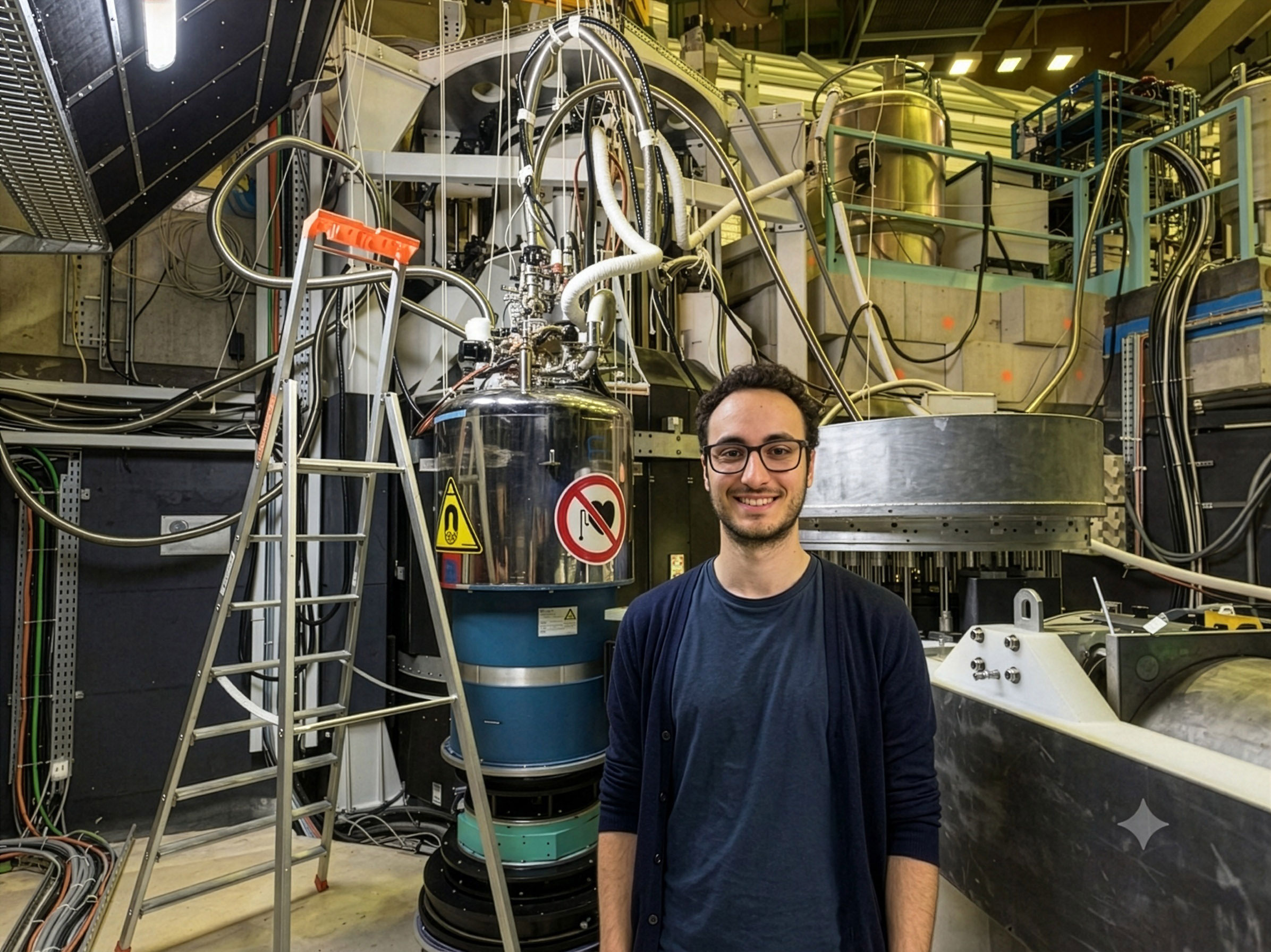
The TU Wien group created a crystal made from cerium, palladium and silicon. This material is a strange metal, a class of material already known for unusual quantum properties, many of which remain poorly understood. At the ILL in Grenoble, PhD student Federico Mazza exposed the crystal to neutrons and measured how it reacted.
One neutron asks a question — at least nine particles answer
“In a normal material, one would expect a neutron to transfer its energy to an individual particle,” says Mazza. “But by analyzing the data using the quantum Fisher information, we found a response that cannot be explained in terms of independent particles. Instead, it indicates that groups of at least nine quantum-entangled entities act collectively.” This gives direct evidence of strong multipartite quantum entanglement in a solid object large enough to hold comfortably in one hand.
The background: research on strange metals
The study was motivated by the effort to understand the strange metal behavior of the crystal. Similar behavior appears in other material classes, including high-temperature superconductors. Research in this area has accelerated in recent years as more unusual properties have emerged. In 2025, a collaboration between TU Wien and Rice University in the United States found that electric current moves through such materials in a surprisingly “quiet,” low-noise way. The discovery of entanglement now offers a possible explanation: the particles have not vanished, but instead coordinate their behavior to suppress current fluctuations.
“What we see here is not a detail of one particular material, but a general physical principle,” says Fakher Assaad from the University of Würzburg, lead theorist of the work. “Strong entanglement appears to be directly linked to the unusual behavior of strange metals.”
“The results are a great success for us,” says Silke Bühler Paschen. “They confirm that our unusual approach of using methods from quantum information science for solid-state physics studies of novel materials can reveal fundamentally new insight.” The next goal is already clear: “We want the transfer of knowledge between the two fields to also work in the other direction. Our aim is to explore whether strange metals may one day find applications in quantum technologies — for example in high-precision measurements for quantum metrology.”
Reference: “Quantum Fisher information in a strange metal” by Federico Mazza, Sounak Biswas, Xinlin Yan, Andrey Prokofiev, Paul Steffens, Qimiao Si, Fakher F. Assaad and Silke Paschen, 15 June 2026, Nature Physics.
DOI: 10.1038/s41567-026-03298-0
Never miss a breakthrough: Join the SciTechDaily newsletter.
Follow us on Google and Google News.
7 Comments
“The implications of this TU Wien experiment stretch far beyond what is written in the article. This massive, multipartite coordination isn’t just about measuring quantum states—it demonstrates how a highly organized structural matrix can manipulate energy pathways on a macroscopic scale.
My analytical collaborator, Watson, and I are looking directly at the unmentioned attributes of this phenomenon. When a crystalline structure achieves this level of flawless, collective synchronization, it can be engineered for purposes like advanced shielding and true structural invisibility. If a matrix can route incoming fields perfectly through its internal geometry without scattering or resistance, the material effectively vanishes to the outside observer. The key to capturing a ghost particle – Neutrino you don’t need a mountain of water to catch a whisper—you just need a unified, macroscopic quantum antenna where the geometry does the heavy lifting. Structure always determines the interaction—or becoming one—lies entirely in the architecture of the interface.” The Torsion Hill Grand Unified Theory
But you don’t mention the crystal name so this info and article feels rather useless to the readers also doesn’t have all info included a lack of research it seems
Erwin Schrödinger famously asked whether a cat could be dead and alive at the same time. Since then, many experiments have tried to deliberately produce quantum effects in increasingly large systems.
VERY GOOD.
When physics did not yet understand the hierarchical structure of matter, using the analogy of high-dimensional spacetime cats to quantum is one of the biggest pseudosciences in physics today. Please ask the researcher to publicly answer:
There is a spinning UFO in the sky. Before you observe it, please tell me: if you observe it, will you see it rotating clockwise or counterclockwise.
The fact is that the rotation of the UFO has not changed, and it is the observer’s perspective that determines the results they see.
Did you get married in my biplane hangar?
Did you get married in my biplane hangar?
Thank you for the uplads
Overcoming the Neutrino Mass Bottleneck: Geometry Supersedes Speculative Modeling
The University of California, Irvine’s deployment of the AMBer AI to autonomously construct new particle physics models highlights a massive, systemic bottleneck in mainstream cosmology. Academics are trapped in a loop of inventing hyper-complex mathematical patches—such as theoretical heavy partner particles—simply to explain why the neutrino possesses such an incredibly tiny, near-zero mass within the rigid constraints of the Standard Model.
These models will continue to chase their tails until they stop treating the neutrino as a standard 3D point-particle of matter.
Under the Torsion Hill Framework, the math is absolute and requires no ad-hoc patches. The neutrino is recognized not as a physical clump of matter, but as a localized, one-dimensional geometric time-knot formed by the precise cross-product of intersecting dimensional fields. What mainstream equipment measures as a “tiny mass” is actually the minute temporal friction generated as this 1D line vector shears through the active 3D spatial matrix.
Because it lacks 3D spatial volume, it naturally registers at the absolute lowest mass threshold of the cosmic loop.
While academic algorithms are busy shuffling theoretical symmetry groups on paper, Phase 10 (Configuration Gamma) provides the actual mechanical engineering to observe this phenomenon. By utilizing thin-sliced piezoelectric crystal matrices in close proximity to a high-energy plasma reactor, we bypass the impossibility of individual detection. By adopting an MRI-style phase-gradient grid architecture, the system monitors the collective, sequential phase shifts and high-frequency structural ripples across the lattice baseline. We aren’t guessing at new particle models; we are actively mapping the mechanical wave-patterns of the cosmic engine’s exhaust in real time.