
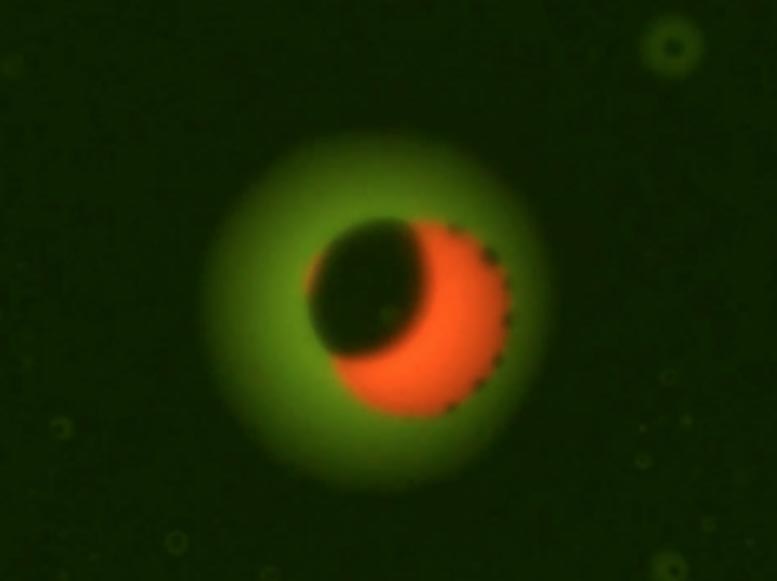
Findings could help explain how air pollutants interact with the atmosphere.
Researchers at the University of British Columbia, University of California Irvine, and McGill University have discovered three liquid phases in aerosol particles, changing our understanding of air pollutants in the Earth’s atmosphere.
While aerosol particles were known to contain up to two liquid phases, the discovery of an additional liquid phase may be important to providing more accurate atmospheric models and climate predictions. The study was published recently in PNAS.
“We’ve shown that certain types of aerosol particles in the atmosphere, including ones that are likely abundant in cities, can often have three distinct liquid phases,” says Dr. Allan Bertram, a professor in the Department of Chemistry. “These properties play a role in air quality and climate. What we hope is that these results improve models used in air quality and climate change policies.”
The Critical Role of Aerosols in Air Quality
Aerosol particles fill the atmosphere and play a critical role in air quality. These particles contribute to poor air quality and absorb and reflect solar radiation, affecting the climate system. Nevertheless, how these particles behave remains uncertain. Prior to 2012, it was often assumed in models that aerosol particles contained only one liquid phase.
In 2012, researchers from the University of British Columbia and Harvard University provided the first observations of two liquid phases in particles collected from the atmosphere. More recently, researchers at UBC hypothesized three liquid phases could form in atmospheric particles if the particles consisted of low-polarity material, medium-polarity material, and salty water.
To test this, a solvatochromic dye—a dye that changes color depending on the polarity of its surroundings—was injected into particles containing a mixture of all three of these components. Although the solvatochromic dye method has been used widely in biology and chemistry, it has not been used to characterize the phase behavior of atmospheric aerosols. Remarkably, three different colors were observed in these particles, confirming the presence of three liquid phases.
Cloud Seeding and Gas Exchange Properties
Scientists were also able to study the properties of particles containing three phases, including how well these particles acted as seeds for clouds, and how fast gases go into and out of the particles.
The study focused on particles containing mixtures of lubricating oil from gas vehicles, oxidized organic material from fossil fuel combustion and trees, and inorganic material from fossil fuel combustion. Depending on the properties of the lubricating oil and the oxidized organic material, different number of liquid phases will appear resulting in different impacts on air quality and climate.
“Through what we’ve shown, we’ve improved our understanding of atmospheric aerosols. That should lead to better predictions of air quality and climate, and better prediction of what is going to happen in the next 50 years,” says Dr. Bertram. “If policies are made based on a model that has high uncertainties, then the policies will have high uncertainties. I hope we can improve that.”
With the urgency of climate goals, policy that is built on accurate atmospheric modeling reduces the possibility of using resources and finances toward the wrong policies and goals.
Reference: “Coexistence of three liquid phases in individual atmospheric aerosol particles” by Yuanzhou Huang, Fabian Mahrt, Shaun Xu, Manabu Shiraiwa, Andreas Zuend and Allan K. Bertram, 15 April 2021, Proceedings of the National Academy of Sciences.
DOI: 10.1073/pnas.2102512118
Funding: Natural Sciences and Engineering Research Council of Canada, Alfred P. Sloan Foundation, Swiss National Science Foundation, US NSF
This study was led by researchers at the University of British Columbia with researchers from the University of California Irvine and McGill University.
Never miss a breakthrough: Join the SciTechDaily newsletter.
Follow us on Google and Google News.