
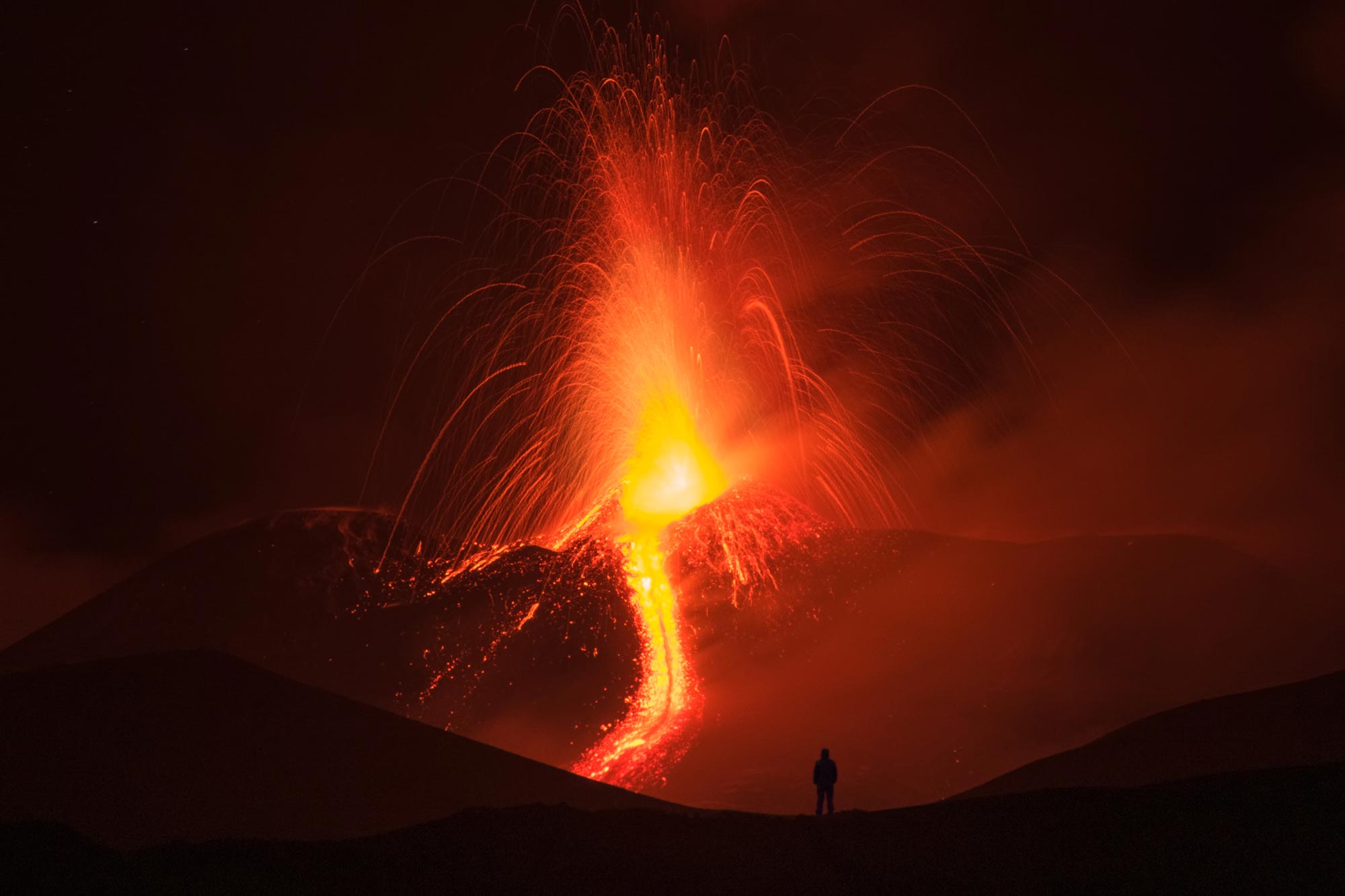
Mount Etna’s past eruptions reveal that a single volcano can erupt through very different underground pathways.
Volcanic plumbing systems can stretch deep underground and form highly complicated networks. Yet even within a single volcano, those internal pathways do not always operate the same way.
A collaboration led by Cornell found that two historic eruptions of Mount Etna in Italy were driven by sharply different processes. Learning how those processes worked, along with the methods used to detect them, can help geologists better evaluate future eruption hazards.
The findings were published in Geochemistry, Geophysics, Geosystems. The first author is former postdoctoral researcher Maxim Gavrilenko.
The project was led by Esteban Gazel, the Charles N. Mellowes Professor in the Department of Earth and Atmospheric Sciences in the Cornell Duffield College of Engineering. Gazel studies how volcanoes operate, including why some eruptions become explosive and which mechanisms control that behavior.
Explosions depend on trapped gas
Several factors influence how explosive an eruption becomes, including magma viscosity and the volatile gases trapped within the magma.
“Imagine a bottle of soda. If you open that bottle without agitating it, you can drink it, but if you shake it up, all the bubbles get separated really fast, and you have an explosion,” Gazel said. “Volcanoes work in a similar way, and my lab is trying to quantify these processes.”
Water and carbon dioxide are the most important volcanic volatiles. For many years, geologists considered water the main volatile controlling volcanic eruptions. In 2023, however, Gazel’s group showed that carbon dioxide can also trigger explosive eruptions. That result came from a new method using Raman spectroscopy to examine crystals formed in magma and measure tiny, micron-sized bubbles that are about 1 to 10% as thick as a human hair.
“That technique gives us the density of CO2, and using a state equation we can transform that density into pressure, and pressure can be transformed into depth,” Gavrilenko said. “Then we apply those techniques to these explosive eruptions, and we are able to reconstruct the plumbing system with an unprecedented precision.”
Etna revealed two eruption routes
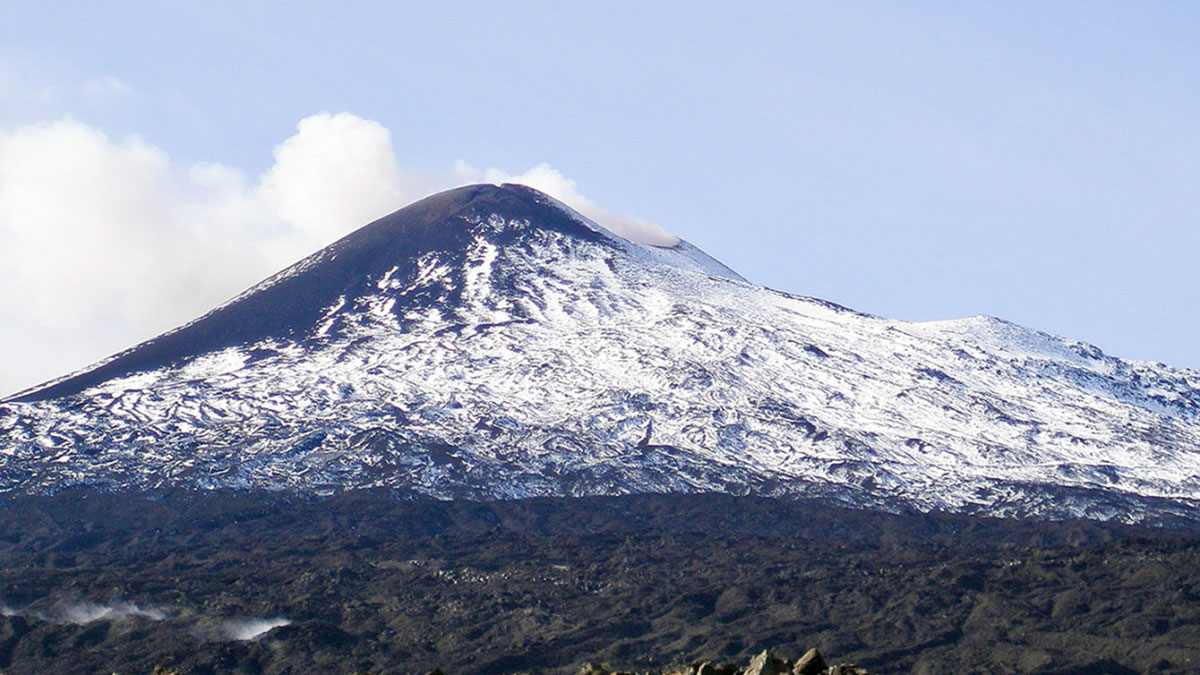
The researchers chose Mount Etna because it offered a comparatively simple volcanic system dominated largely by volatiles. Although Etna is relatively mild compared with many volcanoes, it has produced several powerful explosions in the distant past.
One of the largest recorded events occurred in 122 B.C. That eruption was mafic, meaning it involved low-viscosity magma rich in magnesium and iron, and Plinian, the most explosive eruption category, named after Pliny the Elder, who described the 79 A.D. eruption of Mount Vesuvius.
Collaborators and coauthors Terry Plank of Columbia University and Bruce Houghton of the University of Hawaii, Manoa, visited Mount Etna and carried out systematic field sampling. After sequencing and measuring magma crystals, the researchers found that during the 122 B.C. eruption, magma rose slowly from about 22 km deep. It then stalled for several weeks at a shallow depth of 2 to 5 km, where it gradually lost gas before finally erupting.
The team gathered new data and compared the results with samples from an older eruption, the Fall Stratified event, which occurred nearly 4,000 years ago. In that case, magma surged quickly upward from a deeper mantle level, about 24 to 30 km below the surface, and erupted within hours. That rapid eruption was driven by a much higher concentration of CO2.
Volatiles set the pace
“Some volcanoes are only high CO2, mostly in oceanic islands, and some volcanoes are mostly controlled by water, such as the ones in subduction zones. Etna is one of the few volcanoes in the world where you have the two volatile species competing,” Gazel said. “This shows that at a certain threshold of CO2, the eruption will come from very deep and really fast, but when you have a higher threshold of water, then the process is controlled at shallow levels.”
Gazel’s group is now using the same approach to study volcanoes in Chile, Hawaii, and many other regions.
“Ideally, this should be done in every volcano on the planet,” he said. “This is data we need for physical models of eruptions that are the base of risk assessment.”
A volcano shaped by history
Mount Etna is useful for studying the hidden complexity of volcanic behavior, but Gazel is also drawn to its role in Greek mythology. In those stories, Etna is known as the burial place of the defeated giants Typhon and Enceladus.
“There may be the two giant mythological monsters under Etna,” Gazel said. “And if you look at the plumbing system of the Plinian eruption, it’s like Typhon, because it’s elongated and serpentine, and the other one is Enceladus, because it’s kind of smaller. If you work in Etna, it’s hard not to be connected to history, classical work, and great food.”
Reference: “Deep Origin and Shallow Launch for the Etna 122 B.C. Mafic Plinian Eruption” by M. Gavrilenko, E. Gazel, K. Dayton, A. Barth, T. Plank, E. G. Huggins and B. Houghton, 2 June 2026, Geochemistry, Geophysics, Geosystems.
DOI: 10.1029/2026GC012924
The research was supported by the National Science Foundation.
Never miss a breakthrough: Join the SciTechDaily newsletter.
Follow us on Google and Google News.