
Close Menu
    Facebook X (Twitter) Instagram
    SciTechDaily
    • Biology
    • Chemistry
    • Earth
    • Health
    • Physics
    • Science
    • Space
    • Technology
    Facebook X (Twitter) Pinterest YouTube RSS
    SciTechDaily
    Home»Chemistry»Scientists Finally Capture Carbon’s Most Elusive Shape
    Chemistry

    Scientists Finally Capture Carbon’s Most Elusive Shape

    By University of OxfordAugust 20, 2025No Comments4 Mins Read
    Facebook Twitter Pinterest Telegram LinkedIn WhatsApp Email Reddit
    Share
    Facebook Twitter LinkedIn Pinterest Telegram Email Reddit

    New Allotrope of Carbon
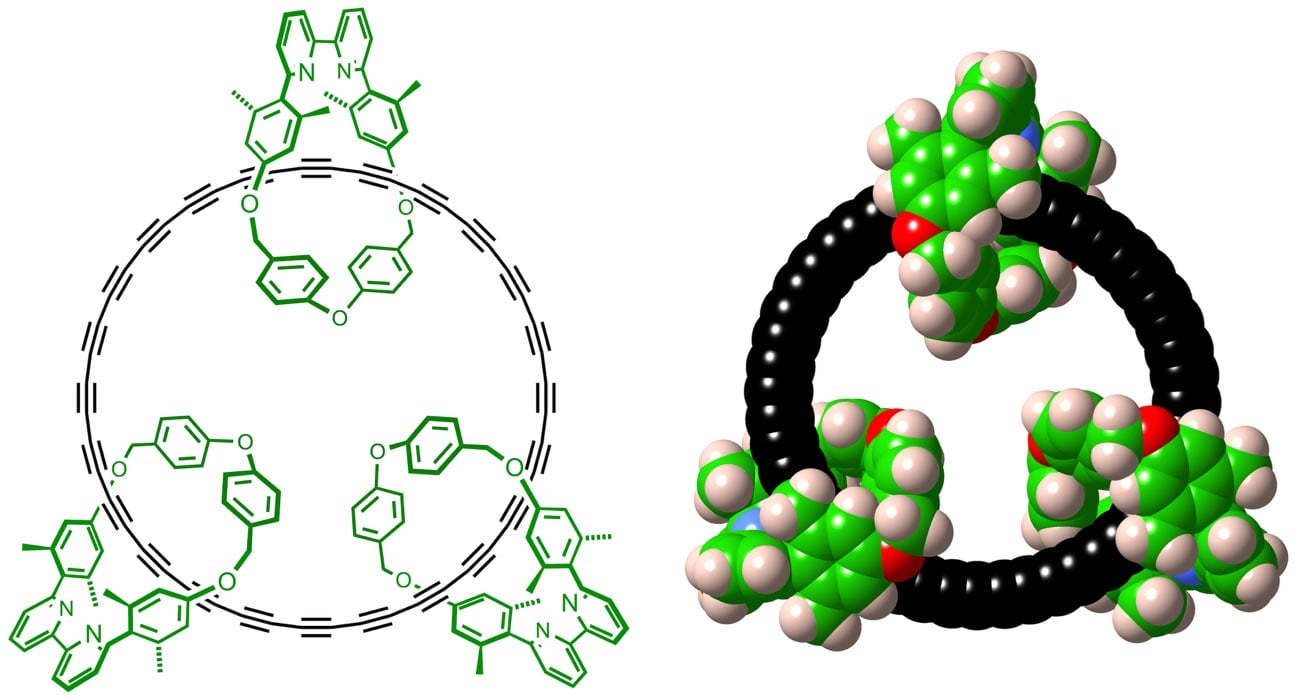
    Left: Chemical structure of the cyclo[48]carbon [4]catenane. Right: Space-filling representation. Credit: Harry Anderson.
    Oxford chemists have finally stabilized a 48-atom carbon ring, creating a rare new allotrope that holds together in liquid at room temperature — a feat once thought impossible.

    • Chemists have successfully created a brand-new form of carbon.
    • The molecule, known as cyclo[48]carbon, contains 48 carbon atoms arranged in a striking ring pattern of alternating single and triple bonds.
    • Remarkably, it is stable enough to be studied in liquid at room temperature, a first for this type of structure.
    • This achievement marks only the second time scientists have produced a new carbon allotrope that can be examined under normal lab conditions.
    • The discovery was reported on August 14 in Science.

    Breakthrough in Carbon Chemistry

    Researchers at Oxford University’s Department of Chemistry have successfully created a cyclocarbon stable enough to be examined in solution at room temperature using advanced spectroscopic methods.

    Developing a new molecular form of carbon that can withstand normal laboratory conditions is extremely rare. The only previous success came in 1990, when Krätschmer et al. synthesized fullerenes (Nature 1990).

    In this latest breakthrough, scientists produced cyclo[48]carbon as a [4]catenane, meaning the C48 carbon ring was threaded through three larger molecular loops. These protective loops, or macrocycles, shield the ring and prevent it from breaking apart, greatly improving its stability.
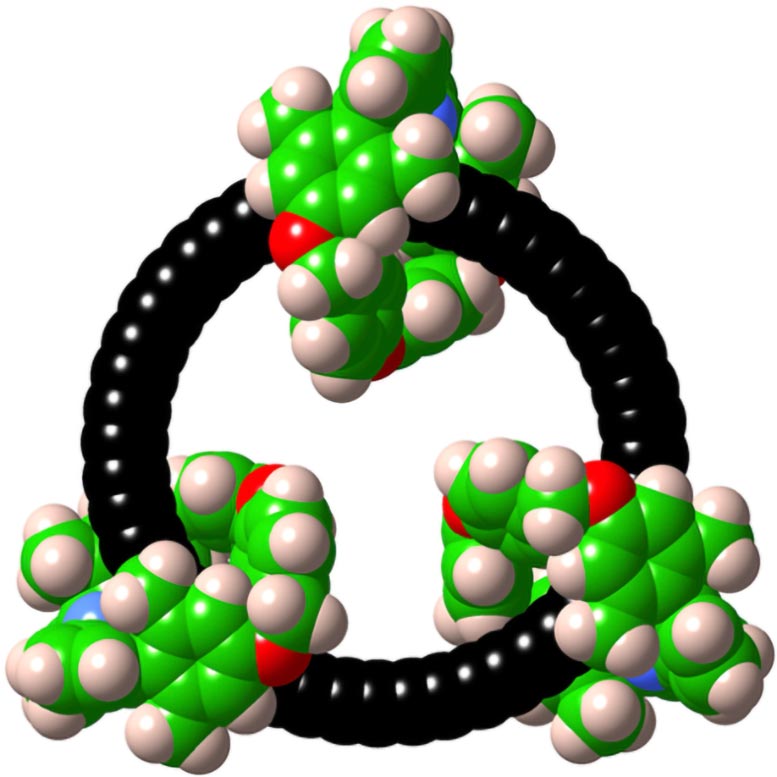
    Cyclo[48]carbon [4]catenane
    Space-filling representation of cyclo[48]carbon [4] catenane. Credit: Harry Anderson

    First Room-Temperature Cyclocarbon in Solution

    Until now, pure carbon rings could only be observed in the gas phase or at cryogenic temperatures (4 to 10 K). The Oxford team has now created a version that remains stable in liquid solution at 20°C, with a half-life of 92 hours. This stability was achieved by combining several strategies: using threaded macrocycles, selecting a large carbon ring with minimal strain, and designing gentle reaction conditions for the unmasking step (where the precursor molecule is converted into the final structure).

    To confirm the result, the team analyzed the cyclocarbon catenane using mass spectrometry, NMR, UV-visible spectroscopy, and Raman spectroscopy. A single strong 13C NMR signal was detected for all 48 sp1 carbon atoms, showing that each atom occupies the same chemical environment. This finding provides compelling evidence for the correct cyclocarbon catenane structure.

    C48 Research Group
    From left to right: Study authors Prakhar Gupta, Yueze Gao, and Harry Anderson holding a model of part of the catenane. Credit: Dr. Robert Eichelmann

    A Fundamental Step for Future Research

    Lead author Dr. Yueze Gao (Department of Chemistry, University of Oxford) said: “Achieving stable cyclocarbons in a vial at ambient conditions is a fundamental step. This will make it easier to study their reactivity and properties under normal laboratory conditions.”

    Study senior author Professor Harry Andersen (Department of Chemistry, University of Oxford) said: “This achievement marks the culmination of a long endeavour to synthesise cyclocarbon catenanes, based on the hope that they might be stable enough to study at room temperature. The original grant proposal was written in 2016, based on preliminary results from 2012–2015. It is satisfying to have reached this point, because there were many times when the goal seemed unrealistic and unachievable. This work would not have been possible without the outstanding facilities for NMR spectroscopy in the Department of Chemistry at Oxford.”

    Reference: “Solution-phase stabilization of a cyclocarbon by catenane formation” by Yueze Gao, Prakhar Gupta, Igor Rončević, Coral Mycroft, Paul J. Gates, Anthony W. Parker and Harry L. Anderson, 14 August 2025, Science.
    DOI: 10.1126/science.ady6054

    The study also involved researchers from the University of Manchester, the University of Bristol and the Central Laser Facility, Rutherford Appleton Laboratory.

    Never miss a breakthrough: Join the SciTechDaily newsletter.
    Follow us on Google and Google News.

    Carbon University of Oxford
    Share. Facebook Twitter Pinterest LinkedIn Email Reddit

    Related Articles

    Scientists Discover a New Cousin of Diamond That Was Thought To Exist Only in Theory

    200x More Effective: Carbon Transforms Silver Into Super Catalysts

    Space’s Secret Ingredient: Pyrene’s Role in Our Universe

    Linus Pauling Was Right: Scientists Confirm Century-Old Electron Bonding Theory

    Opposites Attract, Likes Repel? Scientists Overturn Fundamental Principle of Physics

    Superstructure Carbons: The Newest Breakthrough That Could Revolutionize Energy

    Oxford’s Bold Plan for a Zero-Carbon, Circular Plastics Economy

    Nature Secret Recipe Inspires Breakthrough in Safer, Greener Fluorochemical Production

    1600-Feet Giant Underwater Waves: The Hidden Players in Ocean Heat and Carbon Storage

    Leave A Reply Cancel Reply

    • Facebook
    • Twitter
    • Pinterest
    • YouTube

    Don't Miss a Discovery

    Subscribe for the Latest in Science & Tech!

    Trending News

    NASA’s Voyager 1 Is About to Become the First Spacecraft One Light-Day From Earth

    A Woman Who Lived 30,000 Years Ago Is Changing What We Know About Ice Age Europe

    A Rare Radioactive Element Reveals a Hidden Secret About the Heaviest Atoms

    Breakthrough Cancer Treatment Wipes Out Deadly Brain Tumors in Every Mouse Tested

    Something Remarkable Is Happening to Dogs Living Near Chernobyl’s Nuclear Plant

    Hubble Uncovers a Mysterious 93-Billion-Mile Structure Hiding in a Nearby Star System

    Earth’s Oceans Were Slowly Suffocating Millions of Years Before a Devastating Mass Extinction

    Why Are Men Twice As Likely To Develop Parkinson’s? Scientists Discover a Hidden Clue in the Brain

    Follow SciTechDaily
    • Facebook
    • Twitter
    • YouTube
    • Pinterest
    • Newsletter
    • RSS
    SciTech News
    • Biology News
    • Chemistry News
    • Earth News
    • Health News
    • Physics News
    • Science News
    • Space News
    • Technology News
    Recent Posts
    • Scientists Find a Clever Way to Read Quantum Information Without Destroying It
    • Chemical Breakthrough Could Unlock the “Holy Grail” of Solid-State Battery Technology
    • Kids Who Learn To Swim Early May Have an Unexpected Advantage in School
    • Could Type 2 Diabetes Be Reversed? 14-Year Study Reveals Remarkable Results
    • The Secret to Saving Shellfish From Acidifying Oceans Could Be Hiding in Crushed Shells
    Copyright © 1998 - 2026 SciTechDaily. All Rights Reserved.
    • Science News
    • About
    • Contact
    • Editorial Board
    • Privacy Policy
    • Terms of Use

    Type above and press Enter to search. Press Esc to cancel.