
Close Menu
    Facebook X (Twitter) Instagram
    SciTechDaily
    • Biology
    • Chemistry
    • Earth
    • Health
    • Physics
    • Science
    • Space
    • Technology
    Facebook X (Twitter) Pinterest YouTube RSS
    SciTechDaily
    Home»Chemistry»MIT Team Uses Carbon Nanotubes to Draw Gas Sensors
    Chemistry

    MIT Team Uses Carbon Nanotubes to Draw Gas Sensors

    By SciTechDailyOctober 11, 2012No Comments2 Mins Read
    Facebook Twitter Pinterest Telegram LinkedIn WhatsApp Email Reddit
    Share
    Facebook Twitter LinkedIn Pinterest Telegram Email Reddit
    drawing-carbon-nanotubes
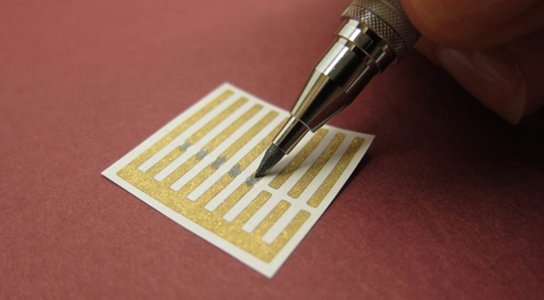
    Drawing gas sensors on paper using a tailor-made, super-conductive carbon nanotube pencil.

    A team of MIT chemists revealed how they developed a method for drawing gas sensors on paper using a tailor-made, super-conductive carbon nanotube pencil.

    The scientists published their findings in the German journal Angewandte Chemie. Electrically charged carbon nanotubes, about 50,000 times thinner than human hair, make for great sensors. When a gas molecule disturbs its surface, it binds to the nanotube, altering the current flow. This kind of system can be used to detect chemical changes in the air, and could lead to the development of biosensors for national security reasons. They could also be used in the food industry since carbon nanotube sensors have been used to detect ethylene levels excreted by ripening fruits.

    Buildings these sensors are inexpensive, but hazardous since the nanotubes must be dissolved in solvents like dichlorobenzene. Therefore, it was thought unlikely that they would ever be mass-produced. The new way described in the paper uses a solvent-free method to overcome this developmental hurdle. Carbon nanotubes are related to the main component in the lead of a pencil, which is graphite, states postdoctoral student Katherine Mirica.

    The team used commercial carbon nanotube powder compressed into the shape of a pencil’s lead. This rendered it stable and reliable. Then, they printed gold electrodes onto standard paper and drew lines of carbon nanotubes using the pencil. Once an electric current is passed along the nanotubes, this particular sensor can measure the ammonia in the atmosphere. However, different types of sensors can be made using this same process.

    Reference: “Mechanical Drawing of Gas Sensors on Paper” by Dr. Katherine A. Mirica, Jonathan G. Weis, Dr. Jan M. Schnorr, Dr. Birgit Esser and Prof. Dr. Timothy M. Swager, 4 October 2012, Angewandte Chemie.
    DOI: 10.1002/anie.201206069

    Never miss a breakthrough: Join the SciTechDaily newsletter.
    Follow us on Google and Google News.

    Carbon MIT Nanotechnology Nanotubes
    Share. Facebook Twitter Pinterest LinkedIn Email Reddit

    Related Articles

    Household Ingredients Rich in Sodium Help Grow Carbon Nanotubes

    MIT Chemists Create New Adaptable Metallic-Cage Gels

    MIT Chemists Develop a Quantum-Dot Spectrometer

    Researchers Grow Single-Walled Carbon Nanotubes with Identical Electronic Properties

    Artificial System Models Light-Capturing Method Used by Deep-Sea Bacteria

    All-Carbon Photovoltaic Cell to Harness Infrared Light

    Balancing Between Life and Research

    Cost Effective Sensor Measures Fruits’ Ripeness

    Analyzing the Environmental Costs and Impacts of Technology

    Leave A Reply Cancel Reply

    • Facebook
    • Twitter
    • Pinterest
    • YouTube

    Don't Miss a Discovery

    Subscribe for the Latest in Science & Tech!

    Trending News

    Scientists May Have Found the Key to Jupiter and Saturn’s Moon Mystery

    Scientists Uncover Brain Changes That Link Pain to Depression

    Saunas May Do More Than Raise Body Temperature – They Activate Your Immune System

    Exercise in a Pill? Metformin Shows Surprising Effects in Cancer Patients

    Hidden Oceans of Magma Could Be Protecting Alien Life

    New Study Challenges Alzheimer’s Theories: It’s Not Just About Plaques

    Artificial Sweeteners May Harm Future Generations, Study Suggests

    Splashdown! NASA Artemis II Returns From Record-Breaking Moon Mission

    Follow SciTechDaily
    • Facebook
    • Twitter
    • YouTube
    • Pinterest
    • Newsletter
    • RSS
    SciTech News
    • Biology News
    • Chemistry News
    • Earth News
    • Health News
    • Physics News
    • Science News
    • Space News
    • Technology News
    Recent Posts
    • Scientists Discover Unexpected Climate Benefit Hidden in Forest Soils
    • The Grand Canyon’s “Swiss Cheese” Rocks Hold a Critical Secret
    • Scientists Discover 430,000-Year-Old Wooden Tools, Rewriting Human History
    • Scientists Make Breakthrough on 40-Year-Old 2D Physics Puzzle
    • As Cities Invade the Amazon, Yellow Fever Makes a Dangerous Comeback
    Copyright © 1998 - 2026 SciTechDaily. All Rights Reserved.
    • Science News
    • About
    • Contact
    • Editorial Board
    • Privacy Policy
    • Terms of Use

    Type above and press Enter to search. Press Esc to cancel.