
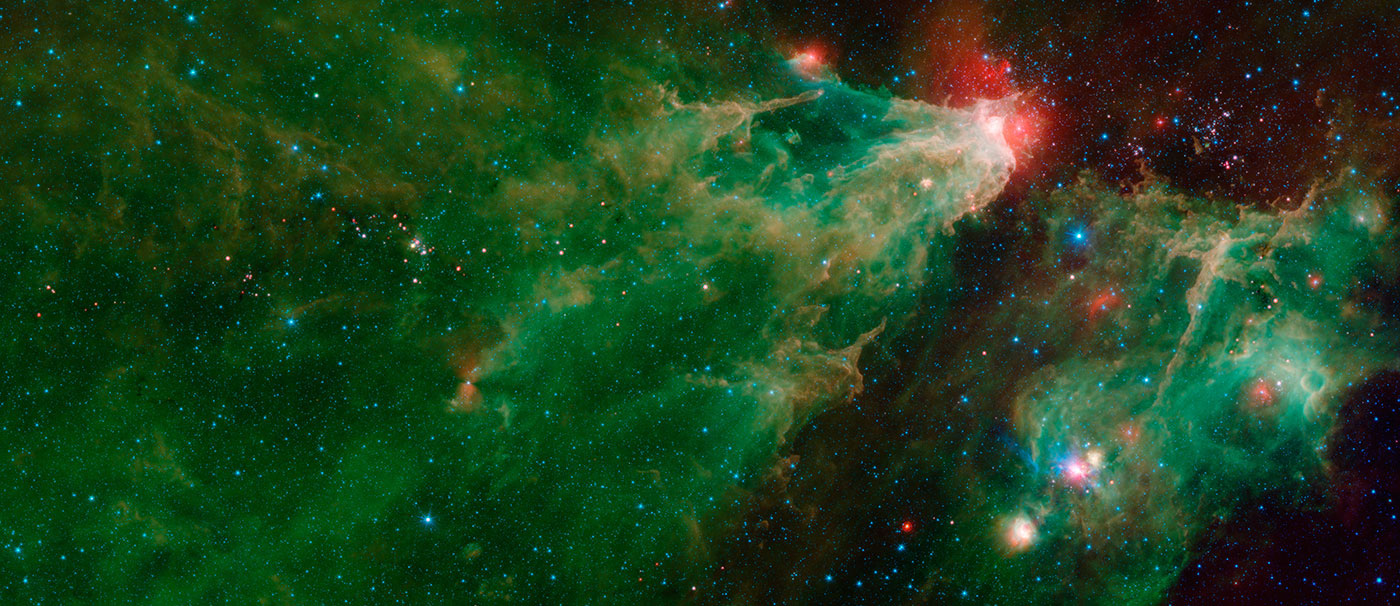
In this large celestial mosaic taken by NASA’s Spitzer Space Telescope, there’s a lot to see, including multiple clusters of stars born from the same dense clumps of gas and dust. Some of these clusters are older than others and more evolved, making this a generational stellar portrait.
The grand green-and-orange delta filling most of the image is a faraway nebula or a cloud of gas and dust in space. Though the cloud may appear to flow from the bright white spot at its tip, it is actually what remains of a much larger cloud that has been carved away by radiation from stars. The bright region is illuminated by massive stars, belonging to a cluster that extends above the white spot. The white color is the combination of four colors (blue, green, orange, and red), each representing a different wavelength of infrared light, which is invisible to human eyes. Dust that has been heated by the stars’ radiation creates the surrounding red glow.
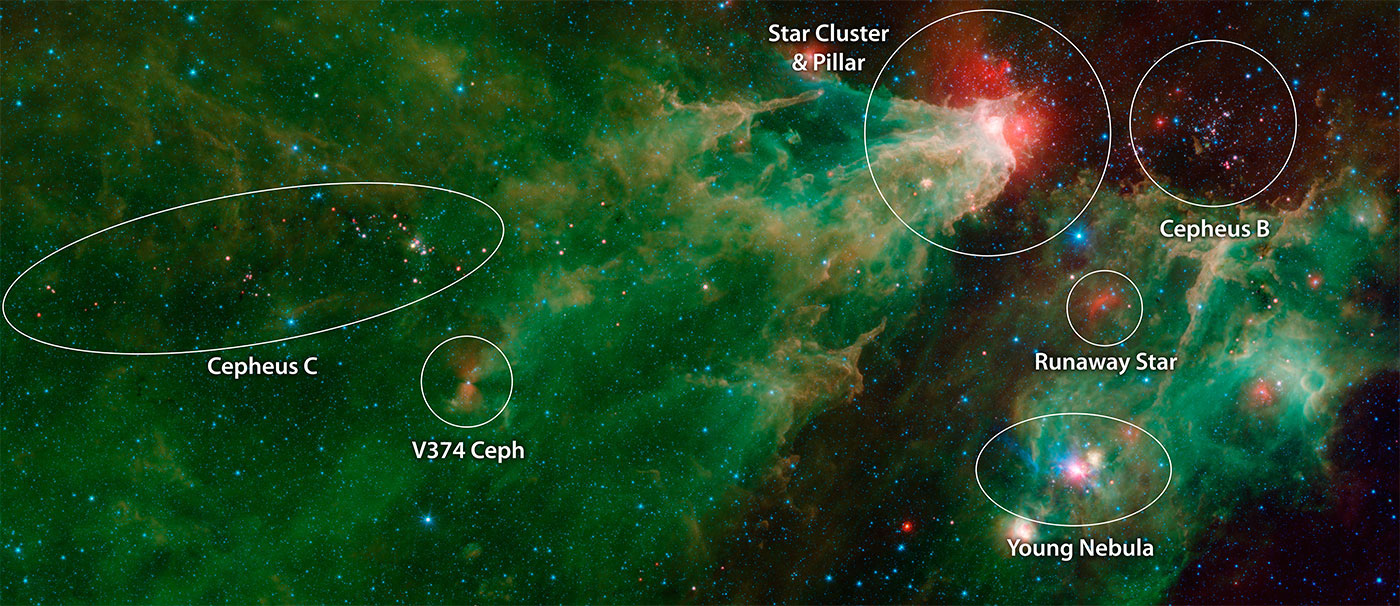
On the left side of this image, a dark filament runs horizontally through the green cloud. A smattering of baby stars (the red and yellow dots) appear inside it. Known as Cepheus C, the area is a particularly dense concentration of gas and dust where infant stars form. The dark vein of material will eventually be dispersed by strong winds produced as the stars get older, and when they eventually explode and die. This will create an illuminated puffed-up region that will look similar to the bright red-and-white region on the large nebula’s upper-right side. The region is called Cepheus C because it lies in the constellation Cepheus, which can be found near the constellation Cassiopeia. Cepheus C is about 6 light-years long and lies about 40 light-years from the bright spot at the tip of the nebula.
A second large nebula can be seen on the right side of the image, with a star cluster located just above it. Known as Cepheus B, the cluster sits within a few thousand light-years of our Sun. A study of this region using Spitzer data found that the dramatic collection is about 4 million to 5 million years old — slightly older than those in Cepheus C.
In that way, the mosaic is a veritable family portrait, featuring infants, parents, and grandparents of star-forming regions: Stars form in dense clouds of material, like the dark vein that makes up Cepheus C. As the stars grow, they produce winds that blow the gas and dust outward, to form beautiful, illuminated nebulas like the bright white spot at the top of the larger nebula. Finally, the dust and gas disperse, and the star clusters stand alone in space, as with Cepheus B.
Other Sights to See
The amazing features in this image don’t end there.
Look closely for the small, red hourglass shape just below Cepheus C. This is V374 Ceph. Astronomers studying this massive star have speculated that it might be surrounded by a nearly edge-on disk of dark, dusty material. The dark cones extending to the right and left of the star are a shadow of that disk.
The smaller nebula on the right side of the image includes two particularly interesting objects. In the upper-left portion of the nebula, try to find a blue star crowned by a small, red arc of light. This “runaway star” is plowing through the gas and dust at a rapid clip, creating a shock wave, or “bow shock,” in front of itself.
Also hidden within this second nebula, a small cluster of newborn stars illuminates the dense cloud of gas and dust where they formed. This region is more obvious in the image below, which uses data from just one of Spitzer’s instruments. (The top image includes data from two instruments.) In the image below, this feature appears as a bright teal splash.

More About the Images
The two-instrument image was compiled using data from the Infrared Array Camera (IRAC) and the Multiband Imaging Photometer (MIPS) during Spitzer’s “cold” mission before the spacecraft’s liquid helium coolant ran out in 2009. The colors correspond with IRAC wavelengths of 3.6 microns (blue), 4.5 microns (cyan), 8 microns (green), and MIPS at 24 microns (red).
The one-instrument image shows data from IRAC only, with colors corresponding to wavelengths of 3.6, 4.5, 5.8, and 8.0 μm (shown as blue, green, orange, and red).
In 2017 and 2016, high school students and teachers contributed to our understanding of the Cepheus C star-forming region. As part of NITARP (NASA/IPAC Teacher Archive Research Program), the students and teachers combed through Spitzer data to identify the presence of young stellar objects. Over two years and with the guidance of astronomer Luisa Rebull of IPAC at Caltech, the students and teachers identified more than 100 such objects that hadn’t been identified in previous studies. Educators interested in participating in NITARP should visit the program website.
The Jet Propulsion Laboratory in Pasadena, California, manages the Spitzer Space Telescope mission for NASA’s Science Mission Directorate in Washington. Science operations are conducted at the Spitzer Science Center at Caltech in Pasadena. Space operations are based at Lockheed Martin Space Systems in Littleton, Colorado. Data are archived at the Infrared Science Archive housed at IPAC at Caltech. Caltech manages JPL for NASA.
Never miss a breakthrough: Join the SciTechDaily newsletter.
Follow us on Google and Google News.
9 Comments
I, a retired aerospace manager, have been a space junkie all my life. My greatest wish is to find acceptable ways, as a knowledgeable citizen scientist, to participate in a meaningful way, in the study, analysis, interpretation, and contribute to data review of photos, or …? in support of NASA, and other organizations. Suggestions are welcome. Thank you.
@Norman Brown Check out zooniverse, there are many space-oriented projects available. https://www.zooniverse.org/projects?discipline=astronomy&page=1&status=live
I came across this website watching the news !!! made my day!! I wrote it down so I can find it again ! thank you for sharing this stuff! THOMAS
I am only an amateur but if you look almost all of the way to the right and just below the center. On the picture at the top there is a red star with a smaller (further probably) white star to the right of it. Just to the right of that you can see what appears to be the gas collapsing in on itself. I think a star is “about to be” born there. Any thoughts?
The whole cepheus cloud is the remnant of a former supernova. star formation should be created inside Herbig Haro systems as the start of star production inside an open star cluster,.
The James Webb Space Telescope will be lunch March 2021. it will observe some of the most distant events and objects in the universe.
This is a very good article.I think On the picture at the top there is a color full star .
i can’t imagine this is actually happened.
Thank you for sharing. It is easy to understand your article. This post helps me understand more about the Spitzer Space Telescope.
Thank you for sharing such an important article.I was being collecting information about Spitzer Space Telescope because it is a technological marvel, featuring many innovations never before used on a space mission.