
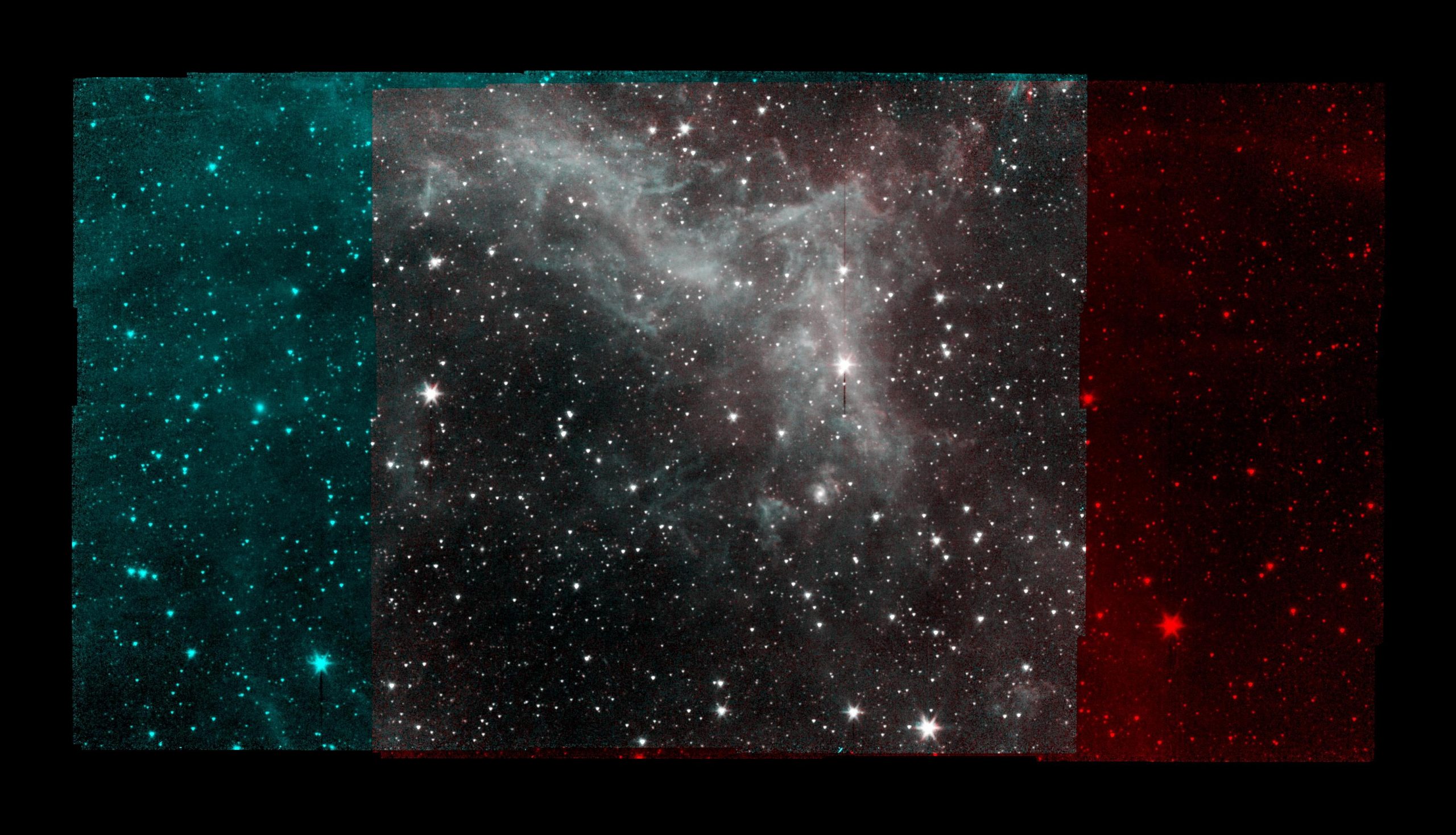
The image composite is just one of hundreds that the infrared observatory produced during its 16 years in space.
Five days before NASA’s Spitzer Space Telescope ended its mission on January 30, 2020, scientists used the spacecraft’s infrared camera to take multiple images of a region known as the California Nebula — a fitting target considering the mission’s management and science operations were both based in Southern California at NASA’s Jet Propulsion Laboratory and Caltech. This mosaic is made from those images. It is the final mosaic image taken by Spitzer and one of hundreds the spacecraft captured throughout its lifetime.
Located about 1,000 light-years from Earth, the nebula looks more than a little like the Golden State when viewed by visible-light telescopes: It is long and narrow, bending to the right near the bottom. The visible light comes from gas in the nebula being heated by a nearby, extremely massive star known as Xi Persei, or Menkib. Spitzer’s infrared view reveals a different feature: warm dust, with a consistency similar to soot, that is mixed in with the gas. The dust absorbs visible and ultraviolet light from nearby stars and then re-emits the absorbed energy as infrared light.
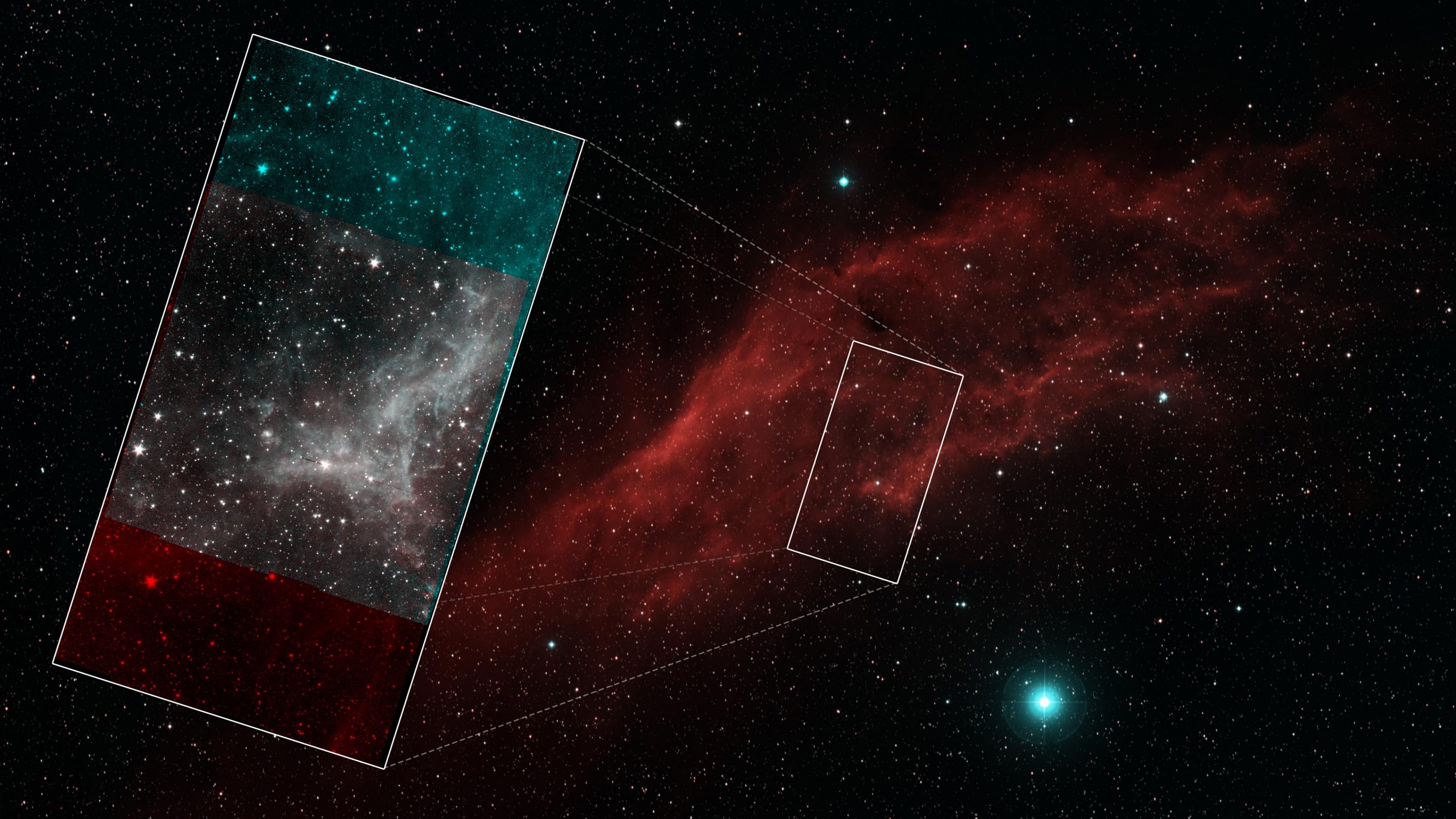
The mosaic displays Spitzer’s observations much the way that astronomers would view them: From 2009 to 2020, Spitzer operated two detectors that simultaneously imaged adjacent areas of the sky. The detectors captured different wavelengths of infrared light (referred to by their physical wavelength): 3.6 micrometers (shown in cyan) and 4.5 micrometers (shown in red). Different wavelengths of light can reveal different objects or features. Spitzer would scan the sky, taking multiple pictures in a grid pattern, so that both detectors would image the region at the center of the grid. By combining those images into a mosaic, it was possible to see what a given region looked like in multiple wavelengths, such as in the gray-hued part of the image above.
In the final week of operations, the mission science team chose from a list of potential targets that would be within Spitzer’s field of view. The California Nebula, which hadn’t been studied by Spitzer before, stood out due to the likelihood that it would contain prominent infrared features and have the potential for high science return.
“Sometime in the future, some scientist will be able to use that data to do a really interesting analysis,” said Sean Carey, manager of the Spitzer Science Center at Caltech in Pasadena, who helped select the nebula for observation. “The entire Spitzer data archive is available to the scientific community to use. This is another piece of the sky that we’re putting out there for everyone to study.”
Final Observations
The Spitzer team made additional science observations through January 29, the day before the mission ended, though none was quite so visually stunning as the California Nebula. Those observations included measuring the light from dust sprinkled throughout our own solar system, called zodiacal dust. This tenuous dust cloud arises from the evaporation of comets and collisions between asteroids. Comets and asteroids are like fossils that retain the chemical composition of the material that formed the planets, so the dust provides a look back in time.

Observatories close to Earth typically have trouble observing the overall zodiacal dust glow because blobs of dust tend to collect around our planet. But Spitzer’s orbit eventually carried it 158 million miles (254 million kilometers) from Earth, or more than 600 times the distance between Earth and the Moon. From that distance, Spitzer had a unique vantage point away from the dust blobs.
The mission team also closed the shutter on Spitzer’s camera for the first time in the mission’s 16-year lifetime. This exercise allowed scientists to observe and then subtract subtle effects that Spitzer’s instruments may have on the measurement of light from distant sources, enabling them to produce more accurate measurements of their cosmic targets.
To learn more about Spitzer and some of its biggest discoveries, check out NASA’s Exoplanet Excursions, a free VR application for HTC Vive and Oculus Rift. This VR experience features a new activity that lets users interactively control a simulation of Spitzer. The application is available from the Spitzer website. Two non-interactive VR activities can be viewed as immersive YouTube 360 videos on the Spitzer YouTube page.
Spitzer science data continues to be analyzed by the science community via the Spitzer data archive located at the Infrared Science Archive housed at IPAC at Caltech in Pasadena. JPL managed Spitzer mission operations for NASA’s Science Mission Directorate in Washington. Science operations were conducted at the Spitzer Science Center at IPAC at Caltech. Spacecraft operations were based at Lockheed Martin Space in Littleton, Colorado. Caltech manages JPL for NASA.
Never miss a breakthrough: Join the SciTechDaily newsletter.
Follow us on Google and Google News.