
Close Menu
    Facebook X (Twitter) Instagram
    SciTechDaily
    • Biology
    • Chemistry
    • Earth
    • Health
    • Physics
    • Science
    • Space
    • Technology
    Facebook X (Twitter) Pinterest YouTube RSS
    SciTechDaily
    Home»Space»Cosmic Spiral Around Red Giant Star R Sculptoris Could Elucidate Stellar Evolution
    Space

    Cosmic Spiral Around Red Giant Star R Sculptoris Could Elucidate Stellar Evolution

    By SciTechDailyOctober 11, 2012No Comments4 Mins Read
    Facebook Twitter Pinterest Telegram LinkedIn WhatsApp Email Reddit
    Share
    Facebook Twitter LinkedIn Pinterest Telegram Email Reddit
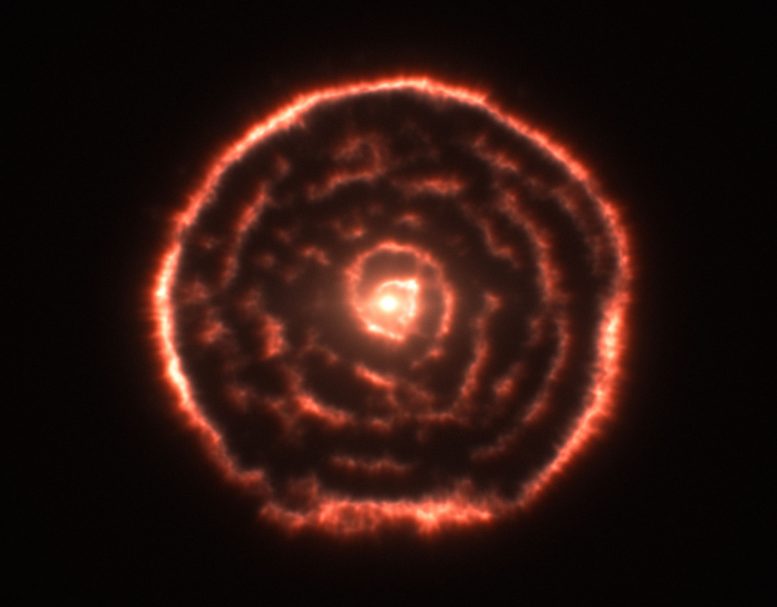
    R Sculptoris
    Observations using the Atacama Large Millimeter/submillimeter Array (ALMA) have revealed an unexpected spiral structure in the material around the old star R Sculptoris. This feature has never been seen before and is probably caused by a hidden companion star orbiting the star. This slice through the new ALMA data reveals the shell around the star, which shows up as the outer circular ring, as well as a very clear spiral structure in the inner material. Credit: ALMA (ESO/NAOJ/NRAO)

    R Sculptoris, an elderly star, located 1,500 light-years from Earth, has been observed in the final stages of stellar life, slowly shedding the outer layers of its atmosphere. There are intensely high temperatures at the star’s core, which create a powerful stellar wind that drives these layers out. They usually accumulate into planetary nebulae over a few million years. It is believed that most small and medium-sized stars will undergo a similar process at the end of their life.

    Every 20,000 years, stars at this stage will undergo a thermal pulse, a 200-year-long thermonuclear convulsion that occurs deep in the star’s core. The star will quickly fuse helium into heavier elements, releasing lots of energy, burning brightly, and shedding a shell of high-density material.
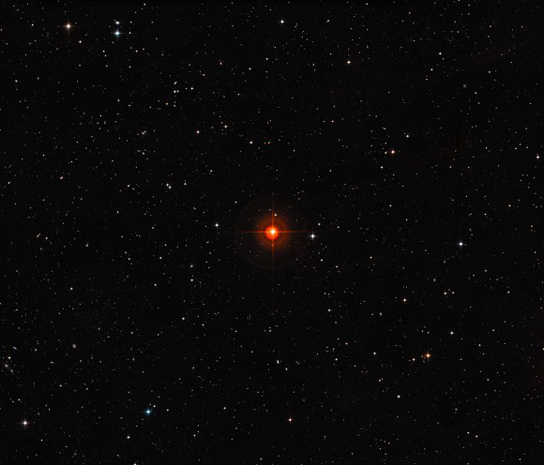
    r-sculptoris-sky
    A wide-field view of the red giant variable star R Sculptoris. Credit: ESO/Digitized Sky Survey 2. Davide De Martin

    The scientists published their findings in the journal Nature. Inside the star, there are a lot of new elements being formed, such as oxygen and carbon, states astronomer Matthias Maercker of the European Southern Observatory, lead author of the new study. These are key ingredients for life, and it’s possible that such a thermal pulsing process in previous generations of stars helped seed the Solar System with the right mix of elements.

    Detached shells have been seen around many stars, but the process happening inside hasn’t been observed. Astronomers used the Atacama Large Millimeter / Submillimeter Array radio telescope to see the spiral structure beneath the shell. The shape is most likely caused by a previously undetected companion star, which is about 0.2 times the mass of Sol, orbiting R Sculptoris and influencing the way it sheds its material.
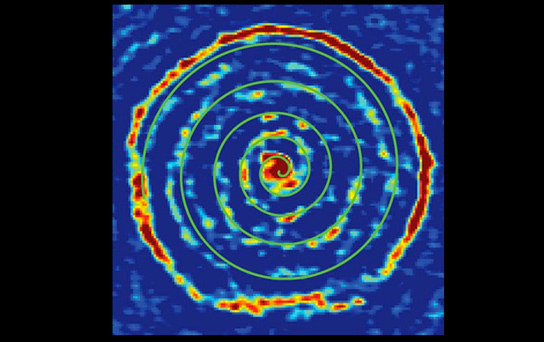
    sn-redgiant-rsculptoris
    Star sheds the equivalent of a thousand Earths of carbon-rich gas.

    Scientists can learn more about the thermal pulse process by calculating the amount of gas and dust in each part of the spiral, and further examining the structure of the star. R Scuptoris suffered a thermal pulse about 1,800 years ago that lasted 200 years.


    This new video shows a computer simulation of how the material is distributed around the star. It presents a series of slices through a 3D model of the surroundings of R Sculptoris. The shell around the star shows up as a circular ring that appears to get bigger and then smaller in different slices. The newly discovered clear spiral structure in the inner material is best seen about half-way through the video sequence. Credit: ESO/S. Mohamed (SAAO), L. Calçada


    This video is a computer model of the evolution of the material around the old red giant star R Sculptoris over a period of 2000 years. This star experiences thermal pulses that lead to the ejection of material from its surface. Astronomers think that the strange spiral structure is the result of the presence of a companion star in orbit around the red giant. Credit: Nature/M. Maercker et al./S. Mohamed/L. Calçada


    This video sequence starts with a view of the rather faint constellations of Sculptor (The Sculptor) and Cetus (The Sea Monster). As we zoom in we see a few faint galaxies but close in on a star that looks very red. This is the old red giant variable star R Sculptoris. Observations using the Atacama Large Millimeter/submillimeter Array (ALMA) have revealed an unexpected spiral structure in the material around this star. Credit: ESO/A. Fujii/Digitized Sky Survey 2

    Reference: “Unexpectedly large mass loss during the thermal pulse cycle of the red giant star R Sculptoris” by M. Maercker, S. Mohamed, W. H. T. Vlemmings, S. Ramstedt, M. A. T. Groenewegen, E. Humphreys, F. Kerschbaum, M. Lindqvist, H. Olofsson, C. Paladini, M. Wittkowski, I. de Gregorio-Monsalvo and L.-A. Nyman, 10 October 2012, Nature.
    DOI: 10.1038/nature11511

    Never miss a breakthrough: Join the SciTechDaily newsletter.
    Follow us on Google and Google News.

    Astronomy Astrophysics European Southern Observatory Popular Stellar Evolution
    Share. Facebook Twitter Pinterest LinkedIn Email Reddit

    Related Articles

    “Doesn’t Make Any Sense” – Star Pair That Shouldn’t Exist Shocks Astronomers

    Astronomers Discover VFTS 352 – The Hottest and Most Massive Touching Double Star System to Date

    SMA Reveals New Insights Into How Cosmic Seeds Grow Into Massive Stars

    ALMA Reveals the Mystery of Missing Massive Galaxies

    New ESO Image Shows Lupus 3

    ALMA Views a Key Stage in the Birth of Giant Planets

    Planetary Nebula Fleming 1 Likely Has Two White Dwarfs Circling Each Other at Its Center

    Centaurus a Hides a Gaseous Spiral at Its Core

    Sugar Molecules Found in Gas Surrounding Sun-Like Star

    Leave A Reply Cancel Reply

    • Facebook
    • Twitter
    • Pinterest
    • YouTube

    Don't Miss a Discovery

    Subscribe for the Latest in Science & Tech!

    Trending News

    Just a Few Breathless Minutes a Day Could Slash Your Risk of 8 Major Diseases

    This Simple Habit Could Cut Your Risk of Dementia by 30%

    Scientists Debunk Rattlesnake Myth That Fooled Hikers and Doctors for Decades

    Scientists Discover Plants Can “Count” – and May Be Smarter Than We Thought

    New Research Reveals Ancient Mars May Have Been Warm, Wet – and Possibly Alive

    This Surprising Daily Habit Could Cut Dementia Risk by 35%

    Just 10 Minutes a Day: Scientists Say This Ancient Chinese Practice Shows Powerful Blood Pressure Benefits

    Scientists Say This Popular Food Could Help Your Body Get Rid of Microplastics

    Follow SciTechDaily
    • Facebook
    • Twitter
    • YouTube
    • Pinterest
    • Newsletter
    • RSS
    SciTech News
    • Biology News
    • Chemistry News
    • Earth News
    • Health News
    • Physics News
    • Science News
    • Space News
    • Technology News
    Recent Posts
    • NASA’s Artemis II Cleared for Moon Flight As Orion Prepares for Critical Engine Burn
    • NASA Artemis II Crew Scrambles To Fix Unexpected Toilet Failure in Space
    • Surviving Burns May Have Changed Human Evolution
    • Scientists Discover Hidden “Footprint of Death” That Could Transform How We Fight Disease
    • Blood-Sucking Parasites Could Revolutionize Treatment for Autoimmune Diseases
    Copyright © 1998 - 2026 SciTechDaily. All Rights Reserved.
    • Science News
    • About
    • Contact
    • Editorial Board
    • Privacy Policy
    • Terms of Use

    Type above and press Enter to search. Press Esc to cancel.