
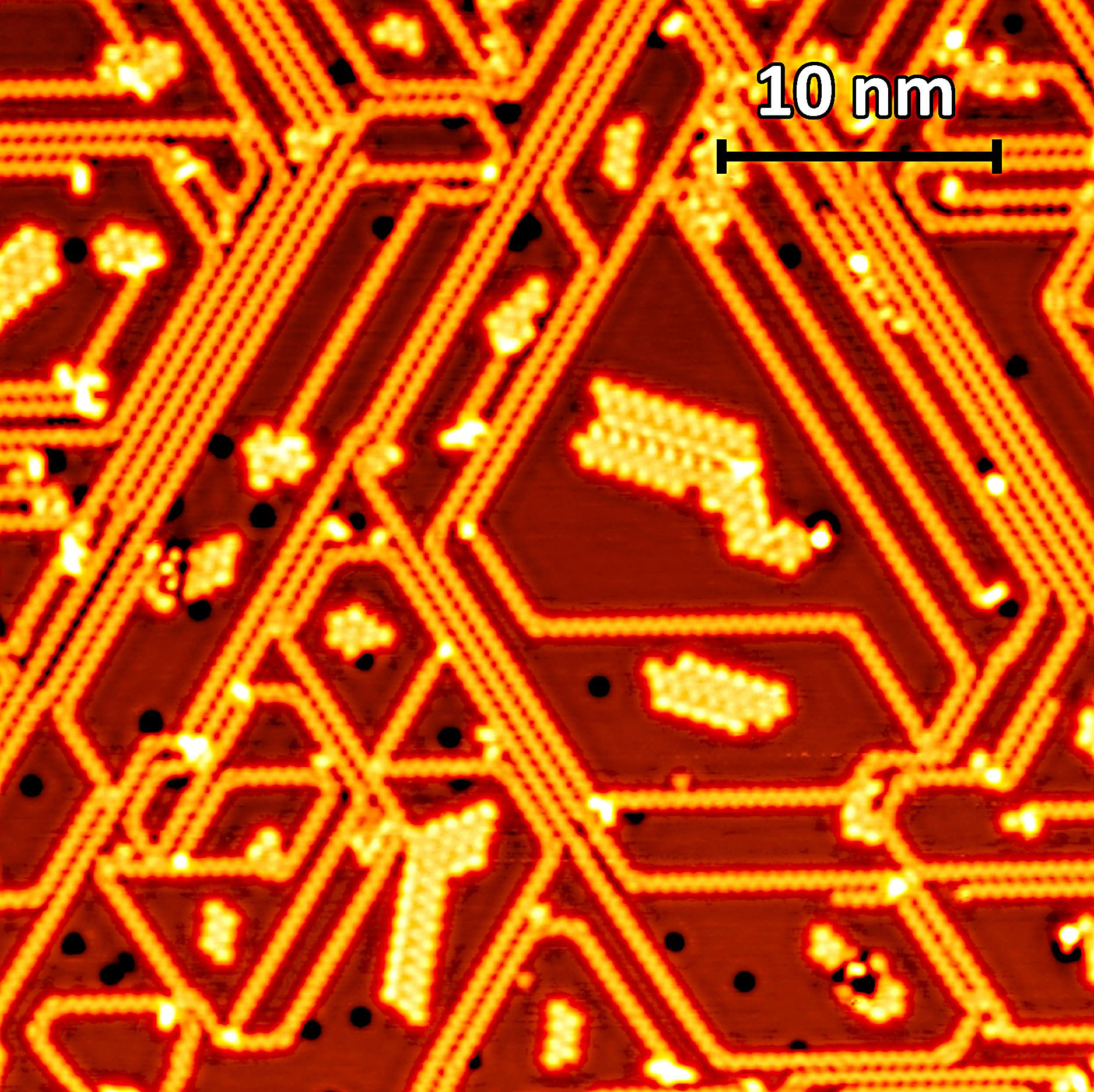
A sophisticated analysis of experimental ARPES data confirmed that the electronic properties of each chain are truly one-dimensional, and calculations further predict an exciting phase transition.
For the first time, researchers at BESSY II have successfully shown that a material can exhibit truly one-dimensional electronic properties. Using a carefully controlled experimental approach, the team studied tiny chains of phosphorus atoms that naturally arrange themselves at specific angles on a silver surface. By applying advanced analytical methods, they were able to separate and identify the signals from chains oriented in different directions. This detailed examination confirmed that each phosphorus chain behaves as a genuine one-dimensional electronic system.
Theoretical calculations add an exciting prediction: when these chains are brought closer together, their behavior is expected to change dramatically. Structures with widely spaced chains act as semiconductors, but when the chains are densely packed, the material could become metallic.
All matter is made of atoms that bond together to form countless substances. Typically, atoms connect both within a plane and in perpendicular directions. However, some elements, like carbon, can form unique two-dimensional (2D) materials such as graphene, where atoms link only within a single plane. Phosphorus is also capable of forming stable 2D structures. These 2D materials have drawn significant attention because of their remarkable electrical and optical characteristics. Scientists now believe that materials confined to just one dimension could possess even more extraordinary electro-optical properties.
Chains of Phosphorous atoms
Recently, it has become possible to produce one-dimensional structures: Under certain conditions, phosphorus atoms do arrange themselves into short lines on a silver substrate. These chains are morphologically one-dimensional. However, it is likely that they interact laterally with other chains. Such interactions influence the electronic structure, potentially destroying the one-dimensionality. Until now, however, it has not been possible to measure this accurately in experiments.
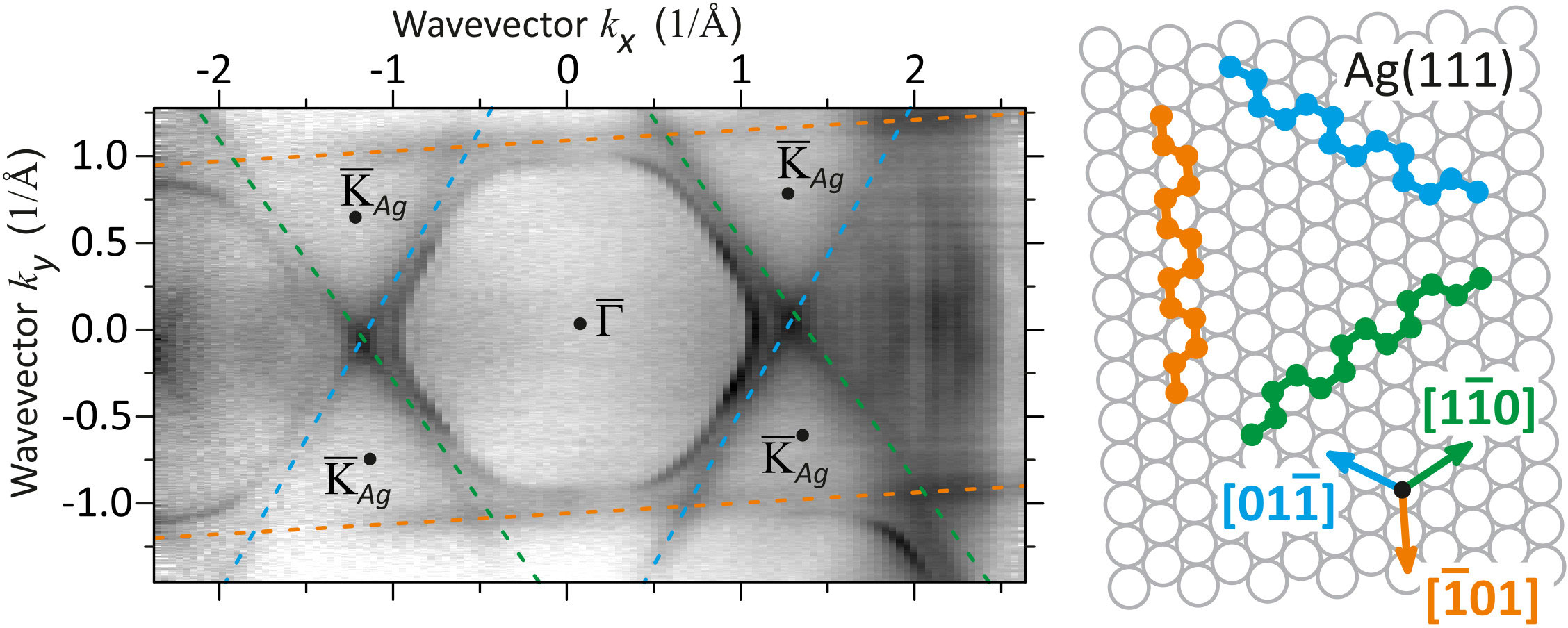
“Through a very thorough evaluation of measurements at BESSY II, we have now shown that such phosphorus chains really do have a one-dimensional electronic structure,” says Professor Oliver Rader, head of the Spin and Topology in Quantum Materials department at HZB.
Dr Andrei Varykhalov and his team first produced and characterized phosphorus chains on a silver substrate using a cryogenic scanning tunneling microscope (STM). The resulting images revealed the formation of short P chains in three different directions on the substrate, at 120-degree angles to each other.
ARPES at BESSY II shows 1D electronic structure
“We achieved very high-quality results, enabling us to observe standing waves of electrons forming between the chains,” says Varykhalov.
The team investigated then the electronic structure using angle-resolved photoelectron spectroscopy (ARPES) at BESSY II, a method with which they already have a great deal of experience.
Phase transition with density predicted
Dr. Maxim Krivenkov and Dr. Maryam Sajedi did pioneering work here: By carefully analyzing the data, they were able to distinguish the contributions of the three differently oriented phosphorus chains. “We could disentangle the ARPES signals from these domains and thus demonstrate that these 1D phosphorus chains actually possess a very distinct 1D electron structure too,” says Krivenkov.
Calculations based on density functional theory confirm this analysis and make an exciting claim: The closer these chains are to each other, the stronger their interaction. These results predict a phase transition from semiconductor to metal as the density of the chain array increases. As a conclusion, a two-dimensional phosphorus chain structure would be metallic.
“We have entered a new field of research here, uncharted territory where many exciting discoveries are likely to be made,” says Varykhalov.
Reference: “Revealing the 1D Nature of Electronic States in Phosphorene Chains” by Maxim Krivenkov, Maryam Sajedi, Dmitry Marchenko, Evangelos Golias, Matthias Muntwiler, Oliver Rader and Andrei Varykhalov, 17 October 2025, Small Structures.
DOI: 10.1002/sstr.202500458
Never miss a breakthrough: Join the SciTechDaily newsletter.
Follow us on Google and Google News.
4 Comments
Under certain conditions, phosphorus atoms do arrange themselves into short lines on a silver substrate. These chains are morphologically one-dimensional. However, it is likely that they interact laterally with other chains. Such interactions influence the electronic structure, potentially destroying the one-dimensionality.
VERY GOOD!
Based on the Topological Vortex Theory (TVT), understanding these chains under the topological vortex framework will provide researchers with more insights.
Topological Vortex Theory (TVT) could reshape our understanding of fundamental physical laws and phenomena.
Please ask the researchers to think deeply:
How are the one-dimensional and two-dimensional structures observed in your experiment defined?
When we pursue the ultimate truth of all things, the space in which our bodies and all things exist may itself be the final and deepest puzzle we need to explore. This is not only the pursuit of physics, but also the most magnificent exploration of the origin of the universe by human reason.
Based on the Topological Vortex Theory (TVT), space is an uniformly incompressible physical entity. Space-time vortices are the products of topological phase transitions of the tipping points in space, are the point defects in spacetime. Point defects do not only impact the thermodynamic properties, but are also central to kinetic processes. They create all things and shape the world through spin and self-organization.
In today’s physics, some so-called peer-reviewed journals—including Physical Review Letters, Nature, Science, and others—stubbornly insist on and promote the following:
1. Even though θ and τ particles exhibit differences in experiments, physics can claim they are the same particle. This is science.
2. Even though topological vortices and antivortices have identical structures and opposite rotational directions, physics can define their structures and directions as entirely different. This is science.
3. Even though two sets of cobalt-60 rotate in opposite directions and experiments reveal asymmetry, physics can still define them as mirror images of each other. This is science.
4. Even though vortex structures are ubiquitous—from cosmic accretion disks to particle spins—physics must insist that vortex structures do not exist and require verification. Only the particles that like God, Demonic, or Angelic are the most fundamental structures of the universe. This is science.
5. Even though everything occupies space and maintains its existence in time, physics must still debate and insist on whether space exists and whether time is a figment of the human mind. This is science.
6. Even though space, with its non-stick, incompressible, and isotropic characteristics, provides a solid foundation for the development of physics, physics must still insist that the ideal fluid properties of space do not exist. This is science.
and go on.
Is this the counterintuitive science they widely promote?
What are the shames?
What are the corruption, dirtiness, and ugliness?
Under the topological vortex architecture, it is highly challenging for even two hydrogen atoms or two quarks to be perfectly symmetrical, let alone counter-rotating two sets of cobalt-60. Contemporary physics and so-called peer-reviewed publications (including Physical Review Letters, Science, Nature, etc.) stubbornly believe that two sets of counter rotating cobalt-60 are two mirror images of each other, constructing a more shocking pseudoscientific theoretical framework in the history of science than the “geocentric model”. This pseudo scientific framework and system have seriously hindered scientific progress and social development.
For nearly a century, physics has been manipulated by this pseudo scientific theoretical system and the interest groups behind it, wasting a lot of manpower, funds, and time. A large amount of pseudo scientific research has been conducted, and countless pseudo scientific papers have been published, causing serious negative impacts on scientific and social progress, as well as humanistic development.
Complexity does not necessarily mean that there is no logical and architectural framework to follow. Mathematics is the language and tool that reveals the motion of spacetime, rather than the motion itself. Although the physical form of spacetime vortices is extremely simple, their interaction patterns are highly complex, and we must develop more and richer mathematical languages to describe and understand them.