
A well-known magnetic metal has emerged as a surprisingly versatile quantum platform.
Cobalt has long been viewed as a textbook example of a ferromagnetic metal, with its structure and behavior thought to be thoroughly understood. Now, an international research team led by HZB physicist Dr. Jaime Sánchez-Barriga has revealed that this familiar element holds far more complexity than expected. Their experiments uncovered intricate topological features hidden within cobalt’s electronic structure.
Using spin-resolved measurements of its band structure (spin-ARPES) at the BESSY II synchrotron, the scientists detected intertwined energy bands that intersect along extended pathways in specific crystallographic directions. Remarkably, these features persist at room temperature. The results suggest that cobalt is not just a conventional magnetic metal, but a highly adjustable topological platform with potential applications in future information technologies that rely on magnetic quantum states.
For decades, cobalt has served as a benchmark ferromagnet. Its crystal structure and magnetic properties have been extensively documented. However, the new findings show that cobalt hosts a rich topological electronic structure that remains stable under everyday conditions, pointing to an unexpected layer of quantum behavior.
“Cobalt is one of the most familiar and extensively studied ferromagnetic elements over the last 40 years, and its electronic structure was thought to be well understood,” says HZB physicist Dr. Jaime Sánchez-Barriga, who led the study. “However, what we find is a topologically interesting band structure with numerous crossings and nodes that dominate its low-energy electronic behavior. This completely changes our current understanding of the fundamental properties of this elemental material.”
Spin-ARPES at BESSY II
To probe these effects, the researchers used spin- and angle-resolved photoemission spectroscopy (spin-ARPES) at BESSY II. This technique allows scientists to map the energy and momentum of electrons while also tracking their spin. The measurements revealed a dense network of magnetic nodal lines, which are topological band crossings where two spin-polarized electronic states continuously intersect without forming an energy gap.
Instead of appearing at isolated points, these crossings extend along continuous paths through momentum space inside the crystal. Such structures produce fast-moving, topologically protected charge carriers that are promising for next-generation electronic and spin-based devices.
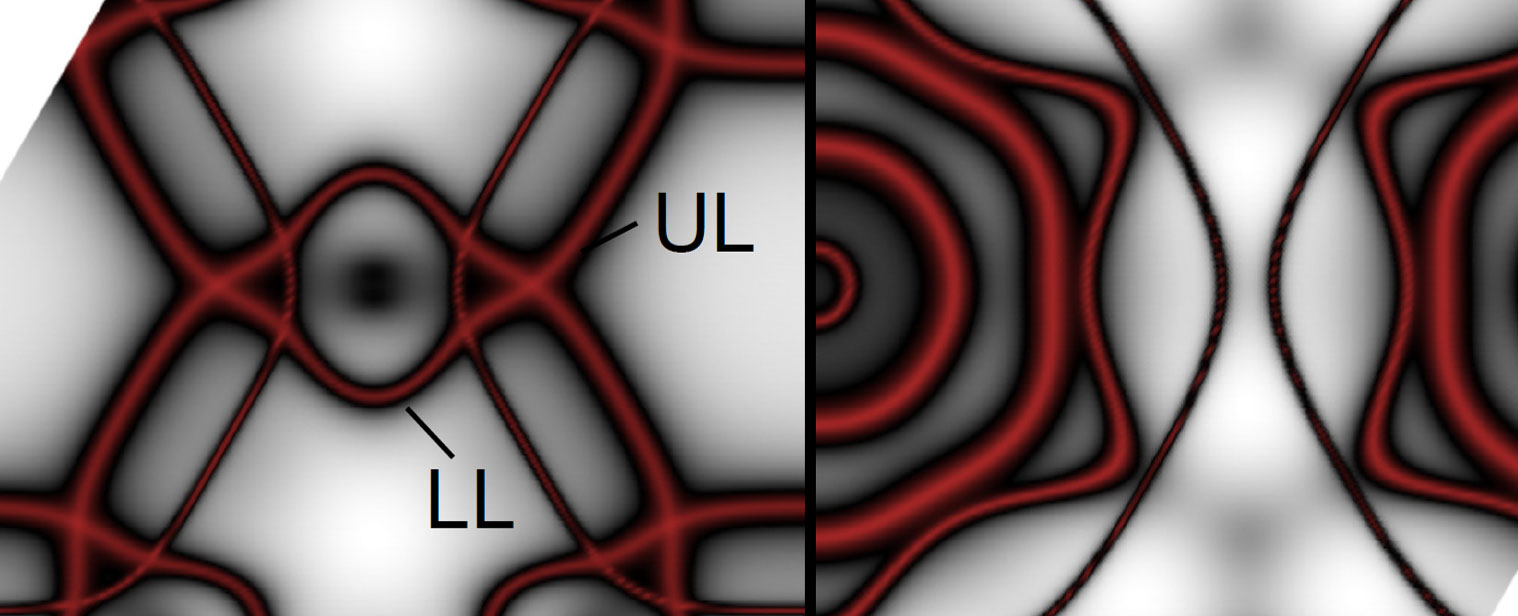
A defining characteristic of cobalt’s nodal lines is that they are inherently spin-polarized. Because ferromagnetism breaks time-reversal symmetry, the electronic states forming these lines carry a net spin orientation. By reversing the material’s magnetization direction, researchers can fully flip this spin polarization.
This ability enables direct magnetic control over the charge carriers linked to the nodal lines, a key requirement for spintronic technologies. Such control does not exist in non-magnetic nodal-line materials.
Cobalt as a model system
“Magnetic nodal-line materials are rare in nature, and in most known cases, such crossings are extremely difficult to stabilize or control,” explains Sánchez-Barriga. “The observation of multiple symmetry-protected nodal lines in a simple elemental ferromagnet is therefore highly unexpected and establishes cobalt as a model system for studying the interplay between topology and magnetism.”
Experimental data fit well to DFT
The experimental observations are supported by first-principles calculations based on density functional theory, carried out by a theory team headed by Dr. Maia G. Vergniory (Donostia International Physics Center and Université de Sherbrooke).
The strong predictive power of these calculations lies in their ability to identify all nodal lines in the calculated bulk band structure at once. The calculations show excellent agreement with the measurements and confirm that the nodal lines in cobalt are protected by crystalline mirror symmetries combined with ferromagnetism. Importantly, the crossings remain gapless even in the presence of spin-orbit coupling.
Switching is possible
“In certain directions inside the crystal, the nodal lines intersect and cross the Fermi energy where electrons can move freely,” explains Sánchez-Barriga. “Near these crossings, electrons in the material behave like massless, relativistic-like particles, similar to how light behaves, and can travel extremely fast. This is an exceptional behaviour that has never been observed in any elemental ferromagnet before. Moreover, by changing the direction of the magnetic field, it is possible either to open a gap at the crossing or to fully control the spin texture of the nodal lines while retaining the unique properties of the gapless state. This is exactly the kind of switch-on-off functionality sought for practical applications.”
Beyond its technological implications, the authors suggest that similar topological features may exist in other elemental and transition-metal ferromagnets, opening new opportunities to discover exotic properties in these materials. They also propose ways to further control these properties, such as studying interfaces with materials that have high nuclear charge or exploring the effects of reduced dimensionality.
Big learnings
The discovery demonstrates that our current understanding of ferromagnetic metals is incomplete. It shows that even the most familiar magnetic materials can still surprise us by hosting hidden, unusual quantum states, revealing exciting new directions for research in magnetism, topological states of matter, and their excitations.
Reference: “Manifold of magnetic nodal lines in an elemental ferromagnet” by O. J. Clark, M. Garcia-Diez, J. Fink, O. Rader, R. Miranda, M. G. Vergniory and J. Sánchez-Barriga, 24 January 2026, Communications Materials.
DOI: 10.1038/s43246-026-01072-6
Never miss a breakthrough: Join the SciTechDaily newsletter.
Follow us on Google and Google News.
3 Comments
The results suggest that cobalt is not just a conventional magnetic metal, but a highly adjustable topological platform with potential applications in future information technologies that rely on magnetic quantum states.
VERY GOOD!
Please ask researchers to think deeply:
How do you understand this topology platform?
Will rotating this topology platform in reverse make them mirror each other?
Remarkably, the features persist at room temperature. WHY?
Are these science?
Example 1
Two sets of cobalt-60 are manually rotated in opposite directions, and even without detection, people around the world know that they will not be symmetrical because these two objects are not mirror images of each other at all. However, a group of so-called physicists and so-called academic publications do not believe it. They conducted experiments and the results were indeed asymmetric, but they still firmly believed that these two objects were mirror images of each other, and the asymmetry was due to a violation of the previous natural laws (CP violation). In the history of science, there can never be a dirtier and uglier operation and explanation than this.
—— Excerpted from https://scitechdaily.com/what-happens-when-light-gains-extra-dimensions/#comment-947619.
Example 2
Please see how the so-called “mystery of θ – τ” is explained: θ and τ are completely identical in all measurable physical properties such as mass, lifetime, charge, spin, etc. However, experimental observations have shown that the θ meson decays into two π mesons, while the τ meson decays into three π mesons, making it difficult for physicists to explain why they are so similar. Physicist Martin Block proposed a highly challenging idea: θ and τ are the same particle, but in weak interactions, parity is not conserved. An easy to understand explanation is the following analogy:: There are two boxes of apples with identical weight, color, and taste. However, when one box is opened, there are two apples, while when the other box is opened, there are three apples. This confuses the old farmer who buys apples. He circled around the orchard and came up with a highly challenging idea: these two boxes of apples are not from the same tree, so they are the same.
—— Excerpted from https://scitechdaily.com/what-happens-when-light-gains-extra-dimensions/#comment-947686.
Everyone who has a reverence for natural laws and regulations deserves respect.
Matter, energy, and space-time are all manifestations of structure, not independently existing substances. Vortices are fundamental not because they are carriers of some more basic substance, but because they are the fundamental units of structure. The core proposition of Topological Vortex Theory (TVT) eloquently expresses this position: “Topology precedes matter, structure precedes existence.”
This philosophical turn echoes discussions in 20th-century philosophy of science regarding “structural realism”—when scientific theory undergoes revolutionary change, continuity is often carried not by entities but by mathematical structures. From classical mechanics to quantum field theory, from relativity to string theory, entities are continually overturned, but mathematical structures (such as symmetry, invariants, topological properties) persist in some manner. TVT pushes this insight to its extreme: if structure is truly fundamental, then the “vortex” as the archetype of topological structure has the potential to become the first principle for reconstructing physics.
Quandary: make a perfect math model of your wife. She will inform you (and all your excited friends) that your cleaver model is not your wife. It will only be a matter of whether you believe her.