

A newly developed material with exceptional high-temperature resistance shows strong promise for use in energy-efficient aircraft turbines.
Metals that can endure extremely high temperatures are essential for technologies such as aircraft engines, gas turbines, and X-ray equipment. Among the most heat-resistant are refractory metals like tungsten, molybdenum, and chromium, which melt at or above 2,000 degrees Celsius.
Despite their impressive thermal stability, these metals face major drawbacks. They become brittle at room temperature and oxidize rapidly when exposed to oxygen, leading to material failure at only 600 to 700 degrees Celsius. Because of this, they can be used effectively only under complex vacuum conditions (for example, as X-ray rotating anodes).
To overcome these obstacles, engineers have long relied on nickel-based superalloys for components that must function in air or combustion environments at high heat. These alloys have become the standard choice for gas turbine construction and similar high-temperature applications.
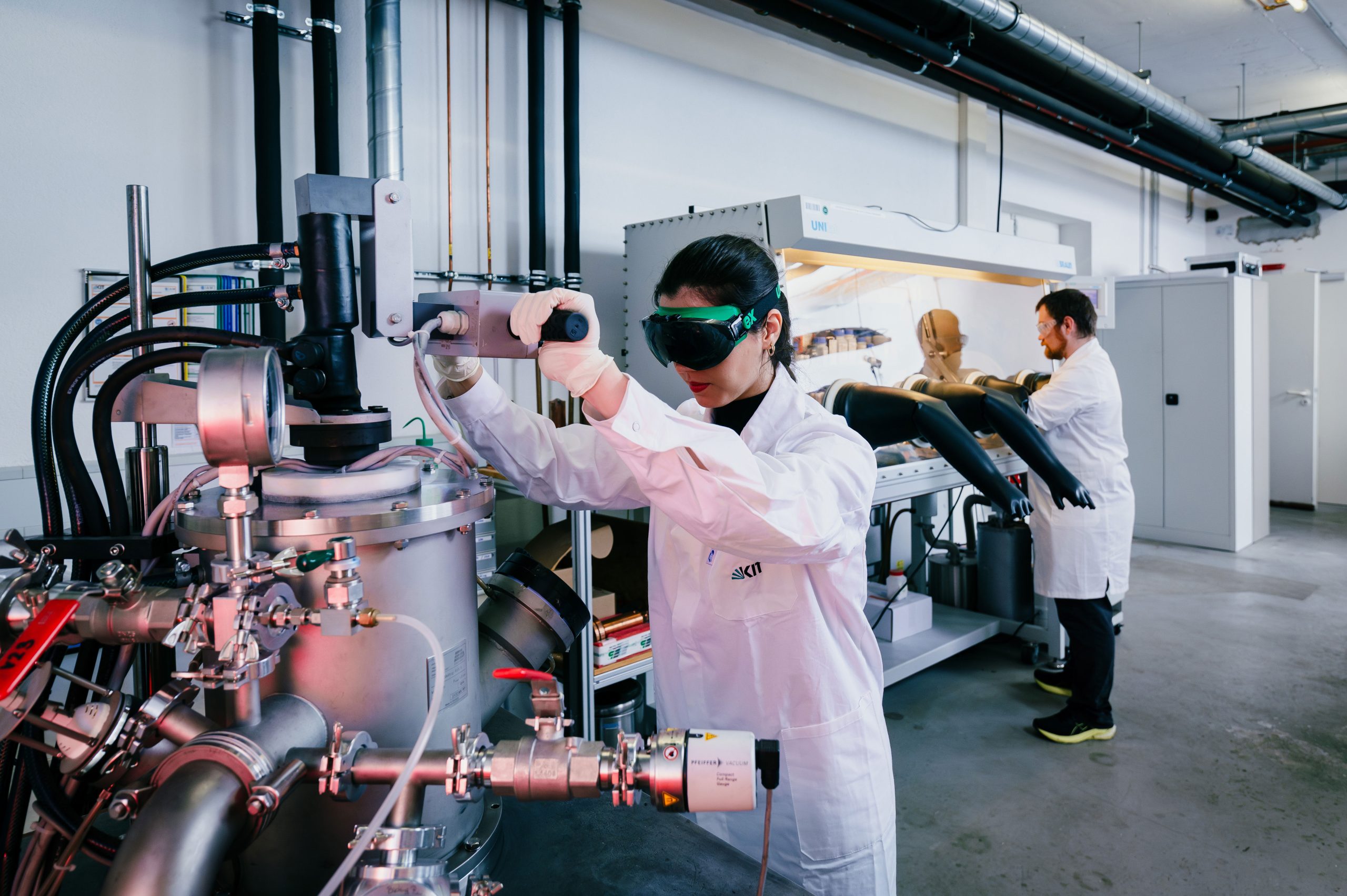
“The existing superalloys are made of many different metallic elements including rarely available ones so that they combine several properties. They are ductile at room temperature, stable at high temperatures, and resistant to oxidation,” explains Professor Martin Heilmaier from KIT’s Institute for Applied Materials – Materials Science and Engineering.
“However – and there is the rub – the operating temperatures, i.e., the temperatures in which they can be used safely, are in the range up to 1,100 degrees Celsius maximum. This is too low to exploit the full potential for more efficiency in turbines or other high-temperature applications. The fact is that the efficiency in combustion processes increases with temperature.”
A Chance for a Technological Leap
This limitation existing with the materials available today was the starting point for Heilmaier’s working group. Within the “Materials Compounds from Composite Materials for Applications in Extreme Conditions” (MatCom-ComMat) research training group funded by the German Research Foundation (DFG), the researchers succeeded in developing a new alloy made of chromium, molybdenum, and silicon.
This refractory metal-based alloy, in whose discovery Dr. Alexander Kauffmann, now professor at the Ruhr University Bochum, played a major role, features hitherto unparalleled properties.
“It is ductile at room temperature, its melting point is as high as about 2,000 degrees Celsius, and – unlike refractory alloys known to date – it oxidizes only slowly, even in the critical temperature range. This nurtures the vision of being able to make components suitable for operating temperatures substantially higher than 1,100 degrees Celsius. Thus, the result of our research has the potential to enable a real technological leap,” says Kauffmann.
This specifically remarkable as resistance to oxidation and ductility still cannot be predicted sufficiently to allow a targeted material design – despite the great progress that has been achieved in computer-assisted materials development.
More Efficiency, Less Consumption
“In a turbine, even a temperature increase of just 100 degrees Celsius can reduce fuel consumption by about five percent,” explains Heilmaier.
“This is particularly relevant to aviation, as airplanes powered by electricity will hardly be suitable for long-haul flights in the next decades. Thus, a significant reduction of the fuel consumption will be a vital issue. Stationary gas turbines in power plants could also be operated with lower CO₂ emissions thanks to more robust materials. In order to be able to use the alloy on an industrial level, many other development steps are necessary,” says Heilmaier.
“However, with our discovery in fundamental research, we have reached an important milestone. Research groups all over the world can now build on this achievement.”
Reference: “A ductile chromium–molybdenum alloy resistant to high-temperature oxidation” by Frauke Hinrichs, Georg Winkens, Lena Katharina Kramer, Gabriely Falcão, Ewa M. Hahn, Daniel Schliephake, Michael Konrad Eusterholz, Sandipan Sen, Mathias Christian Galetz, Haruyuki Inui, Alexander Kauffmann and Martin Heilmaier, 8 October 2025, Nature.
DOI: 10.1038/s41586-025-09516-8
Never miss a breakthrough: Join the SciTechDaily newsletter.
Follow us on Google and Google News.
8 Comments
According to Topological Vortex Theory (TVT), materials that have the stable vortex patterns might be able to resist heat in ways normal materials cannot. Because these vortex structures are protected by mathematical rules, they don’t break down as easily when heated. There might be no fundamental upper limit to how heat-resistant a material can be if its structure is governed by these topological vortices. In other words, materials designed with these vortex patterns could, in theory, survive temperatures far beyond what ordinary materials can handle.
In a turbine, even a temperature increase of just 100 degrees Celsius can reduce fuel consumption by about five percent. This is particularly relevant to aviation, as airplanes powered by electricity will hardly be suitable for long-haul flights in the next decades.
VERY GOOD!
Please ask scientists to think deeply:
1. Are turbines and electric drives related to rotation?
2. Are cars and ships on the ground, airplanes in the sky, and celestial bodies in the universe related to rotation?
3. Can high-speed rotation generate heat?
4. Why is rotation so closely related to thermodynamics and kinetics?
5. What can topological spin tell us?
6. Does topological spin require God?
Will this development negate the hip process in high temperature turbine production?
Yes. Although the hip process is important, it can sometimes be inappropriate.
Does topological spin require God?
Your comment is awaiting moderation.
Article poorly focused and brought to conclusion with still unanswered questions : what are metals in question for the love of Mike Maybe the translation was sloppy in word evaluation?!
Thanks for sharing such helpful instructions, really appreciate your help.
When we pursue the ultimate truth of all things, the space in which our bodies and all things exist may itself be the final and deepest puzzle we need to explore. This is not only the pursuit of physics, but also the most magnificent exploration of the origin of the universe by human reason.
Based on the Topological Vortex Theory (TVT), space is an uniformly incompressible physical entity. Space-time vortices are the products of topological phase transitions of the tipping points in space, are the point defects in spacetime. Point defects do not only impact the thermodynamic properties, but are also central to kinetic processes. They create all things and shape the world through spin and self-organization.
In today’s physics, some so-called peer-reviewed journals—including Physical Review Letters, Nature, Science, and others—stubbornly insist on and promote the following:
1. Even though θ and τ particles exhibit differences in experiments, physics can claim they are the same particle. This is science.
2. Even though topological vortices and antivortices have identical structures and opposite rotational directions, physics can define their structures and directions as entirely different. This is science.
3. Even though two sets of cobalt-60 rotate in opposite directions and experiments reveal asymmetry, physics can still define them as mirror images of each other. This is science.
4. Even though vortex structures are ubiquitous—from cosmic accretion disks to particle spins—physics must insist that vortex structures do not exist and require verification. Only the particles that like God, Demonic, or Angelic are the most fundamental structures of the universe. This is science.
5. Even though everything occupies space and maintains its existence in time, physics must still debate and insist on whether space exists and whether time is a figment of the human mind. This is science.
6. Even though space, with its non-stick, incompressible, and isotropic characteristics, provides a solid foundation for the development of physics, physics must still insist that the ideal fluid properties of space do not exist. This is science.
and go on.
Is this the counterintuitive science they widely promote? What are the shames? Contemporary physics and so-called peer-reviewed publications (including Physical Review Letters, Science, Nature, etc.) stubbornly believe that two sets of counter rotating cobalt-60 are two mirror images of each other, constructing a more shocking pseudoscientific theoretical framework in the history of science than the “geocentric model”. This pseudo scientific framework and system have seriously hindered scientific progress and social development.
For nearly a century, physics has been manipulated by this pseudo scientific theoretical system and the interest groups behind it, wasting a lot of manpower, funds, and time. A large amount of pseudo scientific research has been conducted, and countless pseudo scientific papers have been published, causing serious negative impacts on scientific and social progress, as well as humanistic development.
The branch of mathematics known as topology has become a cornerstone of modern physics. The perpetually swirling topological vortices defy traditional physics’ expectations. The development of the Topological Vortex Theory (TVT) reflects a progression from concrete physical phenomena to abstract mathematical modeling and, ultimately, to interdisciplinary unification.
——Excerpted from https://t.pineal.cn/blogs/4569/An-Overview-of-the-Development-of-Topological-Vortex-Theory-TVT.